Prepositions of Movement - Meaning, Uses, Examples
 Nikita Aggarwal30 Mar, 2026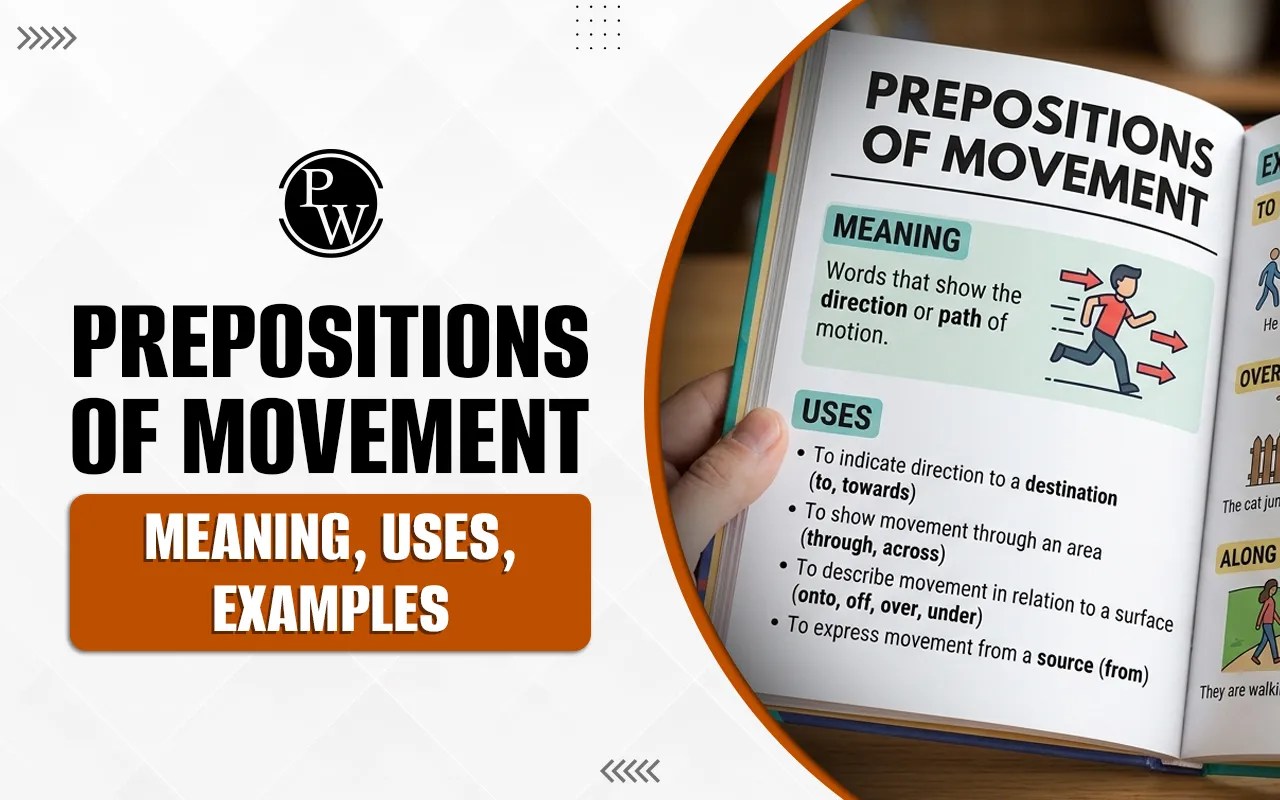
What is Prepositions of Movement?
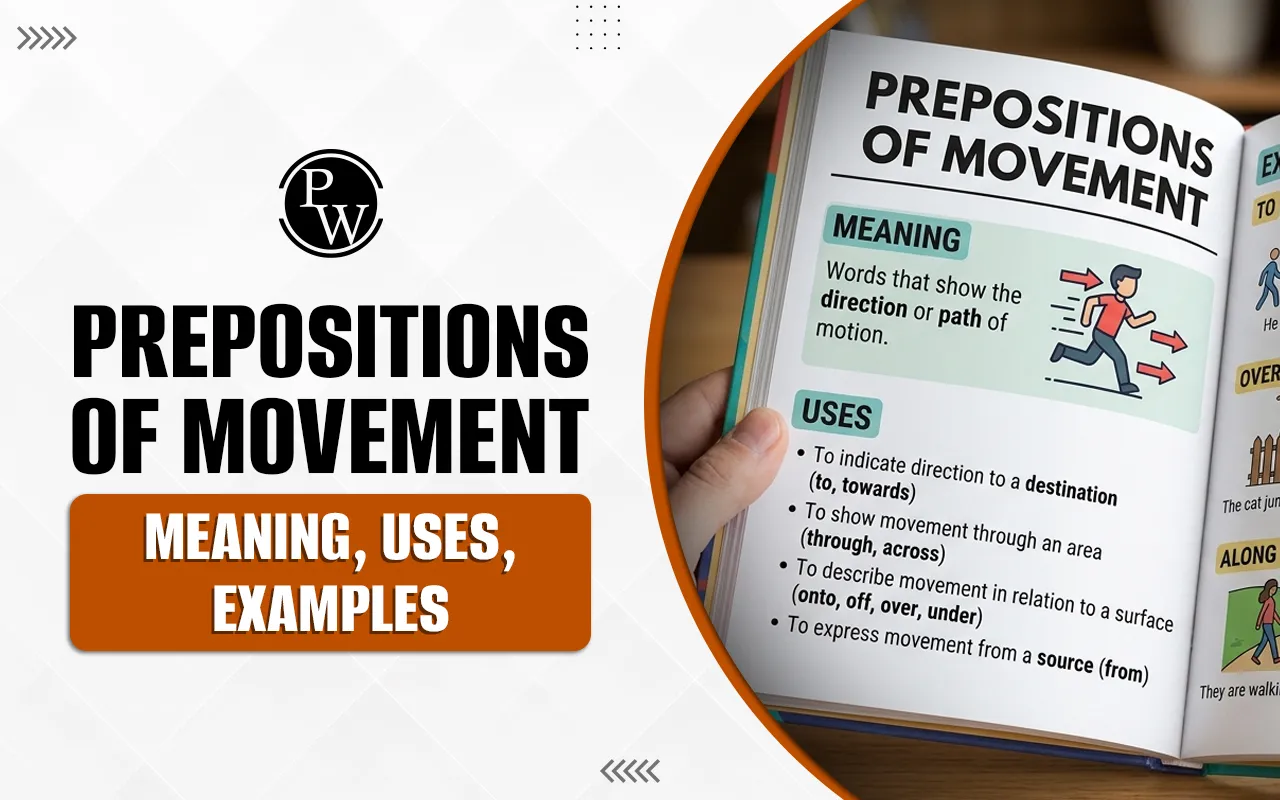
Also known as prepositions of direction, they are words that show movement from one place to another. Unlike prepositions of place, which tell us where something is statically located (like 'on' or 'at'), these prepositions describe a dynamic path or a change in position.
The prepositions of movement meaning centres on the relationship between a noun and a direction. Most of these words suggest a trajectory. For instance, if you say you are going "to" the park, "to" indicates your final destination. If you say you are walking "through" the park, it suggests you are entering one side and exiting the other.
Using it correctly ensures your descriptions are precise. Without them, a sentence like "I ran the woods" makes little sense. By adding "through" or "into", you provide the necessary context of motion.
Common Prepositions of Movement Uses
There are several ways we use these words in English. Let’s look at the most frequent uses to see how they function in different scenarios.
1. To (The most common direction)
We use 'to' to indicate a specific destination or a movement toward a place.
-
Example: We are driving to London this weekend.
2. Into (Moving inside)
This shows movement from the outside to the inside of an enclosed space, such as a room, a box, or a vehicle.
-
Example: The cat jumped into the cardboard box.
3. Across (Crossing a surface)
'Across' is used when moving from one side of a surface to the opposite side. This is common with roads, rivers, or bridges.
-
Example: She swam across the river to reach the other bank.
4. Through (Movement within a 3D space)
We use 'through' when moving inside a space that has boundaries on all sides, like a tunnel, a forest, or a crowd.
-
Example: The train sped through the dark tunnel.
5. Over and Under
'Over' indicates movement at a higher level than something, while 'under' indicates movement at a lower level.
-
Example: The bird flew over the house.
-
Example: The ball rolled under the parked car.
Preposition of Movement Examples
To make things easier to visualise, here is a breakdown of common examples and how they are applied.
|
Preposition |
Movement Description |
Sentence Example |
|
To |
Towards a specific destination |
He goes to school every morning. |
|
Across |
From one side to the other |
They walked across the busy street. |
|
Into |
Entering an enclosed space |
Step into the office, please. |
|
Out of |
Leaving an enclosed space |
Get out of the taxi near the station. |
|
Through |
Moving from one end to the other inside something |
We walked through the thick forest. |
|
Up |
Moving to a higher point |
The hiker climbed up the steep hill. |
|
Down |
Moving to a lower point |
He ran down the stairs quickly. |
|
Past |
Moving near something without stopping |
I drove past your house earlier. |
|
Around |
Moving in a circular path or skirting an object |
The earth moves around the sun. |
|
Towards |
In the direction of something (not necessarily reaching it) |
She started walking towards the exit. |
Read More - Preposition of Place: Definition, Rules & Examples
How to Use Prepositions of Movement in English?
Mastering it requires looking at the nuance between similar words. Often, students get confused between 'to' and 'towards' or 'into' and 'in'.
To vs. Towards
While both indicate direction, 'to' implies that the person or object actually reaches the destination. 'Towards' simply indicates the direction of travel.
-
He is going to the library. (He will arrive there.)
-
He is walking towards the library. (That is the direction he is heading, but he might stop elsewhere.)
Into vs. Onto
'Into' is for 3D spaces or containers (rooms, boxes, water). 'Onto' is used for movement towards the surface of something.
-
The diver jumped into the pool.
-
The cat jumped onto the kitchen counter.
Along and Past
'Along' is used for following a line, like a road or a path. 'Past' is used when you go by a point and continue further.
-
We walked along the beach for miles.
-
The marathon runners ran past the town hall.
Prepositions of Movement Important Formulas
Use this simple logic to choose the correct preposition:
1. Movement + Destination → “to”
2. Movement + Inside a space → “into”
3. Movement + Across a surface → “across”
4. Movement + Through a space → “through”
5. Movement + Direction without arrival → “towards”
Read More - Prepositions of Manner - Definition, Rules, Examples in English
Prepositions for Movement Practice Questions
Fill in the blanks:
-
She walked ___ the room.
-
The dog ran ___ the garden gate.
-
He swam ___ the river.
-
The bird flew ___ the tree.
-
They drove ___ the city.
Answers:
-
into
-
through
-
across
-
over
-
to
Importance of Prepositions of Movement for Students
When you use the right preposition of movement, you paint a clearer picture for your reader. In exams or creative writing, precision is key. Instead of saying "he went the hill," saying "he trekked up the hill" or "he cycled around the hill" gives two completely different meanings.
Using these correctly also helps in understanding complex instructions. For instance, "Go through the gate and past the fountain" is a very specific set of directions that relies entirely on these movement indicators.
Tips for Learning Prepositions of Movement
-
Watch the Verb: Remember this topic follows verbs of action. If there is no movement involved, you likely need a preposition of place (at, on, in).
-
Visualise the Path: Imagine an arrow moving. Is it going through a hoop? (Through). Is it landing on a table? (Onto). Is it pointing at a target? (To).
-
Read Aloud: Natural English often has a rhythm. "I went into the room" sounds much more natural than "I went in the room" when describing the actual act of entering.
Key Takeaway Prepositions for Movement
-
It defines the direction of an action.
-
They are usually paired with motion verbs like walk, run, or fly.
-
The meaning is tied to the start, path, or end of a journey.
-
Common examples include to, across, through, into, and over.
By practising these regularly, you will find that your English becomes more descriptive and accurate. Whether you are describing a journey or explaining a scientific process, these words are your best tools for showing motion.
Help Your Child Develop Strong English Skills with PW CuriousJr
PW CuriousJr provides well-structured online English classes designed to make learning simple and effective for young learners. With small batch sizes, every child gets personalized attention, ensuring better understanding and continuous support. Interactive activities keep students engaged while building confidence in reading, writing, speaking, and listening skills.
The curriculum follows globally recognized English standards, helping children use the language confidently in everyday situations. Each course is easy to understand, well-organized, and designed to offer a smooth and enjoyable learning experience.
In addition to live classes, students also get access to recorded video lessons for revision and extra practice. These recordings allow them to revisit concepts anytime and learn at their own pace, making learning more flexible and effective.