Speed Maths Test for Class 2 (Try Now)
 Nivedita Dar20 May, 2026
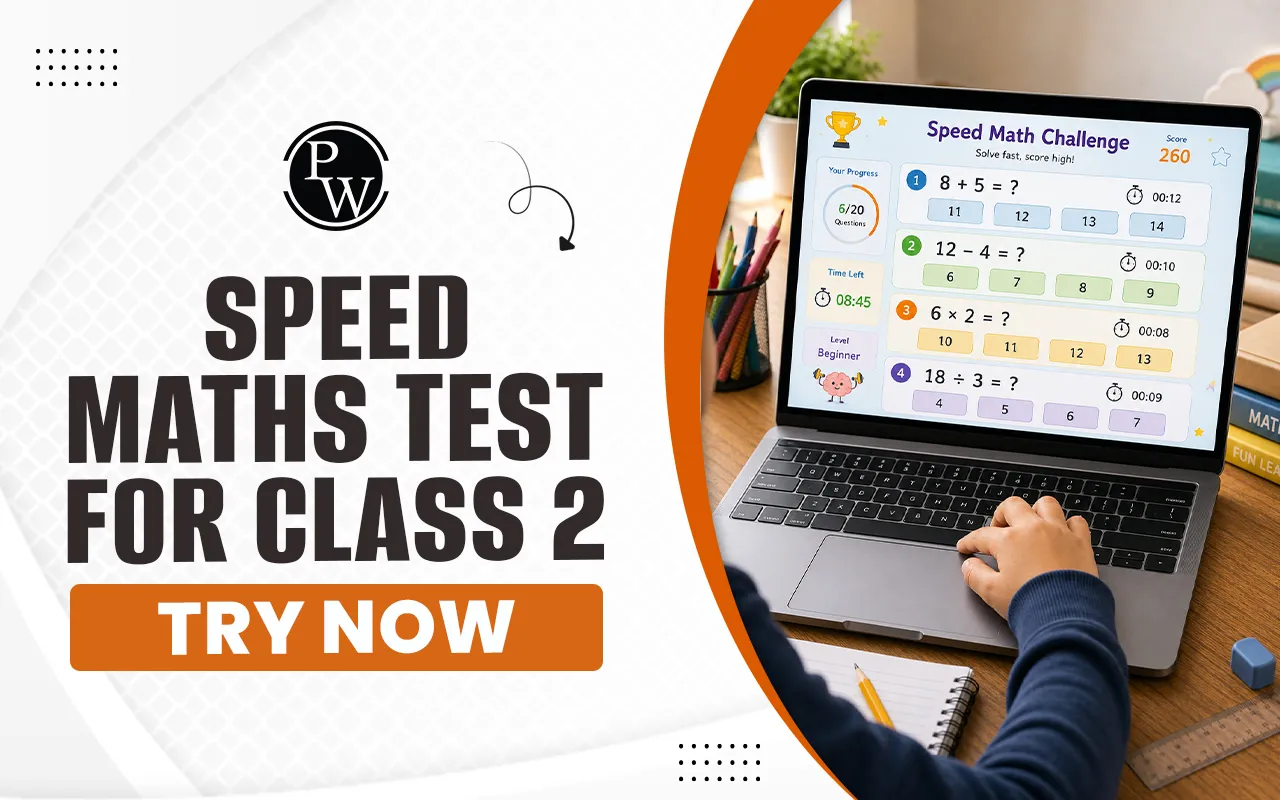
Many parents continue to focus only on rote learning and neglect approaches that develop children’s mental maths skills. If your child takes a long time to work out sums or is still counting on their fingers, they might need more practice with calculations. The speed maths test class 2 can help to improve speed, accuracy and confidence.
This article will help your child to develop strong mental maths skills step by step.
What is Speed Maths?
Entering into more advanced arithmetic calculations is a big academic achievement for the average 7-year-old. At this stage, pupils should be able to calculate larger numbers and perform more than one calculation, but many pupils are not agile enough to do so in seconds. The goal of the speed maths test class 2 is to develop the mental endurance needed for instant recall, not to make the test stressful.
Most parents will find that their child can subtract and multiply numbers up to 100 when the operation is represented visually, but then faces a “mental roadblock” when the operation is not presented visually. This wariness is what a structured maths test is designed to help remedy. Children have the opportunity to move beyond counting and to visualise numbers as flexible blocks. A full guide to increasing calculation speed, using a maths quiz format and fun drills to help your child achieve mathematical fluency easily.
Speed Maths Questions for Class 2
We have created a range of questions to cover all parts of the Class 2 syllabus so your child can practise. Challenge them to solve these problems without the aid of pencil and paper for doing calculations.
Section 1: Multiple Choice Questions (MCQs)
1. What is the sum of 45 and 30?
a) 65
b) 75
c) 70
d) 85
2. How many marbles will each child receive if they share 12 marbles equally among 3 children?
a) 3
b) 5
c) 4
d) 6
3. What is 5 x 4?
a) 9
b) 20
c) 15
d) 25
4. Subtract 15 from 50. What is the result?
a) 35
b) 45
c) 25
d) 40
Read More - Mental Division Tricks for Class 4
Section 2: Fill in the Blanks
-
The number that comes exactly between 148 and 150 is ________.
-
20 divided by 2 equals ________.
-
When we add 0 to any number, the result is ________.
-
7 times 3 is the same as adding 7 ________ times.
-
There are ________ tens in the number 82.
Section 3: Real-World Word Problems
-
Shopping: Rahul has 25 blue pens and 15 red pens. How many pens does he have altogether?
-
Sharing: A baker baked 18 cupcakes and divided them into 2 boxes so that each box has the same number of cupcakes. In each box, how many cupcakes does it take to fill?
-
Gardening: There are 5 flowers in a vase. How many flowers are there in all if there are 6 vases?
-
Pocket Money: Sarah had Rs. 80. She bought a toy for 30 rupees. What will be the remaining amount of money?
Section 4: Speed Round
-
What is double 8?
-
What is half of 20?
-
What is 100 minus 10?
-
How many ones are there in 47?
-
What is 5 plus 5 plus 5?
-
How many tens are there in 90?
-
What number comes before 300?
-
Is 45 greater than 54?
Section 5: The Time Clock
-
Identify the hour: If the minute hand is on 12 and the hour hand is on 9, what time is it?
-
Half-past: Where does the minute hand point when it is "half-past" any hour?
-
Logic: If a game starts at 4:00 and lasts for 30 minutes, when does it end?
Read More - 10-Second Addition Tricks for Class 1
Section 6: Measurement and Units
-
Which is longer: 50 centimetres or 1 metre?
-
Is a bottle of juice measured in grams or litres?
-
If one pencil is 10cm long, how long are three pencils placed end-to-end?
Answer key for parents and teachers
Check your child's answers here to see how they performed!
MCQ Answers:
-
b) 75
-
c) 4
-
b) 20
-
a) 35
Fill in the blanks.
-
149
-
10
-
The same number
-
3 times
-
8 tens
Word Problems:
-
40 pens
-
9 cupcakes
-
30 flowers
-
50 rupees
Speed Round Answers:
-
16
-
10
-
90
-
7
-
15
-
9
-
299
-
No
Time Answers:
-
9:00
-
Points to 6
-
4:30
Measurement Answers
-
1 meter
-
litre
-
30cm
Benefits of Speed Maths Test Class 2
Class 2 regularly takes part in a speed maths test, and there are many cognitive benefits to the exercise beyond working with numbers.
-
Heightened Concentration: Timed quizzes require sustained focus. This will help children learn to tune out distractions during school time.
-
Confidence Boost: If the child passes a mental maths test, they feel good. This gives the child instant feedback and helps them avoid seeing maths as a hard subject.
-
Exam Readiness: Students get the sense of timed testing by completing a quick maths quiz, which helps ease "maths anxiety" in the true final test.
-
Logical Reasoning: Vedic maths speed techniques are used during training to make children think of shortcuts. They are taught that 9 x 3 equals 9 + 9 + 9.
-
Improved Memory: Mental arithmetic exercises children's working memory, requiring them to keep numbers in mind while calculating.
How Parents Can Help with Speed Maths Class 2
There's no need to have a classroom to practice. Make a mini quick maths quiz a part of your daily routine.
-
Grocery Shopping: Have your child help you count out while shopping. What is the total number of apples if we have 4 apples and we then purchase 4 more?
-
Number Plates: While travelling, have them add up the numbers on the car in front of them.
-
Kitchen Maths: Talk about capacity using measuring cups. How many little cups will it take to make the big jug full?
-
Board Games: Ludo or Snakes and Ladders are great games for practising 'counting on' and simple addition.
How Does CuriousJr Help with Class 2 Mental Maths?
CuriousJr is a digital space that helps children enjoy maths and make it seem like a game. The platform is like a digital playground for a Class 2 student, ensuring that numbers aren't confined to textbooks. The platform is a digital playground for a Class 2 student, and the numbers don't have to be limited to textbooks.
Interactive Learning Modules
CuriousJr online mental maths class offers fun and interactive 2nd-grade speed maths worksheets instead of traditional ones. These modules provide a high degree of colour and instant feedback. The child is more likely to remember the learning loop process and will be motivated to do more when they see a 'correct' badge after a mental maths test.
Structured Curriculum
The site's design is logical. It starts with basic number identification and gradually moves towards complex word problems. This will keep the child from becoming overwhelmed. Curious Junior helps children understand how to break a big problem into smaller, manageable pieces by using some Vedic maths tricks.
Progress Tracking
One of the most helpful aspects is that one can see where a child is getting stuck. A child's performance on subtraction versus addition in a maths quiz can be identified when their performance on subtraction is consistently slower than their performance on addition. This enables specific practice instead of repetitive and unnecessary drills.