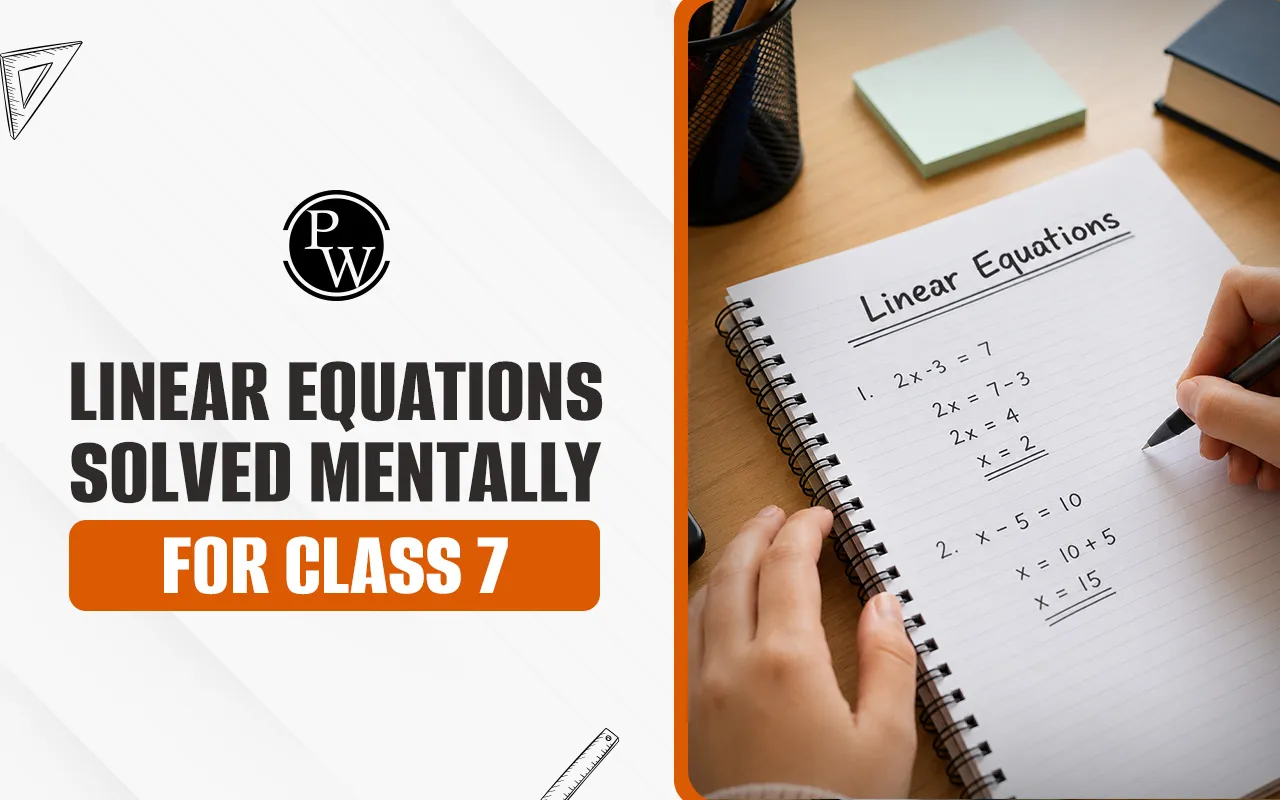
Linear Equations Solved Mentally for Class 7
 Nikita Aggarwal20 May, 2026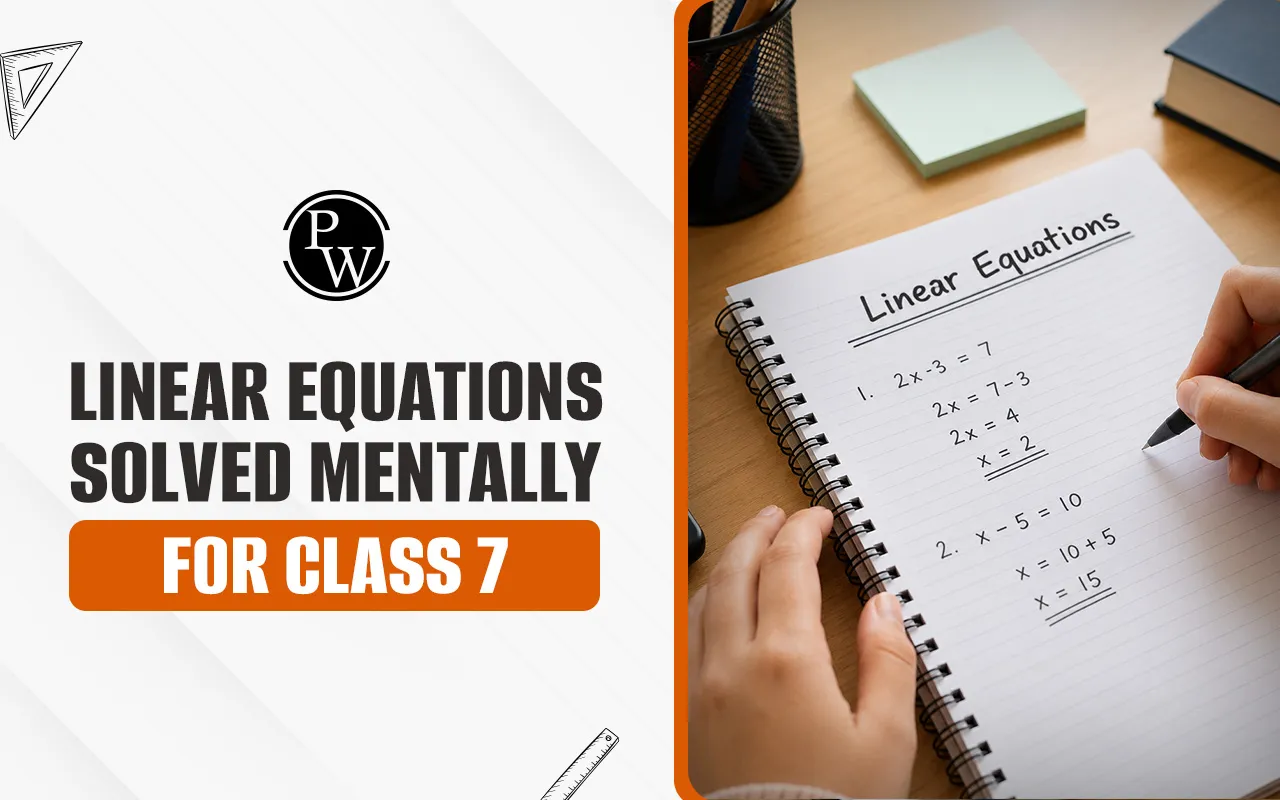
What is a Linear Equation?
You can think of it as a balancing scale. One side is an expression, on the other a value (or another expression), with an equals sign between them. In Class 7, we start with linear equations in one variable. It implies that only a single unknown letter, say, either 'x' or 'y', exists, and its maximum power will always equal one.
The objective is the same every time: plug and chug that variable until you find just what value of it makes your equation true. Students are usually taught the so-called transpose method, which involves moving numbers from one side of an equation to the other while changing their signs. This approach is a fantastic start, but if you need to write out every step each time, the process can slow you down during exams or competitive quizzes.
Tricks for Solving Linear Equations Mentally
The mental maths approach to solving equations is, therefore, to gain a better understanding of numbers rather than to memorise the rules. These are some of the useful mental maths shortcuts to get you your answer in no time.
1. The Cover-Up Method
This technique is actually one of the superb linear equation tricks for beginners. Pretend your thumb is covering the variable part of this equation.
-
Example: x + 8 = 20
-
Mental Thought: Cover the 'x'. Ask yourself: "What number added to 8 gives 20?"
-
Result: The answer 12 pops up instantly.
2. The Balancing Act
For you to solve a linear equation mentally, your thinking needs to be in reverse. The brain should work upwards and think of division whenever it sees multiplication in the equation.
-
Example: 4x = 32
-
Mental Thought: What multiplied by 4 equals 32? Or, what is 32 divided by 4?
-
Result: x = 8.
3. Handling Two-Step Equations
When solving 2x + 3 = 11, do not attempt to solve it all at once. Split it into two little jumps.
-
Step 1: Subtract the constant. (11 minus 3 is 8).
-
Step 2: Divide by the coefficient. (8 divided by 2 equals 4).
-
Result: x = 4.
4. The "Undo" Strategy
Remember that an equation consists of a couple of actions you perform on 'x'. If you want to solve for 'x', then simply reverse them in the opposite order. Double 'x' and add 5 gives that. To get the answer, first halve the result, then subtract 5. It helps resolve the equations mentally without losing them in symbols.
Read More - 10-second addition tricks for Class 7
5. Working with Fractions
When you observe x/3 = 5, make the division open to a form of multiplication.
-
Mental Thought: If a number is one-third of 5, then the whole must be three times bigger.
-
Result: 5 times 3 equals 15.
6. Balance the Coefficients
If you have something with x on both sides — like 3x = 2x + 5 (which is an equality) — mentally "take away" the smaller amount of x from each side.
-
Mental Thought: If I take 2x away from both sides, I'm left with 1x on the left and 5 on the right.
-
Result: x = 5.
Read More - Speed Maths Test for Class 7 (Try Now)
Practise Sheet to Solve Linear Equations Mentally
Here is a comprehensive practice set designed to sharpen your skills. Try to solve these using only your mind before checking the answers.
Section A: Short Equations (One-Step)
-
Question: Solve x + 12 = 30.
-
Question: Solve y - 9 = 21.
-
Question: Solve 7z = 56.
-
Question: Solve a/5 = 9.
-
Question: Solve 15 + b = 40.
Section B: Long Equation Solver (Two-Step)
-
Question: Solve 2x + 5 = 15.
-
Question: Solve 3y - 4 = 11.
-
Question: Solve 10 + 4z = 30.
-
Question: Solve (x / 2) + 3 = 7.
-
Question: Solve 5m - 10 = 40.
Section C: Multiple-Choice Questions (MCQs)
-
What is the value of x in the equation 4x = 20?
a) 4
b) 5
c) 16
d) 80 -
If x/3 = 7, then x equals:
a) 21
b) 10
c) 4
d) 3.5 -
Find x if 2x + 2 = 12:
a) 10
b) 7
c) 5
d) 6
Benefits of Solving Linear Equation Mentally
Being good at algebra has benefits beyond just getting a good grade; you can solve it in your head.
-
Saves Time: You can save half the time of the algebra section in competitive exams or timed type tests.
-
Reduces Errors: Visualisation helps eliminate "sign errors" that frequently occur when calculating quickly.
-
Improves Focus: As mental maths is only possible when a person is maximally concentrated, this exercise naturally increases brain power and memory.
-
Confidence Boost: This feature is always a very cool "wow" moment; it goes irrespective of the answer before other friends have even picked up their pencils.
-
Better Number Sense: You see patterns in numbers, instead of mere symbols on a page.
How Does CuriousJr Help with Class 7 Mental Maths?
That is CuriousJr online mental maths classes, which changes the perception of maths by combining fun and rational interaction. It does so in the following way:
-
Bite-Sized Lessons: It splits the large class's 7 topics into small, digestible lessons.
-
Gamified Learning: You solve problems through games rather than boring drills; your brain stays engaged, and you retain the shortcuts.
-
Visual Aids: The system uses visual model equations, which allow plotting the balancing-scale-like nature much more easily.
-
Instant Feedback: You do not have to wait for a teacher to grade your work. You have instant feedback, which helps you adjust your logic immediately.
-
Adaptive Practice: The more you practise, the better the system knows your current strength and gives challenges that are normal for where you currently stand.
-
Mobile Learning: It is app-based; you can practise your linear equations tricks from anywhere, whether you are in a car or waiting for lunch.