Why Kids Struggle with Multiplication in Class 1
 Nivedita Dar20 May, 2026
For a Class 1 child, moving from "one more" thinking to "groups" is a significant change in their thinking. Without being able to count fluently and identify digits, the "times tables" puzzle can be unsolvable. Recognising these particular multiplication problems class 1 is crucial to avoid maths anxiety as a lifetime issue.
This article provides actionable strategies and mental maths tricks to build a rock-solid mathematical foundation.
What is Multiplication?
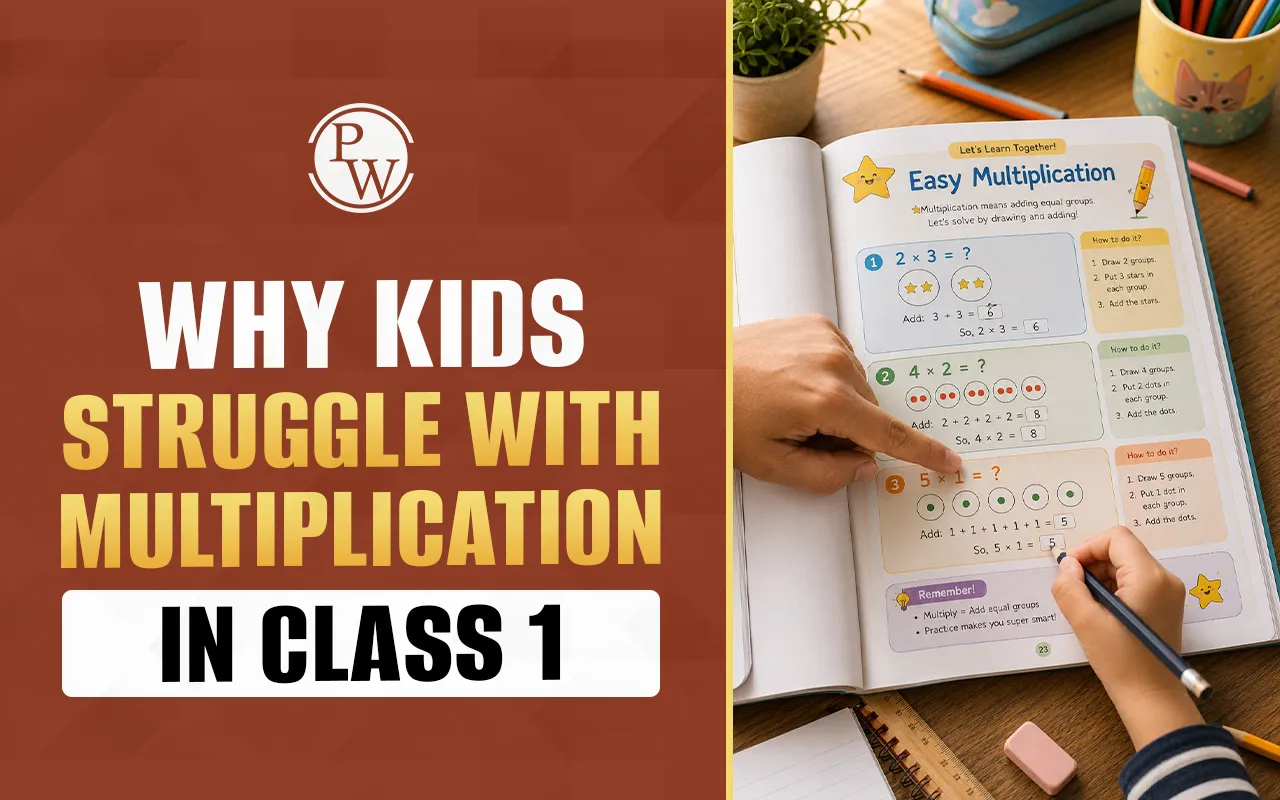
Multiplication is just a quick way of adding, or a shortcut for addition. We repeat the same number to make a sum; we use multiplication to find the sum quickly. We define it for a Class 1 student as "repeated addition".
When you see 3 boxes, then each box has 2 chocolates; you could count them all: 1, 2, 3, 4, 5, 6. You could also write the equation as 2 + 2 + 2 = 6. When we multiply a number by another number, we can say, “I have 3 groups of 2.”
Common Multiplication Problems Class 1
Often, children have difficulties with multiplication because their number skills are still developing. These are the specific areas that can cause difficulties for Class 1 students, resulting in multiplication problems. Class 1.
1. Counting Problems and Sequence Gaps
A child's fluency with counting forwards and backwards is crucial for multiplication. The following problems occur with many students:
-
Skipping Numbers: A child may skip the numbers between 13 and 15 when counting. These tiny gaps are too big to bridge in order to learn multiplication tables.
-
Forgetting the Sequence: A child could begin well and then "get lost" after 20.
-
Weak Forward Counting: If a child is slow at basic counting, then he/she will have trouble counting by 2s, 5s, or 10s, which is the core of multiplication.
-
Impact: The foundation of counting is not strong, so the foundation of multiplication is not strong.
Read More - Mental Division Tricks for Class 4
2. Number Recognition Weakness
Occasionally, the problem isn't the maths logic but the way a child sees the numbers. Often, maths mistakes in Class 1 occur due to visual confusion.
-
Confusing 6 and 9: Children sometimes multiply the wrong value, as 6 and 9 may seem the same when rotated.
-
Mixing 12 and 21: Reversing the order of digits is very common. One child may cross off the 21 and put down 12.
-
Reversing Digits: During practice, there are major calculation mistakes in the reversal of digits, which is known as 'mirror writing'.
3. Attention and Focus Challenges
Multiplication is a process with several steps. Even if a child has to solve a simple problem, such as 3 x 2, they will need to carry several pieces of information in their head.
-
Quick Distractions: A child may begin a problem but distracts him/herself by looking away, thus losing his/her "place" in the problem.
-
Missing Steps: They may count groups but fail to count items in groups.
-
Incomplete Solving: Kids tend to write down the first number that they think of for a number, even if it is not the correct count.
4. Memory difficulties
Some people have trouble with memory. Without being able to memorise simple number facts, a child will not be able to apply fast multiplication tricks.
-
Forgetting Facts: A child learns 2 x 2 one day and forgets the next morning.
-
Pattern Recognition: Multiplication has patterns in it (such as every 5x table ending in 0 or 5). Children who are unable to spot or remember these patterns see them as meaningless, disconnected facts.
5. Lack of Visual Understanding
Multiplication is one of the greatest multiplication problems Class 1 because of the early teaching of "pure numbers".
-
The Symbol Trap: It's not enough to write "2 x 3" on a chalkboard and have a kid understand what it means. It's nothing more than a weird line pattern.
6. Weak Basic Addition Skills
Multiplication is about repeated addition, so any difficulties with addition will be evident.
-
Difficult Addition: If a child has difficulty adding 4 + 4 + 4, then adding 4 x 3 will be difficult.
-
Cognitive Load: When they are using all of their brain trying to add 4 + 4, they have nothing left to give when it comes to understanding what the multiplication part of the problem is.
Read More - Learn Subtraction Without Borrowing (Class 3)
How to Solve Multiplication Problems Class 1
You can obtain solutions to such problems by returning to the basics and using techniques that stimulate a child's senses. The following are some of the hands-on ways to approach multiplication problems in Class 1 effectively.
-
Solve Counting Gaps with Movement: clap counting or jump counting (hopping for every 2nd number or 5th number). Counting real objects, such as toys or candies, helps them make the connection between numbers and reality and keeps them from omitting numbers in the counting sequence.
-
Fix Number Recognition with Tracing: With colourful tracing flashcards and dot tracing, assist the brain in recognising numbers 6 and 9! Number puzzles reinforce the concept of the symbol to minimise mistakes such as reversing 12 and 21.
-
Manage Attention with Micro-Practice: Make sessions 5–10 minutes to correspond to a Class 1 focus window. Keep engagement high by using movement-based games rather than long worksheets.
-
Improve Memory via Rhythm: Use songs and rhymes to skip count (2, 4, 6, 8…). Melody aids the brain to keep patterns and number facts much longer than silent reading does.
-
Enhance Visual Understanding: Always draw a real-life example such as fruit or stickers. Show apples to make the concept concrete, rather than using a 2 x 2.
-
Strengthen Addition Daily: Practise doubles (2+2, 4+4) and number bonds every day. When students have strong addition skills, multiplication does not seem like a daunting task.
Tips for Multiplication Problems Class 1
To help students avoid maths mistakes in Class 1, it is vital to have a regular, relaxed approach to practice. Practice and develop confidence in these key activities.
-
Daily Movement: 5 minutes to practise counting sequences of jumps by 2s, 5s and 10s.
-
Tracing: Do dot traces for 10 mins and fix 6/9 and 12/21 reversals.
-
Visual Grouping: Create “equal groups” every day with 10 toys/snacks and practice the Apple Rule!
-
Rhythmic Chanting: Sing skip-counting patterns when travelling in the car or at meal times.
How Does CuriousJr Help with Class 1 Mental Math?
In class 1, CuriousJr online mental maths class transforms abstract multiplication concepts into age-appropriate adventures that are both exciting and fun:
-
Gamified Sequences: Children progress through games, solving skip-counting puzzles to help remove "sequence-forgot" habits.
-
Visual-First Approach: The app presents the concept of "groups" using 3D objects and animation before introducing the multiplication symbol.
-
Vedic Maths Multiplication: It provides Vedic Maths logic and simple, fast multiplication tricks for young minds.
-
Bite-Sized Lessons: Modules are 5-10 minutes long, avoiding maths mistakes, class 1 brought on by short attention spans.
-
Mental Stamina: Interactive tasks have children remember numbers in their heads, enhancing pattern recognition and memory.