
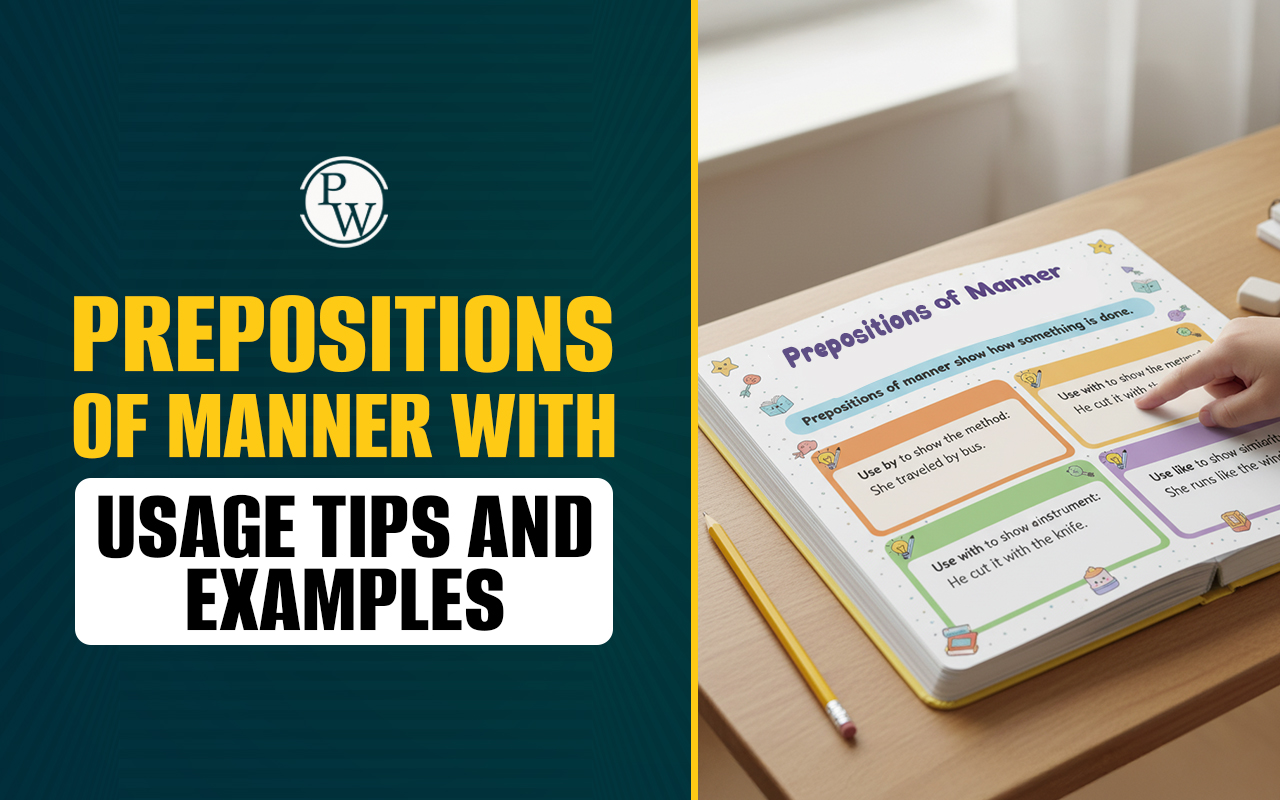
Prepositions of Manner: Definition, Rules, Examples and Sentences
 Nikita Aggarwal28 Sept, 2026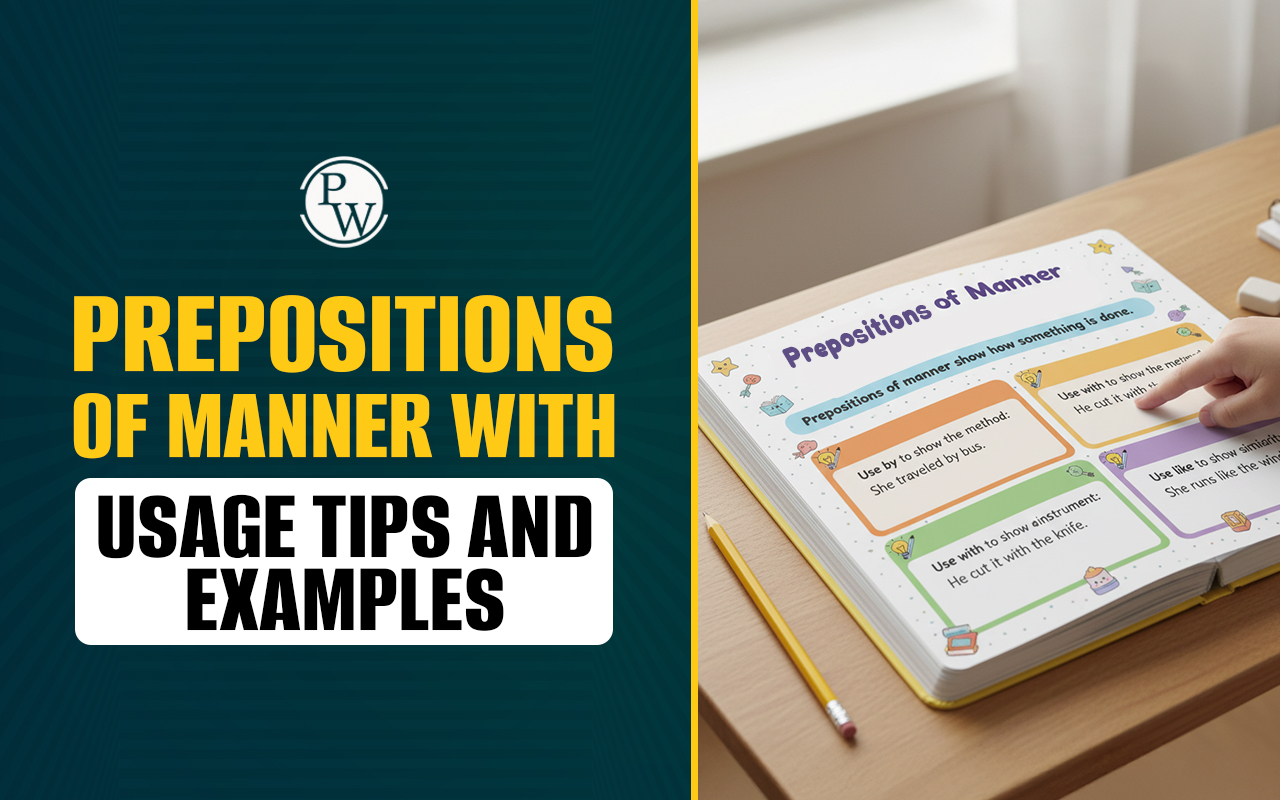
What Is a Preposition of Manner?
A preposition of manner is a preposition that helps describe how, by what method, or in what way an action is performed.
It connects an action with the manner, method, or means used to perform it.
Examples:
-
She spoke with confidence.
-
He travelled by train.
-
They completed the work with care.
-
She improved her English by practising every day.
-
He finished the task without help.
In these examples, with, by, and without help explain how the action happened.
Simple Definition
A preposition of manner is a preposition used to show the way or method in which an action is performed.
The exact category can vary across grammar books. In school grammar, words such as with, by, in, through, and without are commonly used to express manner or means.
Preposition of Manner Meaning
The word manner means the way something is done.
For example:
She spoke with confidence.
Here, with connects the verb spoke with the manner in which she spoke.
Similarly:
He completed the work with care.
The phrase with care tells us how he completed the work.
A useful question to ask is:
How was the action performed?
If a prepositional phrase answers that question by showing the method, manner, or means, it may be functioning as a phrase of manner or means.
Check: Interrogative Sentence – Definition, Meaning, Types & 10+ Examples
Common Prepositions of Manner
Some common prepositions used to express manner or means are:
| Preposition | Common use | Example |
| with | manner, feeling, quality or instrument | She spoke with confidence. |
| by | method or means | He travelled by train. |
| in | manner, style or condition | She answered in a polite manner. |
| through | means, process or effort | They succeeded through hard work. |
| without | absence of something | He completed the work without help. |
| like | similarity or comparison | He runs like a professional. |
Not every preposition in this list expresses manner in every sentence. The meaning depends on the context.
For example:
-
She travelled by train. → method or means
-
She sat by the window. → place
So, the same preposition can have different functions in different sentences.
Preposition of Manner Examples
Here are some simple examples:
-
She spoke with confidence.
-
He completed the work with care.
-
We travelled by train.
-
They travelled by bus.
-
She learned English through practice.
-
He solved the problem with patience.
-
She answered in a polite manner.
-
He completed the project without help.
-
They worked with enthusiasm.
-
She improved her writing through regular practice.
These examples show how prepositions can connect an action with the method or manner in which it is performed.
Also, check: Auxiliary Verbs: Types, List, Rules and Examples
10 Preposition of Manner Examples with Answers
Here are 10 sentences that use common prepositions of manner or means.
| No. | Sentence | Preposition |
| 1 | She spoke with confidence. | with |
| 2 | He travelled by train. | by |
| 3 | They worked with patience. | with |
| 4 | She learned the skill through practice. | through |
| 5 | He completed the task without help. | without |
| 6 | She answered in a polite manner. | in |
| 7 | He opened the box with a key. | with |
| 8 | They succeeded through hard work. | through |
| 9 | She travelled by bus. | by |
| 10 | He spoke with great care. | with |
Quick Tip
Do not assume that a word is a preposition of manner simply because it appears in the sentence. Look at what relationship the preposition expresses.
Preposition of Manner Rules
Follow these rules when using prepositions of manner and means.
1. Use the preposition that fits the meaning
Different prepositions express different relationships.
Incorrect:
She spoke by confidence.
Correct:
She spoke with confidence.
Here, with confidence is the natural expression.
2. Use “by” to show a method or means
By is commonly used to explain how something is done or the means used.
Examples:
-
He travelled by train.
-
She sent the message by email.
-
We improved our skills by practising regularly.
When by is followed by an action, it is commonly followed by a gerund (-ing form).
Example:
He learned English by reading books.
Not:
He learned English by read books.
3. Use “with” to show an instrument, quality or manner
Examples:
-
She wrote with a pen.
-
He spoke with confidence.
-
They worked with patience.
-
She completed the task with care.
The meaning depends on the context.
4. Use “without” to show the absence of something
Examples:
-
He completed the work without help.
-
She left without saying goodbye.
-
They solved the problem without difficulty.5. Do not repeat a preposition unnecessarily
Incorrect:
He travelled by by train.
Correct:
He travelled by train.
6. Remember that the same preposition can have different meanings
For example:
He travelled by train.
Here, by shows means or method.
The children sat by the door.
Here, by shows place.
The function of a preposition depends on the sentence.
With vs By in Prepositions of Manner
With and by are especially common, but they are not interchangeable in every sentence.
“With”
Use with to show an instrument, manner, feeling, or quality.
Examples:
-
She wrote with a pencil.
-
He spoke with confidence.
-
They worked with care.
“By”
Use by to show a method or means.
Examples:
-
He travelled by bus.
-
She improved by practising daily.
-
We contacted him by email.
Compare
She opened the door with a key.
The key is the instrument.
She travelled by train.
The train is the means of travel.
Preposition of Manner vs Adverb of Manner
A preposition of manner is part of a prepositional phrase, while an adverb of manner directly describes how an action happens.
Preposition of manner or means
She spoke with confidence.
The phrase with confidence describes how she spoke.
Adverb of manner
She spoke confidently.
The word confidently directly describes the verb spoke.
More examples:
-
He worked with care. → prepositional phrase
-
He worked carefully. → adverb
-
She answered in a polite manner. → prepositional phrase
-
She answered politely. → adverb
Both can describe manner, but they are formed differently.
Preposition of Manner in Different Types of Sentences
Affirmative Sentences
-
She spoke with confidence.
-
He travelled by train.
-
They worked with patience.
Negative Sentences
-
He completed the task without help.
-
She did not leave without saying goodbye.
Questions
-
How did you travel?
-
By what means did they reach the city?
-
Did she complete the work with help?
Preposition of Manner in English Grammar
Prepositions are words that show relationships between words in a sentence.
They can express different ideas, including:
-
Time: at, on, in, before, after
-
Place: in, on, under, behind, near
-
Direction: to, into, towards, from, across
-
Manner or means: with, by, through, without
Students can strengthen their English grammar skills through interactive learning resources on CuriousJr.
The same preposition can belong to different functional categories depending on its use.
For example:
He went by train.
Here, by shows means.
The shop is by the station.
Here, by shows place.
This is why the context of a sentence is important when identifying the function of a preposition.
Preposition of Manner Examples in Sentences
Read these examples carefully:
-
The teacher explained the lesson with patience.
-
She completed the drawing with great care.
-
We travelled by bus.
-
He sent the document by email.
-
She learned the song through regular practice.
-
He finished the work without assistance.
-
The student answered in a polite manner.
-
They achieved their goal through teamwork.
-
She opened the package with scissors.
-
He solved the puzzle with determination.
-
We improved our speaking skills by practising every day.
-
She completed the assignment without any help.
-
He spoke with enthusiasm.
-
They succeeded through hard work.
-
She explained the answer in a simple way.
Identify the Preposition of Manner
Try to identify the preposition or prepositional phrase that shows manner or means.
Example 1
She spoke with confidence.
Answer: with
Phrase: with confidence
Example 2
He travelled by train.
Answer: by
Phrase: by train
Example 3
They succeeded through hard work.
Answer: through
Phrase: through hard work
Example 4
He finished the work without help.
Answer: without
Phrase: without helpPreposition of Manner Practice Questions
A. Fill in the Blanks
Fill in each blank with a suitable preposition.
-
She spoke ______ confidence during the presentation.
-
We travelled ______ train.
-
He completed the work ______ great care.
-
She improved her English ______ practising every day.
-
They succeeded ______ hard work.
-
He finished the task ______ help.
-
She wrote the letter ______ a pen.
-
He sent the message ______ email.
-
The teacher explained the topic ______ patience.
-
She answered ______ a polite manner.
Answers
-
with
-
by
-
with
-
by
-
through
-
without
-
with
-
by
-
with
-
in
B. Choose the Correct Answer
1. Which sentence uses the preposition correctly?
a) She spoke by confidence.
b) She spoke with confidence.
c) She spoke on confidence.
Answer: b) She spoke with confidence.
2. Which word shows the means of travel?
He travelled by train.
a) travelled
b) by
c) train
Answer: b) by
3. Choose the correct sentence.
a) He improved by practise every day.
b) He improved by practising every day.
c) He improved with practise every day.
Answer: b) He improved by practising every day.
4. Which preposition shows the absence of help?
He completed the work without help.
a) with
b) by
c) without
Answer: c) without
5. Choose the correct sentence.
a) She completed the project with care.
b) She completed the project by care.
c) She completed the project on care.
Answer: a) She completed the project with care.
C. Make Your Own Sentences
Make one sentence using each word:
-
with
-
by
-
through
-
without
-
in
Example:
with: She spoke with confidence.
Common Mistakes with Prepositions of Manner
Mistake 1: Using “by” instead of “with”
Incorrect:
She spoke by confidence.
Correct:
She spoke with confidence.
Mistake 2: Using the wrong form after “by”
Incorrect:
He improved by practise every day.
Correct:
He improved by practising every day.
Mistake 3: Repeating the preposition
Incorrect:
They travelled by by bus.
Correct:
They travelled by bus.
Mistake 4: Treating every preposition as a preposition of manner
A preposition can have different functions.
For example:
The cat jumped over the wall.
Here, over shows movement or position, not manner.
Similarly:
The boat moved across the river.
Here, across shows movement from one side to another.
So, words such as over, under, across and along should not automatically be listed as prepositions of manner.
Quick Revision: Prepositions of Manner
-
A preposition of manner helps show how or by what means an action is performed.
-
Common examples include with, by, through, in and without, depending on context.
-
With can show an instrument, quality, feeling or manner.
-
By commonly shows a method or means.
-
By + verb is commonly followed by the -ing form.
-
Without shows the absence of something.
-
A preposition can have different functions in different sentences.
-
Always choose a preposition according to the meaning of the sentence.
Quick Examples
with confidence
by train
through practice
in a polite manner
without help




Preposition of Manner FAQs
1. What is a preposition of manner in English grammar?
2. What is an example of a preposition of manner?
3. Which prepositions are commonly used to show manner?
4. What is the difference between with and by?
With often shows an instrument, quality, feeling, or manner, while by commonly shows a method or means.
Examples:
-
She wrote with a pen.
-
She travelled by train.