How to Make Fractions Easy for Class 3 Students
 Nivedita Dar16 May, 2026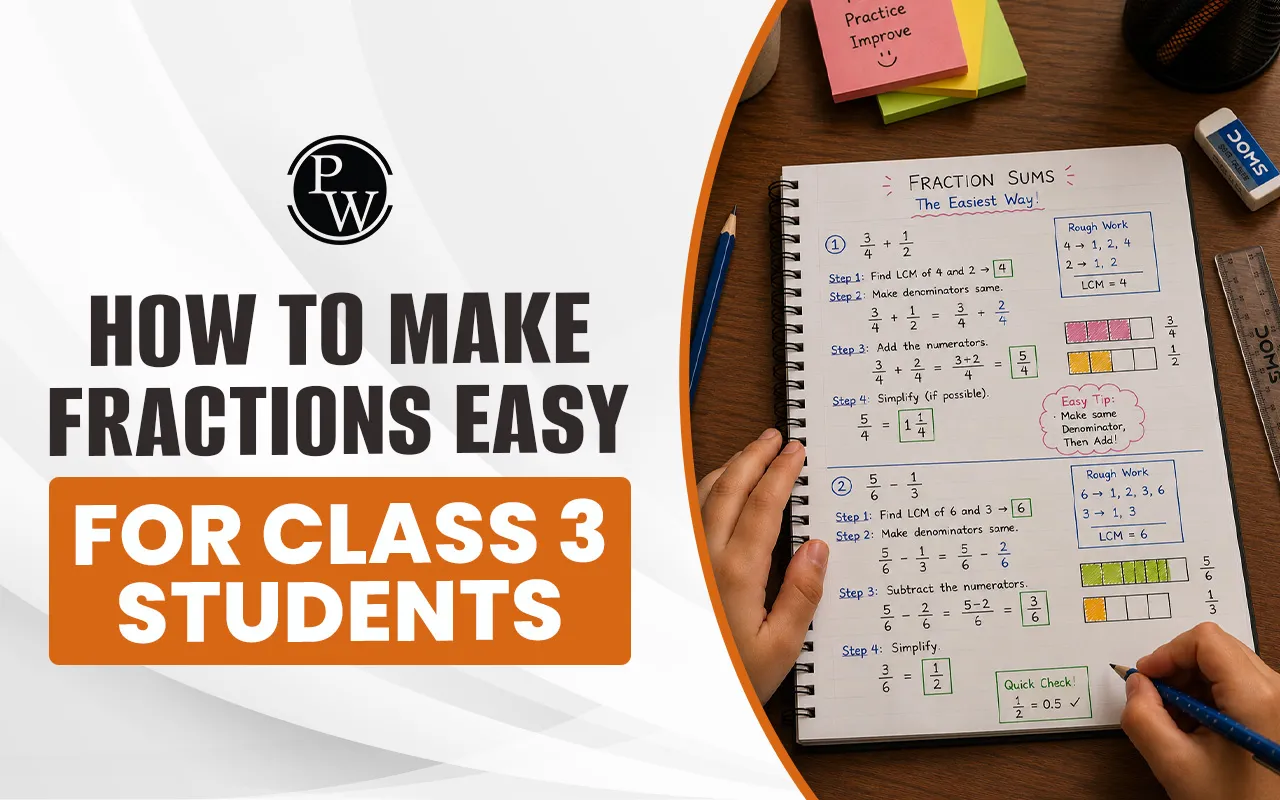
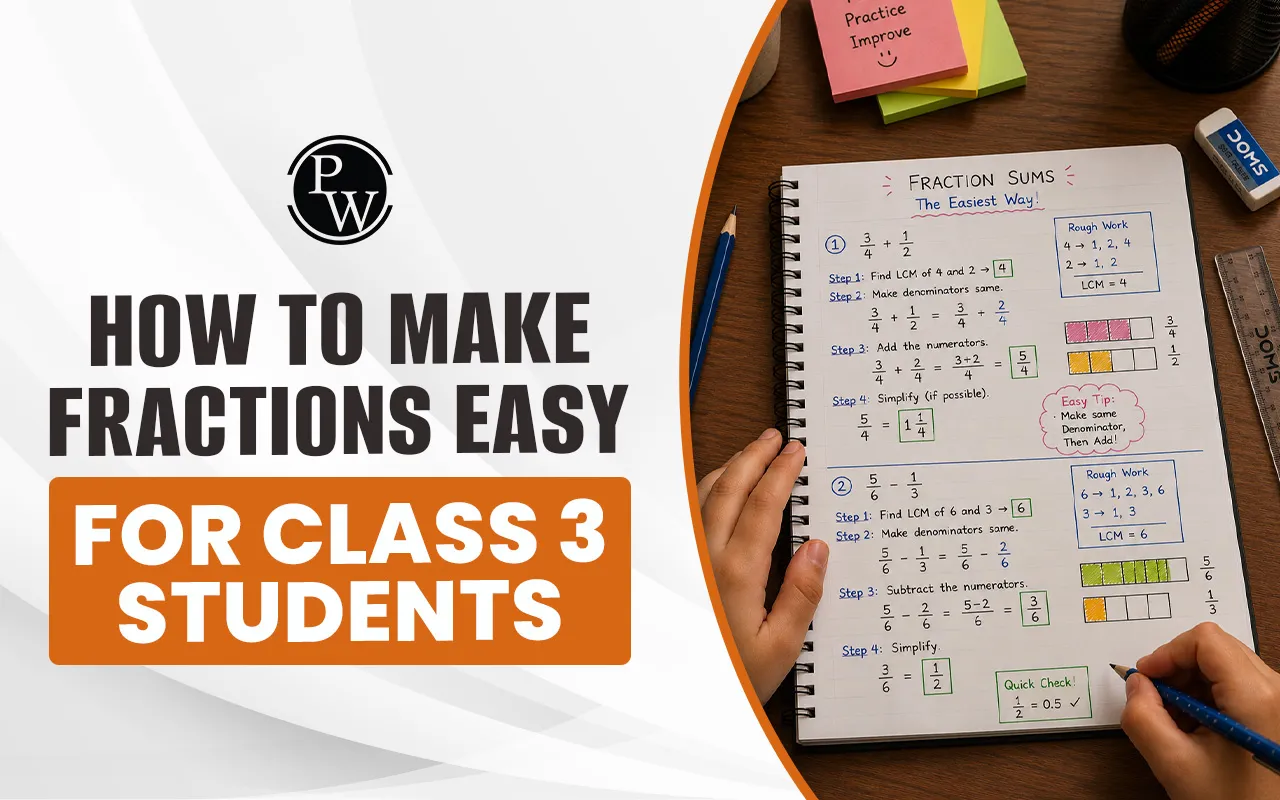
Many young learners feel a bit nervous when they first see numbers stacked on top of each other. It looks different from the addition or subtraction they are used to. However, fractions are simply a way of talking about sharing. The biggest challenge with fractions for class 3 is moving from whole numbers to parts. This article breaks down these "scary" numbers into visual maths concepts that make sense. We will look at how to identify parts of a whole, how to name them correctly, and how to use simple tricks to make learning fractions easy and part of your daily routine.
What Are Fractions for Class 3?
At its simplest level, a fraction tells us how many parts of a whole we have. Imagine you have a delicious, round pepperoni pizza. If you eat the entire thing, you have eaten one "whole." But what if you cut it into two equal pieces and eat one? You have eaten one-half.
Parts of a Fraction
Every fraction has two main numbers separated by a horizontal line:
-
The Numerator (Top Number): This tells us how many parts we are talking about or how many parts are "shaded."
-
The Denominator (Bottom Number): This tells us the total number of equal parts the whole has been divided into.
Key Rule: For a fraction to be fair, every single part must be the exact same size. If one slice of pizza is huge and the other is tiny, they are not true mathematical fractions.
Visual Fraction Concepts for Class 3
One of the best ways to build fraction confidence is to look at shapes. Class 3 students should focus on three main shapes: circles, squares, and rectangles.
1. The Circular Model (The Pizza Method)
Circles are perfect for showing halves, quarters, and eighths.
-
Half (1/2): One line down the middle creates two equal parts.
-
Quarter (1/4): Two lines (like a cross) create four equal parts.
2. The Bar Model (The Chocolate Method)
A long rectangle is often easier for mental math fractions because you can see the segments clearly. If you have a chocolate bar with 5 squares, each square is 1/5 of the whole bar.
|
Fraction Name |
Numerical Form |
Description |
|
One Half |
1/2 |
The whole split into 2 equal parts. |
|
One Third |
1/3 |
The whole split into 3 equal parts. |
|
One Quarter |
1/4 |
The whole split into 4 equal parts. |
|
One Fifth |
1/5 |
The whole split into 5 equal parts. |
Read More - Class 4 Word Problem Solving Tricks
Steps to Learn Fractions for Class 3
Learning fractions does not have to be a struggle. Follow these three steps to get it right every time:
Step 1: Count the total parts
Before you do anything else, count how many pieces make up the whole object. This number goes on the bottom (the denominator).
Step 2: Count the "active" parts
Look at how many pieces are coloured in, eaten, or taken away. This number goes on the top (the numerator).
Step 3: Say the name out loud
Instead of just saying "one over four," try saying "one-fourth" or "one-quarter." This helps your brain understand that you are talking about a specific size.
Fun Fraction Activities for Class 3 Students
To make fractions for class 3 stick, you need to move away from the textbook and into the real world. Try these quick activities at home:
-
The Fruit Salad Challenge: Take an apple and cut it into four equal pieces. Ask your child to show you 3/4 of the apple.
-
Lego Fractions: Use a large Lego brick with 8 dots. Cover 4 dots with a smaller brick. What fraction of the big brick is covered? (It is 4/8, which is also 1/2!).
-
Laundry Sort: If you have 10 socks and 5 are blue, what fraction of the socks are blue? This is a great way to practice mental math with fractions while doing chores.
Read More - Subtraction Tricks Without Fingers for Class 1
Common Fraction Mistakes Class 3 Students Make
Even the best students can get tripped up sometimes. Here are the most common "potholes" to watch out for:
-
Thinking the bigger denominator means a bigger piece: In fractions, it is the opposite! A 1/10 slice of cake is much smaller than a 1/2 slice. Think of it this way: the more people you share with, the smaller your piece gets.
-
Unequal Parts: Always check that the pieces are identical in size.
-
Mixing up Numerator and Denominator: Remember, D is for Denominator and D is for Down. The denominator always sits downstairs.
Mental Maths Fractions Tricks for Kids
When you are comfortable with fractions for class 3, you can start doing them in your head.
-
Finding Half: To find half of any even number, just divide by 2. Half of 6 is 3, so 3/6 is the same as 1/2.
-
Doubling the Denominator: If you cut a half in half again, you get a quarter. Notice how the bottom number doubled (from 2 to 4), but the piece got smaller?
Class 3 Fraction Practice Worksheet
Copy these questions into a notebook to test your skills!
Section A: Identify the Fraction
-
A circle is divided into 3 equal parts. 2 parts are shaded. Write the fraction.
-
A square is divided into 4 equal parts. 1 part is shaded. Write the fraction.
Section B: Comparison (Use > or <)
-
1/2 ____ 1/4
-
1/8 ____ 1/3
Section C: Word Problems
-
Sam has a chocolate bar with 6 equal squares. He gives 2 squares to his sister. What fraction did he give away?
-
There are 5 birds on a fence. 3 fly away. What fraction of birds left the fence?
Learn Fractions for Class 3 with CuriousJr
Excelling at fractions for class 3 requires consistent practice, strong number sense, and an engaging learning environment. CuriousJr offers interactive mental maths classes specially designed for Class 3 students to make concepts like fractions, multiplication, division, addition, and subtraction easier to understand through fun and structured activities. The platform focuses on helping children improve calculation speed, accuracy, and confidence without relying too much on fingers or rough work.
Through live interactive classes, personalised mentor support, and gamified learning methods, CuriousJr turns difficult maths topics into exciting challenges. Students learn fractions using visual models, puzzles, logic games, Sudoku activities, and Vedic maths techniques like complements, doubling, and halving. These methods help children understand visual math concepts more clearly while improving mental maths fractions skills and logical reasoning abilities.
CuriousJr online mental maths classes also include homework support, doubt-solving sessions, regular progress tracking, and parent-teacher updates to ensure steady improvement. With CBSE, ICSE, and state-board-aligned learning, flexible online schedules, and step-by-step teaching methods, CuriousJr helps students build confidence with fraction in a fun, fast, and fearless way. By combining interactive tools with real classroom concepts, the platform makes easy fractions learning more practical, enjoyable, and effective for young learners.