10-second Addition Tricks for Class 8
 Nivedita Dar20 May, 2026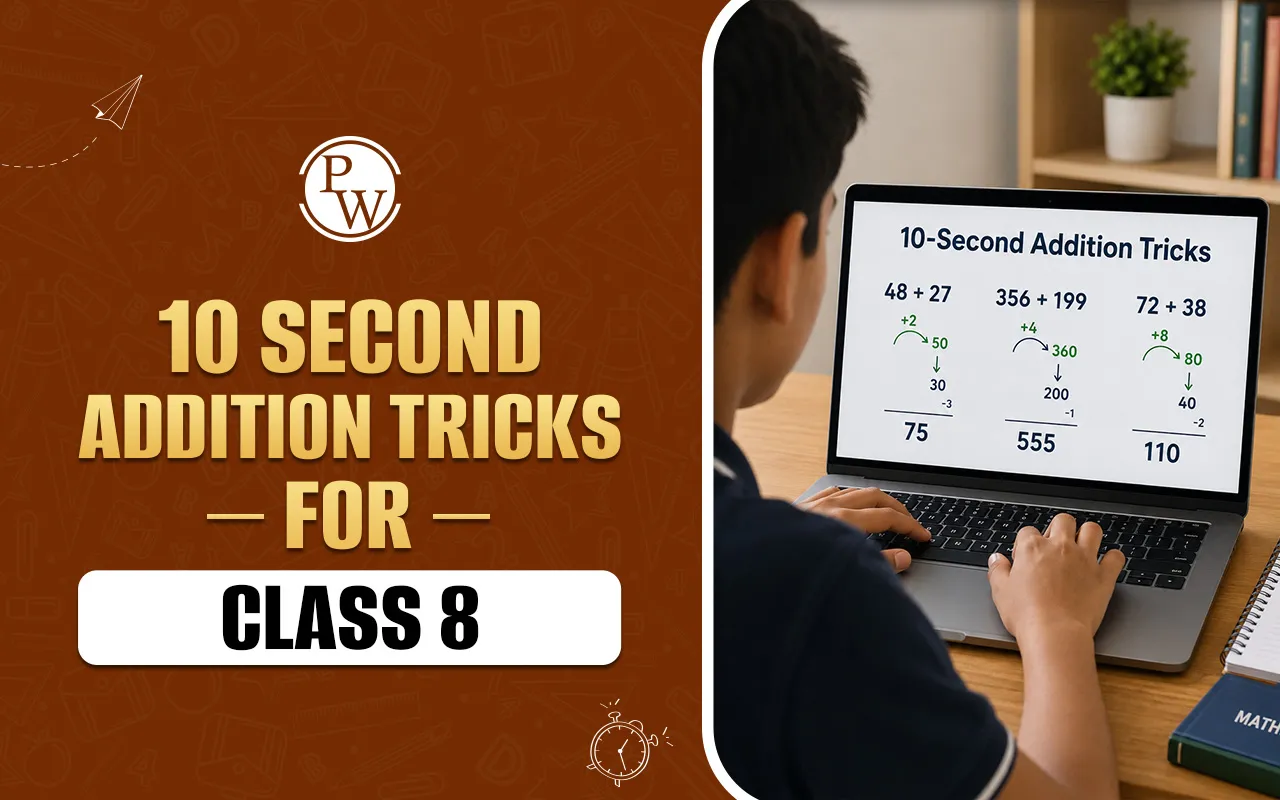
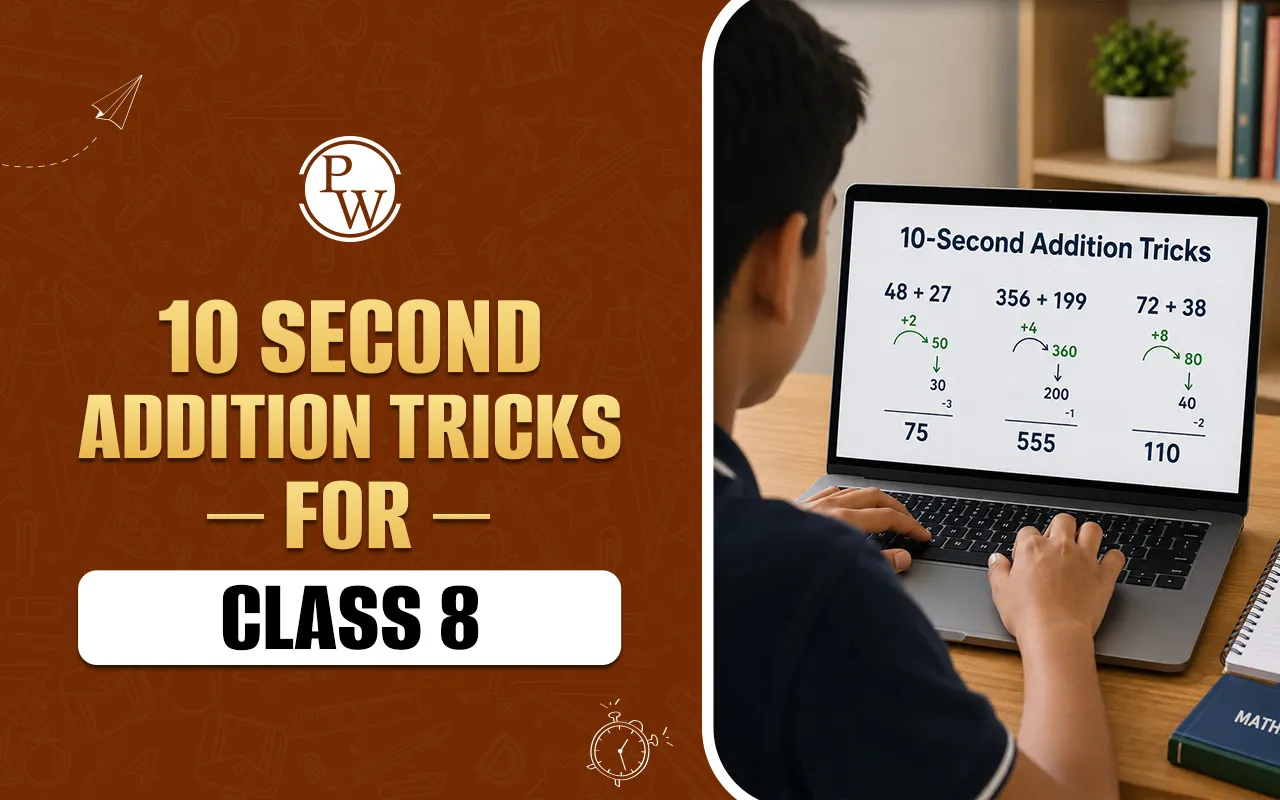
A timed paper is like a race against time, and most of the time, when you are doing a timed paper, you are faced with a long list of sums. If you find yourself scratching your head at the end of a row of numbers or counting on your fingers, you're not alone! Knowing addition tricks for class 8 will help you to become a quick calculator and a mental mathematician.
Some techniques can make you a superstar of maths and make your homework easier and your exams less daunting, as this guide will show.
What are Addition Tricks?
In class 8, sometimes it seems like a giant jump from easy number sums to algebra. In most cases, students find it difficult to work with many numbers, which causes examination stress and unnecessary mistakes. The key issue is not that they don't know about it, but that they don't use it fast enough. When you're stuck with basic sums, and you want to solve higher-level algebraic problems, you need to shift your strategy.
The best way to overcome this blockage is to learn addition tricks for Class 8. Once you have learnt these mental shortcuts, you will change your way of thinking about numbers and begin to see them not by using your fingers, but rather instantly. The methods will enable you to complete your homework quickly and develop a good grip on mental maths class 8.
Best Addition Tricks for Class 8
The key to the show is speed. The carry-over, or "right to left" method is reliable but slow, and most students use it. If you want to reach that 10-second target, then you have to take a new strategy. These are the best ways to boost your brain's processing speed.
1. Compatible Numbers Trick
Rather than just add the numbers in the order they are given, search for “friendly” pairs of numbers. This is a great, fast addition trick, as the numbers add to 100 or 10, as they naturally do.
-
The Concept: Add small numbers together first.
-
Example: Solve 48 + 52 + 19 + 81.
-
Step 1: Pair (48 + 52), which equals 100.
-
Step 2: Pair (19 + 81), which equals 100.
-
Step 3: Total = 100 + 100 = 200.
2. Round Off and Adjust
Hard data can slow you down. This trick involves changing a hard number into a simple one, then adjusting the final answer.
-
The Concept: Create a "tough" number and a "round" number.
-
Example: 398 + 257.
-
Step 1: Treat 398 as 400 (you added 2 extra).
-
Step 2: Add 400 + 257 = 657.
-
Step 3: Take away the additional 2 that were added. 657 - 2 = 655.
3. Left-to-Right Addition
It is a typical school approach to teach from right to left. But you read from left to right, which is how your brain does it. In mental mathematics class 8, it is easier to add the highest place values first.
-
Example: 347 + 231.
-
Hundreds: 300 + 200 = 500.
-
Tens: 40 + 30 = 70.
-
Units: 7 + 1 = 8.
-
Final Result: 500 + 70 + 8 = 578.
Read More - Why Kids Struggle with Multiplication in Class 1
4. Column Addition Speed Method
It is important to line up numbers when writing sums down. When numbers are aligned correctly, "digit drift" does not occur, or you don't add the tens digit to the hundreds digit.
-
Example: 458 + 327.
-
Ones Place: 8 + 7 = 15 (Write 5, carry 1).
-
Tens Place: 5 + 2 + 1 (carry) = 8.
-
Hundreds Place: 4 + 3 = 7.
-
Total: 785.
5. Break Into Parts (Partitioning)
This is an essential concept of addition tricks in 8th-grade maths. You retain the first number as it is and use place value to add the second number, number by number.
-
Example: 586 + 247.
-
Step 1: 586 + 200 = 786.
-
Step 2: 786 + 40 = 826.
-
Step 3: 826 + 7 = 833.
6. Add in Pairs
If you have many numbers in a list, do not add them in turn. Organize them into sensible groups of two.
-
Example: 25 + 75 + 36 + 64.
-
Pair 1: 25 + 75 = 100.
-
Pair 2: 36 + 64 = 100.
-
Total: 200.
Read More - Learn Subtraction Without Borrowing (Class 3)
7. Compensation Trick
This method is ideal for numbers that are near a milestone number, such as 99, 49, or 999.
-
Example: 999 + 456.
-
Step 1: 999 is almost 1000.
-
Step 2: 1000 + 456 = 1456.
-
Step 3: Since you added 1 extra to reach 1000, take it away. 1456 - 1 = 1455.
8. Decimal Addition Trick
Many students feel afraid of decimals, but it's simple to avoid that fear: treat the decimal point as an anchor.
-
Rule: The decimal points should be in a vertical straight line.
-
Example: 12.5 + 3.75.
-
Tip: Add a "0" to 12.5 to make it 12.50 so the digits line up perfectly.
-
Result: 16.25.
Addition Tricks for Class 8 Practice Questions
There are several tips for Class 8 addition tricks; if you wish to get proficient with these addition tricks, then you have to use them in real life. Write the answers to the questions below in the spaces provided, using the shortcuts you just learned.
Real-Life Exampls
-
The Grocery Run: A chocolate bar cost 48 rupees, a juice box 52 rupees and a packet of chips 35 rupees. The total is __ rupees (using the compatible numbers trick).
-
The Library Book: A book has 398 pages. There are 257 pages of reading. The total number of pages in two such books is ____, by the round off and adjust method.
-
Cricket Score: In a particular match, Team A scored 347 runs in 1st inning and 231 runs in 2nd inning. They perform left-to-right addition and arrive at __.
-
Pocket Money: You saved 999 rupees in January, and you saved 456 rupees in February. Using the Compensation Trick, you can save a total of __.
-
School Project: You purchased glitter for Rs. 12.50 and glue for Rs. 3.75. Total rupees spent using Decimal Addition Trick = __
Fill in the blanks.
-
To add 340 + 120 easily, start from the left: 300 + 100 = 400 and 40 + 20 = 60. Final answer = __.
-
156 + 24 can be broken up as 156 + 20 = 176 and 176 + 4 = _______.
-
75 + ______ = 100 The pair of numbers that makes 100 is.
-
I can break down 586 + 247 into parts to make it quicker: 586 + 200 + 40 + 7 = ______.
Benefits of Addition Tricks for Class 8
Why bother to learn these? There are benefits to more than passing a school test.
-
Saves Valuable Time: Every second matters in competitive exams. These techniques help you to get it done quickly so you can review it.
-
Reduces Mental Fatigue: Traditional addition is fatiguing. Shortcuts enable you to visualise more clearly when solving more difficult problems, such as algebra or geometry.
-
Improves Accuracy: Most errors are due to carryover. Small errors can be minimised through partitioning and rounding techniques.
-
Builds Number Sense: Begin to understand relationships between numbers, an important ability in higher maths.
-
Builds Confidence: It’s a good feeling when you can do a sum faster than a calculator.
How Does CuriousJr Help With Class 8 Mental Math?
CuriousJr makes mental maths class 8 fun and engaging. No more boring drills and long lectures; we take a modern approach to learning.
-
Interactive Practice: Games that reward you for learning tricks to add, making practice more fun.
-
Visual Learning: We explain Vedic maths clearly with the help of animation so that you get a clear idea of how the numbers move.
-
Personalised Learning: We know what tricks you’ve struggled with and give you tailored exercises to master them.
-
Real-World Application: We show how these tools can be applied in everyday life – for shopping, sports statistics, etc.