Subtraction Tricks Without Fingers for Class 1
 Nivedita Dar16 May, 2026
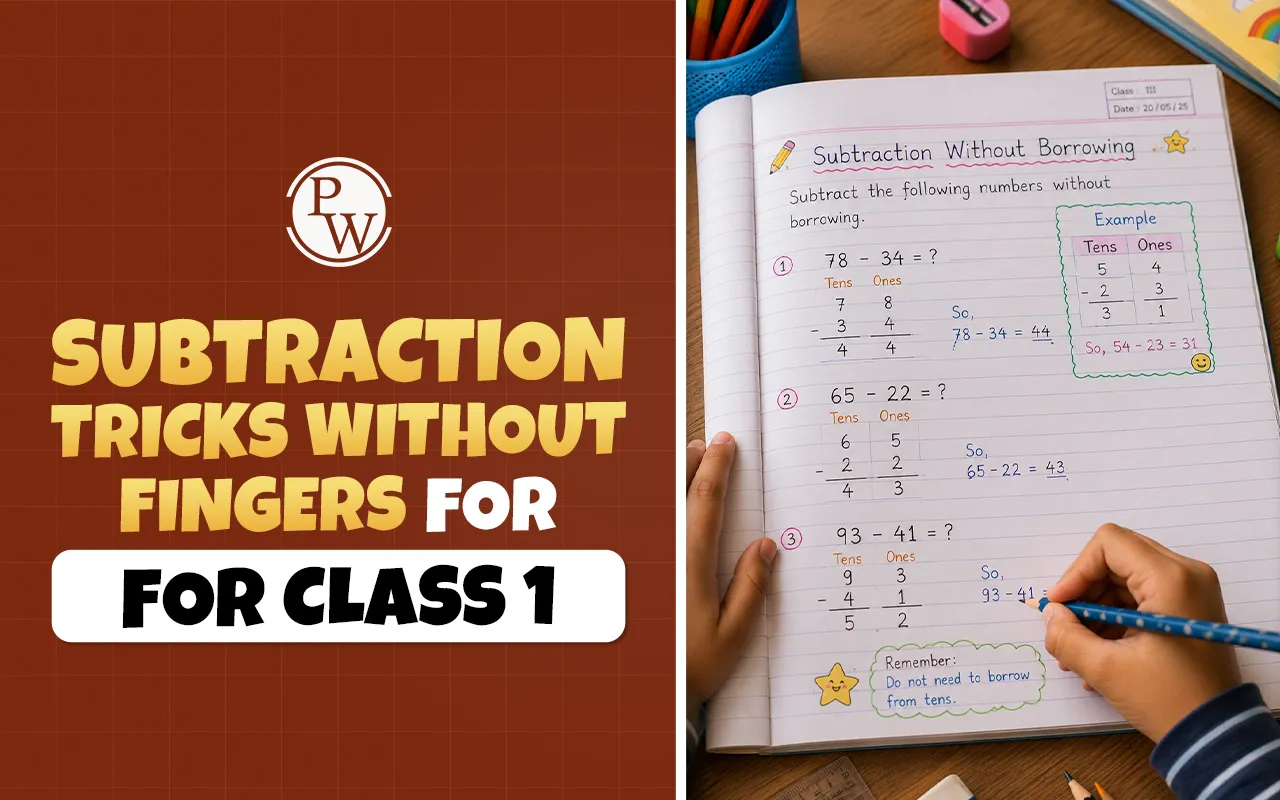
Teaching a child to subtract often starts with fingers, but moving toward mental strategies is where the real magic happens. The secret lies in switching from physical counting to mental subtraction methods. When kids understand how numbers relate to each other, they stop "calculating" and start "visualising." This article explores fun, easy-to-follow subtraction tricks for class 1 that transform maths from a chore into a quick mental game, ensuring your little one stays ahead in their maths learning journey.
Importance of Subtraction Tricks for Class 1
While fingers are great "built-in" calculators for toddlers, they have limitations. You only have ten of them, and as numbers get bigger, the process slows down. Moving to subtraction practice early on helps develop "Number Sense." This means a child understands that 5 is made of 2 and 3, rather than just being five separate sticks. Developing these maths shortcut techniques early builds the foundation for more complex arithmetic in later grades.
Mental Math Subtraction Tricks for Class 1
Trick 1: The Power of "Counting Back"
This is often the first step in maths learning. Instead of putting up fingers and taking them down, teach your child to "keep the big number in their head" and count backwards.
How it Works:
To solve 8 - 3:
-
Put the number 8 in your "mind's pocket."
-
Count back three steps: 7, 6, 5.
-
The last number you say is the answer!
Why it works: It bridges the gap between physical objects and mental imagery. It is one of the most effective subtraction tricks because it uses a skill they already know—counting—but in reverse.
Trick 2: Using Number Bonds to 10
Think of number bonds as "best friends." If a child knows that 7 and 3 always make 10, they can subtract from 10 instantly.
-
If the sum is 10 - 7, they don't need to count. They just remember that 3 is 7's best friend to make 10.
-
Common Best Friends: (1,9), (2,8), (3,7), (4,6), (5,5).
Learning these pairs is a vital part of subtraction methods. Once they know these pairs by heart, they can solve any subtraction problem involving the number 10 in less than a second.
Trick 3: The "Subtracting Nearly All" Rule
Sometimes, the numbers are very close to each other, like 9 - 8 or 6 - 5. In these cases, we don't need to count back at all.
The Rule: If the numbers are neighbours (like 4 and 5), the answer is always 1.
-
Example: 10 - 9 = 1
-
Example: 3 - 2 = 1
Teaching this as a "neighbour rule" is a fantastic maths shortcut technique that saves time and boosts a child's confidence.
Read More - Two Digit Addition Tricks for Class 2
Subtraction Tricks for Class 1 Practice Worksheet
To help with subtraction practice, try this "No-Finger" challenge with your child. Use a timer to make it feel like a game!
|
Problem |
Trick to Use |
|
5 - 1 |
Count back one |
|
10 - 2 |
Number Bonds (8's friend) |
|
7 - 6 |
Neighbour Rule |
|
9 - 3 |
Count back: 8, 7, 6 |
|
4 - 4 |
The "Same Number" Rule (0) |
Fun Activities to Practice Subtraction Tricks
To truly excel subtraction tricks for class 1, children need to see numbers as groups. Try these activities at home:
-
The Vanishing Snack: Place 6 grapes on a plate. Have the child close their eyes, "steal" 2, and ask them how many are left based on what they saw originally.
-
Number Line Jump: Draw a chalk line on the floor with numbers 0-10. Have them physically jump backward. This helps the brain transition from physical movement to mental movement later.
-
The "Zero" Hero: Remind them that any number minus itself is always zero. Use a superhero name like "Zero the Hero" to make it stick.
Read More - Why Kids Struggle with Multiplication in Class 8
Daily Practice Tips for Class 1 Kids
At this age, attention spans are short. Effective subtraction practice should follow the "Little and Often" rule:
-
The 5-Minute Dash: Do five mental sums before breakfast.
-
Visual Cues: Keep a small chart of number bonds on the fridge.
-
No Pressure Zone: If they get stuck, don't go back to fingers immediately. Ask, "What is the number just before that?" to nudge their memory.
Using these mental subtraction methods for just a few minutes a day is much more effective than a long one-hour study session on the weekend.
Practice Subtraction Tricks with CuriousJr
Building a strong foundation in arithmetic is easier when children learn through engaging and interactive activities. CuriousJr helps young learners strengthen subtraction tricks for class 1 by turning math practice into fun, bite-sized learning challenges designed specially for beginners.
CuriousJr online mental maths classes offer live interactive classes, gamified learning modules, and personalized guidance that help children move beyond finger counting and develop strong mental maths skills from an early age. Through visual activities and guided exercises, students learn these methods in a way that feels simple, enjoyable, and stress-free.
With CuriousJr, children can:
-
Practice subtraction tricks for class 1 without relying on fingers or rough work.
-
Build strong number sense through fun mental maths activities.
-
Improve speed and accuracy with quick calculation exercises.
-
Learn through rewards-based games and interactive challenges.
-
Get personalized support with teacher guidance and doubt-solving.
-
Track their daily progress and performance through engaging learning dashboards.
-
Practice easy maths learning anytime from home using structured lessons.
The visual feedback and step-by-step activities provided by CuriousJr help children understand subtraction concepts naturally instead of memorising answers. With consistent practice, students become more confident, faster, and fearless while solving classroom maths problems.