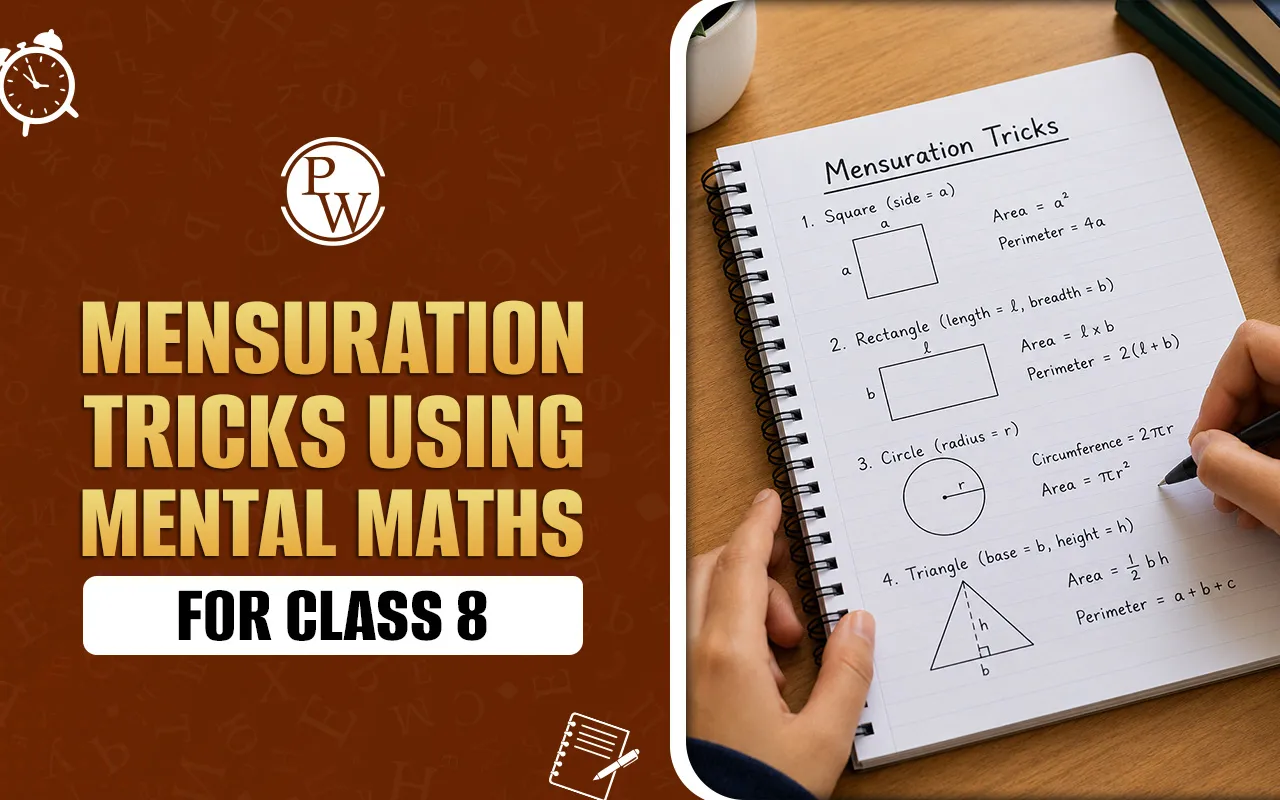
Mensuration Tricks Using Mental Maths for Class 8
 Nikita Aggarwal20 May, 2026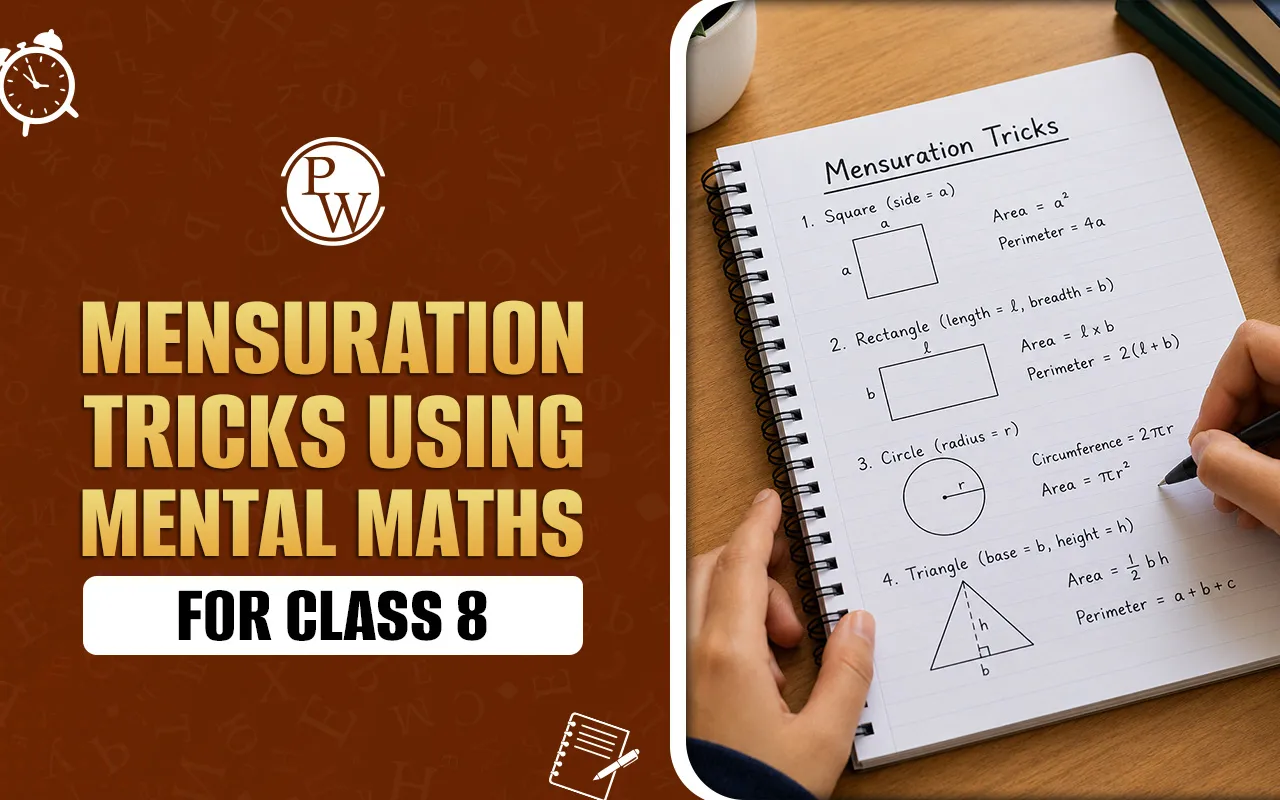
What are Mensuration Tricks?
Mensuration tricks are effective, time-saving strategies that help solve problems involving areas, volumes & perimeters of various shapes in fewer steps, without lengthy calculations. The tricks do not depend primarily on standard formulas; they help you calculate using simplified techniques, make approximations, and identify patterns to get answers quickly in competitive exams.
So, students can solve them with speed and accuracy in measurements of shapes such as squares, rectangles, circles, cylinders, etc., by learning some tricks for mensuration. These strategies help reduce calculation time, avoid common errors, and improve overall problem-solving efficiency, thereby making such formulas highly relevant for competitive exams and school-level maths.
Some Mensuration Tricks Using Mental Maths
If you intend to be agile, then your perspective on the numbers must change. These are the best tricks as per the Class 8 syllabus.
1. Formula First, Calculation Later
This is a fundamental principle. Preamble: To multiply or not to multiply, so often, it seems, before students even know what the numbers mean. Instead, always write your formula correctly the first time and start step by step to simplify the variables.
-
Rectangle: l × b
-
Cylinder: πr²h
-
Cube: a³
All your efforts are wasted if you have used the wrong formula. Choose a formula, observe what cancels out, and start working mentally here.
2. The π = 22/7 Smart Use Trick
Another thing you should know is that most mensuration problems are actually solvable. When a radius (r) or diameter is exactly divisible by 7, i.e., a multiple of a number less than a multiple of seven (7, 14, 21…), in both cases use Pi.
-
Example: If r = 7, Area = πr².
-
Mental Calculation: 22/7 × 7 × 7. One 7 cancels the other out.
-
Result: 22 × 7 = 154.
This way, you don't need to do long multiplications with 3.14 at all
3. The Power of Cancellation
One of the fastest Vedic maths tricks ever. Never multiply the numerator entirely if you still have a denominator to divide.
-
Example: Calculating the area of a triangle (½ × base × height).
-
If the base is 16 and the height is 10, do not calculate 16 × 10 = 160 and then divide 160 by 2.
-
Mental Shortcut: 16 ÷ 2 = 8. Now, 8 × 10 = 80.
Small numbers across the call chain are key to speedy geometry calculations.
4. Cylinder Volume Fast Trick
The volume of a cylinder (πr²h) often looks complex to calculate. Break it into parts.
-
Example: r = 7, h = 10.
-
Step 1: Use π ≈ 22/7.
-
Step 2: (22/7) × 7 × 7 × 10.
-
Step 3: Cancel the 7s. You are left with 22 × 7 × 10.
-
Step 4: 22 × 7 = 154. Now just add the zero for 10. Result: 1540.
5. Surface Area Shortcut for Cubes
The total surface area of a cube is 6a². The trick here is the order of operations.
-
Example: a = 5.
-
Mental Process: Always square the number first. 5² = 25.
-
Step 2: Now multiply by 6. Think of 25 × 6 as (25 × 4) + (25 × 2).
-
Calculation: 100 + 50 = 150.
Squaring first keeps the multiplication manageable.
Read More - 10-second Addition Tricks for Class 8
6. Sphere and Hemisphere Approximation
Volume of a sphere: 4/3 πr³. You may need to use a stepwise breakdown since this often results in decimals.
-
Find r³ first. If r = 3, then r³ = 27.
-
27 ÷ 3 (from the 4/3) = 9.
-
Now multiply 4 × 9 × π.
Dividing the formula into smaller segmented "bites" is protection against mental overload.
7. Memorise Essential Square and Cube Values
There are certain values that you must already have plugged into your "mental hard drive" (surface area and volume tricks – at the end of this article).
-
Squares: 12² = 144, 15² = 225, 25² = 625.
-
Cubes: 2³ = 8, 5³ = 125, 10³ = 1000.
And since this value is pre-computed, you can skip the multiplication steps and go right to the final part of your problem.
Read More - Why Kids Struggle with Multiplication in Class 8
Practise Sheet for Mensuration Tricks Using Mental Maths
Test Your Skills: Attempt to solve them without the use of a pen or paper.
Section 1: Mental Drills
Question: Find the area of a square with a side of 15 cm.
Question: A circle has a radius of 14 cm. Find its circumference.
Question: Find the volume of a cube with a side of 5 cm.
Question: A triangle has a base of 20 cm and a height of 15 cm. Find the area.
Question: What is the volume of a cylinder where r = 7 and h = 5?
Section 2: Multiple Choice Questions (MCQs)
-
What is the area of a triangle with a base of 20 cm and a height of 15 cm?
a) 300 cm²
b) 150 cm²
c) 200 cm² -
If the radius of a cylinder is 7 cm and its height is 5 cm, what is its volume?
a) 770 cm³
b) 154 cm³
c) 350 cm³
Section 3: Match the Following (Formula Edition)
Match the shape to the correct mental calculation path.
|
Shape |
Calculation Path |
|
1. Cube Volume |
A. l × b × h |
|
2. Rectangle Area |
B. side × side × side |
|
3. Cylinder Volume |
C. 2 × (l + b) |
|
4. Rectangle Perimeter |
D. Pi × r² × h |
Benefits of Mensuration Tricks Using Mental Maths
These tricks of surface area and volume provide many benefits beyond just scoring well.
-
Improved Cognitive Load: When you don't have to worry about elementary multiplication, you're free to work on the more complex aspects of the question – like turning units into each other.
-
Better Accuracy: This may feel counter-intuitive for some, but mental maths will also be more accurate than paper at most simple steps simply because the act of working it out on your own means you don't end up misreading what you've written down or accidentally losing track of carry-overs.
-
Foundation for Vedic Maths: These shortcuts usually reduce Vedic maths methods, and reasonably, they can provide you a 2-course advantage over advanced calculations.
-
Confidence in Exams: You can easily prepare for the first five questions of a paper and know that this will be mentally solvable with confidence when you make sure.
How Does CuriousJr Help with Class 8 Mental Maths?
By Class 8, CuriousJr online mental maths classes also know that children are going through a critical year for maths. The platform allows Class 8 mental maths to be fun and easy
-
Interactive Visualisation: In place of still photos, CuriousJr provides tools to explore how a shape changes as its dimensions are modified. This makes the logic underlying tricks easier to understand.
-
Gamified Drills: Practising Fast Calculation. Additionally, you are racing against your own best time, which automatically increases your speed.
-
Concept Simplification: We build a logical flow with every formula so that you can find out why each shortcut is evaluated in this way.
-
Snippet-Based Learning: Information is organised in bullet points and in relatable ways to make this guide easy to review; you won't be bombarded with long paragraphs.