Mental Division Tricks for Class 3
 Nivedita Dar20 May, 2026
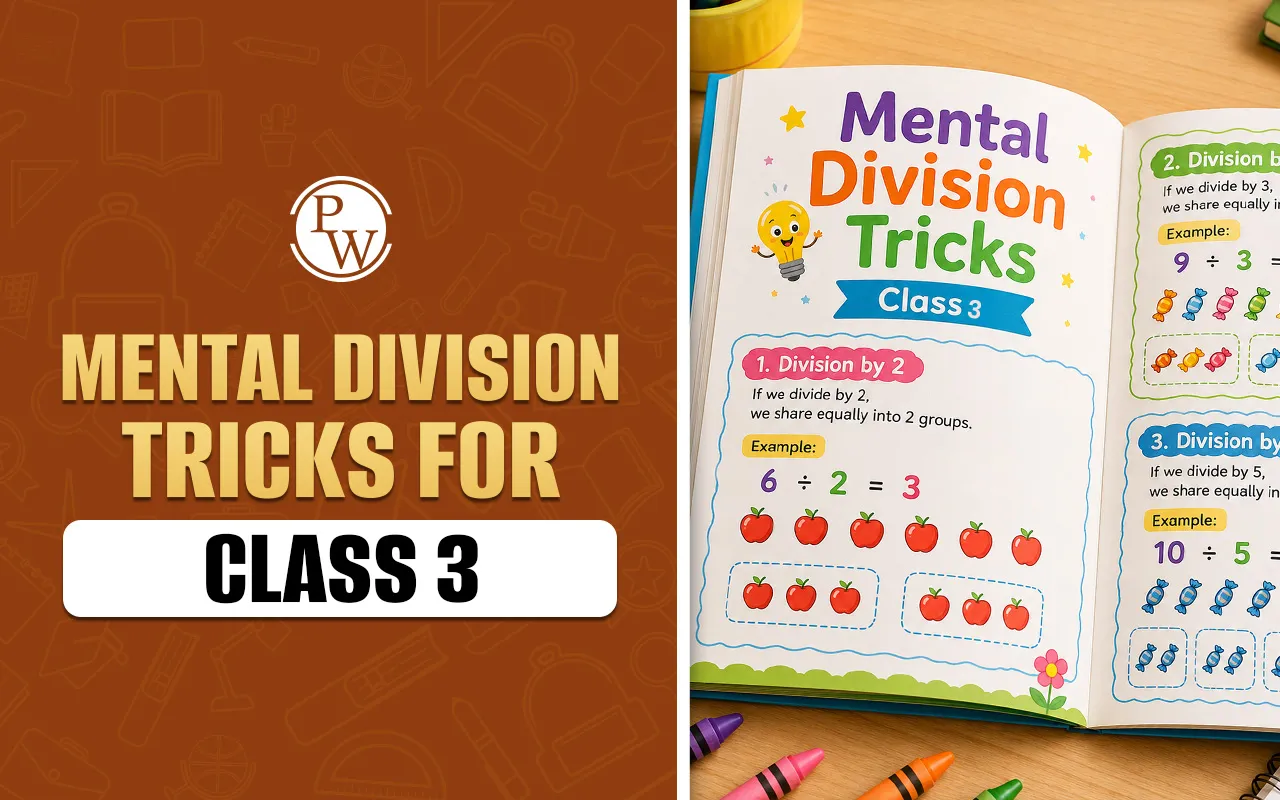
When teachers first introduce large numbers, many young students feel intimidated by math. Division is usually the most challenging problem, as it involves undoing the facts they have learned about multiplication. If your child hates doing long calculations and homework, the essential thing is to learn some division tricks class 3.
What is Division?
It is first necessary to understand what division really means before moving on to the shortcuts. Division is the opposite of multiplication. Division is the process of dividing a whole number into equal parts or groups. The system or strategy for distributing or sharing things fairly in the mathematical sense. If you bring sweets and want to share them equally among your friends, you are dividing.
When dividing, there are three key elements to remember:
-
Dividend: The total amount of something you begin with (the entire stack).
-
Divisor: How many groups are you creating (how many people are sharing).
-
Quotient: The answer at the end (value for each group or each person).
Remember, division is the inverse of multiplication. Multiplication is used to join small groups together to make a larger group; division is used to separate a large group into smaller groups. This is the "backwards" aspect of division in maths and will help children solve problems without using a calculator!
Class 3 Division Tricks Methods
To help students get faster and more accurate, we have suggested some of the best division tricks for class 3. These techniques can make abstract numbers more concrete and easier to understand, so kids can practise and learn these concepts with ease.
1. The Sharing Method
This is the most intuitive method of thinking about division. It is best when children visualise giving things to friends as they give them away.
-
The Idea: Pass out an item at a time until all items have been passed out.
-
Example: 12 divided by 3.
-
Suppose that you have 12 chocolates and 3 friends. Each friend will have 4 chocolates if you give each one of them again and again.
-
Result: 12 divided by 3 = 4.
2. The Grouping Trick
This trick is based on asking, instead of "How many?", "How many groups can I fit inside this number?" This technique is one of the beginner division tricks that can help you divide quickly.
-
The Idea: Summarise the whole number into certain group sizes.
-
Example: 15 divided by 5.
-
How many sets of 5 are there in 15? You have 5, then 10, then 15.
-
This will make a total of 3 groups.
-
Result: 15 divided by 5 = 3.
3. Skip Counting Method
If your child is able to memorise the multiplication tables, they can skip count to solve the question in seconds.
-
The Idea: Make "jumps" of the divisor until reaching the dividend.
-
Example: 18 divided by 3.
-
Count by 3s: 3, 6, 9, 12, 15, 18.
-
Record the number of jumps you performed. You jumped 6 times; the answer is 6.
-
Result: 18 divided by 3 = 6.
Read More - How to Make Fractions Easy for Class 3 Students
4. Repeated Subtraction
This approach will make children see and understand the "logics" of division. It demonstrates that division is repeated subtraction.
-
The Idea: Subtract the divisor until it becomes zero.
-
Example: 16 divided by 4.
-
16 minus 4 = 12 (1st time)
-
12 minus 4 = 8 (2nd time)
-
8 minus 4 = 4 (3rd time)
-
4 minus 4 = 0 (4th time)
-
You have subtracted 4 times, so your answer should be 4.
5. Use Multiplication in Reverse
An extremely strong division maths calculator. It makes the connection between division and the time tables that children should be familiar.
-
The Idea: Make the problem a "missing number" multiplication problem.
-
Example: 20 divided by 5.
-
Think: "5 times what number equals 20?
-
Since 5 times 4 = 20, the answer is 4.
-
Result: 20 divided by 5 = 4.
6. Circle Group Method
The circle method is a visual division approach suitable for students who enjoy drawing, which allows them to easily review their work.
-
The Idea: To create a total of items and to circle them in sets.
-
Example: 10 divided by 2.
-
Draw 10 small circles. Now, make a large loop around each of the 2 circles.
-
Count your loops. There are 5 large loops that you'll see.
-
Result: 10 divided by 2 = 5.
Read More - Subtraction Tricks Without Fingers for Class 1
7. Big Box Trick
Children can picture large storage boxes when using multiples of 10.
-
The Idea: Count by tens for easy division tricks.
-
Example: 30 divided by 10.
-
Imagine 30 items. How many boxes will be required if each holds 10?
-
Box 1 (10), Box 2 (20), and Box 3 (30).
-
Result: 3 boxes.
Practise Sheet for Division Tricks Class 3
Use the division tricks that Class 3 students have learned above to solve these practice questions. Try to use a different trick for each one!
|
Question |
Trick to Use |
Your Answer |
|
1. 10 divided by 2 |
Circle Group Method |
______ |
|
2. 21 divided by 3 |
Skip Counting |
______ |
|
3. 40 divided by 10 |
Big Box Trick |
______ |
|
4. 15 divided by 3 |
Skip Counting |
______ |
|
5. 25 divided by 5 |
Reverse Multiplication |
______ |
|
6. 18 divided by 2 |
Sharing Method |
______ |
|
7. 12 divided by 4 |
Repeated Subtraction |
______ |
|
8. 30 divided by 5 |
Grouping Trick |
______ |
Benefits of Division Tricks Class 3
Quick division tricks are not only the correct answer on a test, but they also will help you learn division most effectively. It influences the child's attitude toward challenges.
-
Improved Calculation Speed: This technique helps to boost a child's speed of calculation, as they won't need to draw the long division brackets.
-
Enhanced Memory: They will learn to skip count and to multiply the numbers backwards, which will help them to remember their times tables.
-
Logical Reasoning: Repeated subtraction is a technique in which subtraction is used to help introduce the concept that maths has rules and that these rules must be followed when solving problems.
-
Foundational Strength: Vedic maths division or long division becomes effortless in the future once these basics are learned.
-
Confidence Boost: When a student can solve a maths problem without any assistance before others, he or she feels very proud.
How Does CuriousJr Help with Class 3 Mental Math?
CuriousJr Mental Maths online class is intended to be a fun and non-stressful learning environment. Class 3 is beginning to learn division. The process is scary because it is a step up from addition, but it can also be an adventure with the right tools.
-
Guided Practice: CuriousJr Guided Practice gives students the chance to learn the division tricks, class 3, step by step.
-
Vedic Maths Introduction: Vedic maths division concepts are made easy by the platform, accessible to younger children and advantageous for them.
-
Visual Engagement: The platform has been designed with colourful animations to suit the two methods, "Circle" and "Sharing", which may be more comfortable for visual learners than just dealing with plain numbers.
-
Progressive Difficulty: Lessons start with sharing and slowly move towards faster division tricks with a remainder that will not overwhelm the child.
-
Instant Feedback: Praise and immediate rewards are given when the child uses a trick correctly; this approach helps motivate them to continue practising mental division.
With these "modern" teaching techniques and "shortcuts", one can develop a strong mathematical mind that is ready to face any challenge in academic life.