Why Kids Struggle with Multiplication in Class 2
 Nivedita Dar20 May, 2026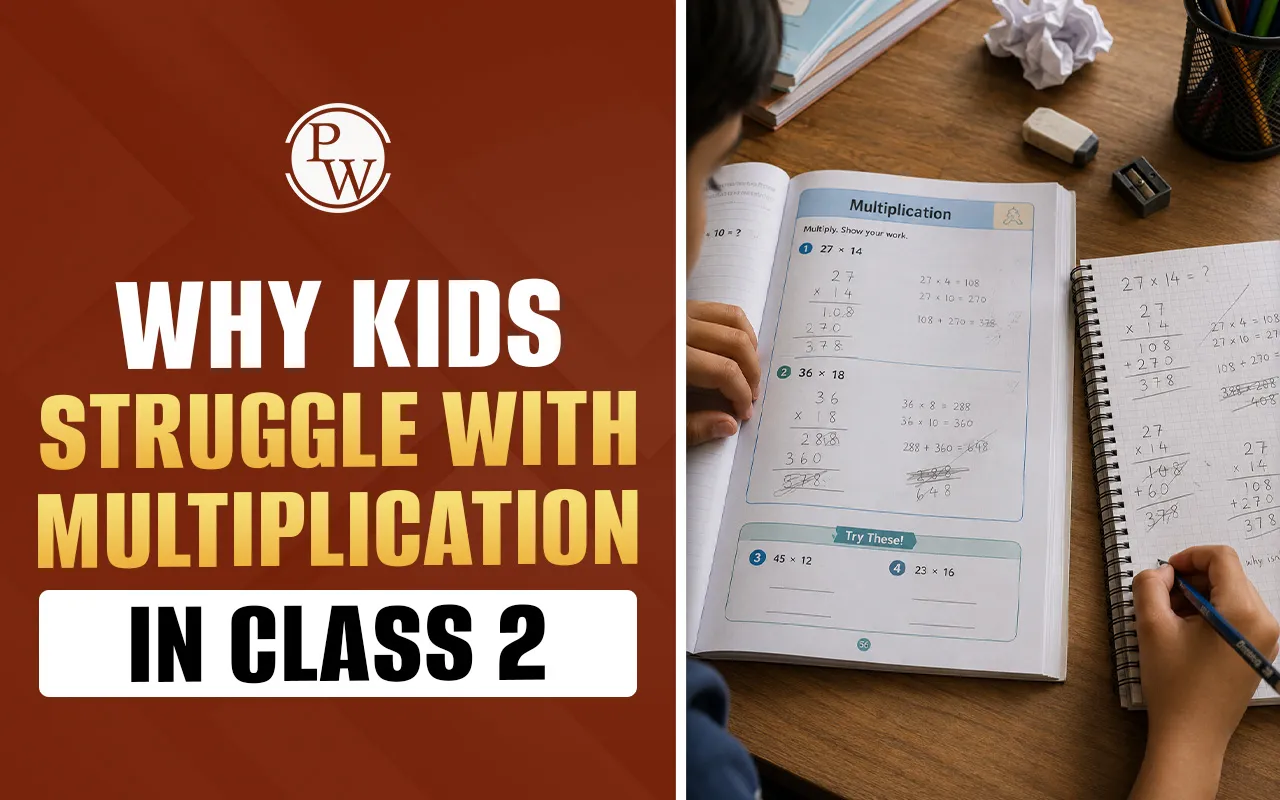
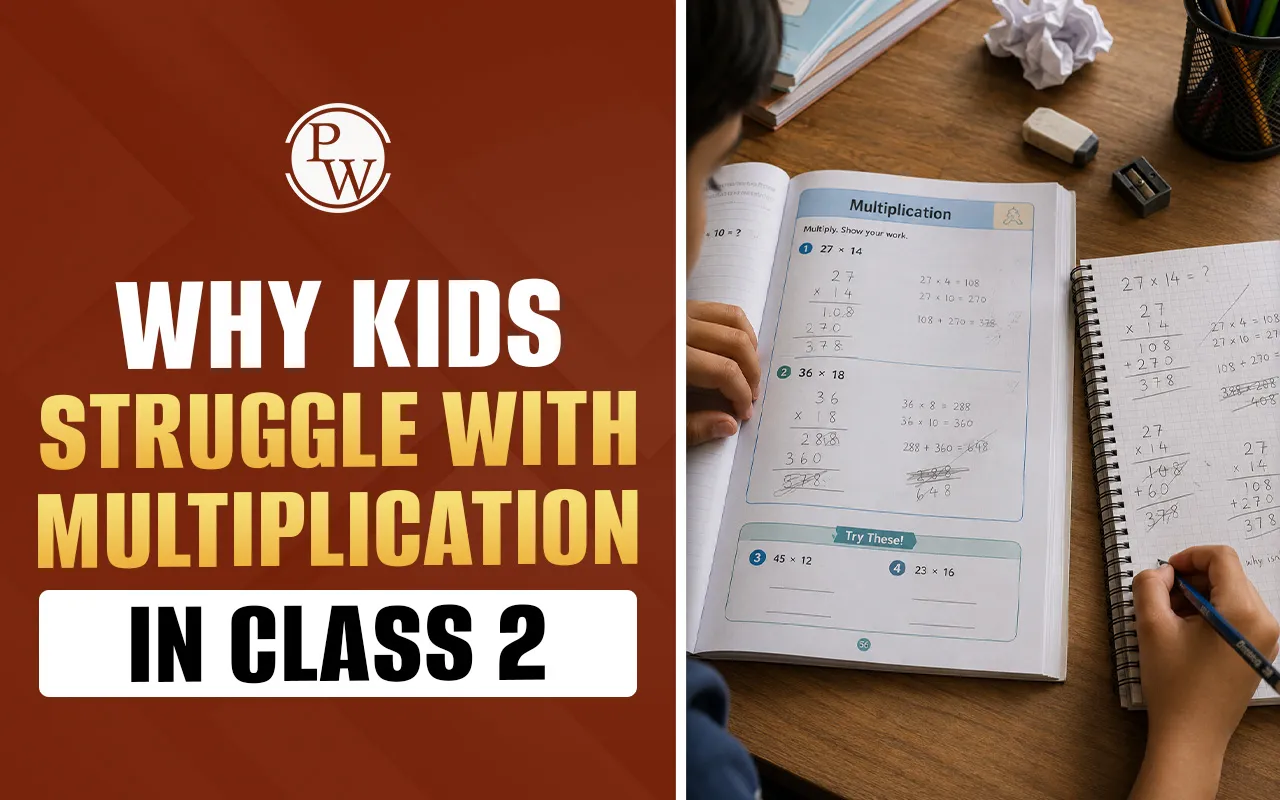
Multiplication is frequently the first "big" concept that a child encounters in their primary school curriculum. Students often face difficulty in multiplication problems class 2 because they have not yet developed conceptual understanding.
This article will explain how kids struggle with multiplication and how they can improve it by understanding it.
What is Multiplication?
Multiplication is essentially a quicker method of counting. Children learn that 2 + 2 + 2 + 2 + 2 is the same as counting five groups of 2. This is important because it builds on the ideas of scaling up and proportional reasoning, which are fundamentals for further work in maths, such as area and fractions.
-
The Concept of Groups: to understand that numbers can refer to sets (e.g., 3 groups of 4 apples).
-
The Multiplication Symbol (×): a short way of writing ’combining equal sets.’
-
A Building Block: Students will learn these basics, and division, which will be introduced soon, is a building block of multiplication.
Common Issues in Multiplication Problems Class 2
A breakdown in one of the five areas is generally the reason for a child's struggles. The first step to correcting "bottlenecks" is to understand them.
1. Multiplication Symbol Confusion
A + and a × sign can easily be mistaken for each other, especially when written hastily, particularly by a Class 2 student. This results in a maths mistake in class 2, 3 × 2 is seen as 3 + 2. When the brain sees a cross-shaped symbol, it is still wired for addition, which will make it easier for the brain.
2. The Repeated Addition Issue
We work on multiplication as "repeated addition", but some children become fixated on the addition part. They may be able to reason that 5 x 3 is the same as 5 + 5 + 5, but they still use their fingers to count to find the product.
This method remains acceptable for small quantities, but as the number of numbers increases, the process becomes too slow, time-consuming, and error-prone. If the student does not move toward fast multiplication tricks, he/she is still stuck in an inefficient and tedious counting cycle.
3. Weak Working Memory
Multiplication involves a child having to keep more than one thing in their head. They need to keep track of the groups, how many are in each group and the total number so far. Weak working memory means a child may not remember how many groups they have already added up by the end of the calculation. That is how many children begin a problem the right way and end up with the wrong answer!
4. Misalignment and Spatial Confusion
Children continue to practice their handwriting and spatial awareness in Class 2. They sometimes don't line up tens and ones in straight columns when representing multiplication problems. If the '2' in a product is not aligned under the '2' in the factor, the child may not understand the number he or she is about to write. It is one of the most frequently encountered physical multiplication problems among class 2 students.
5. Word Problem Difficulties
The student may do well on a worksheet with the equation 4 × 2 but be unable to do the problem when asked: If there are 4 bikes, and each one has 2 wheels, how many wheels are there in total? Converting English words into mathematical operations is another skill. Children may have trouble recognising the "clue words" that would indicate a multiplication problem and may experience "operation paralysis" – that is, not knowing where to begin.
Read More - Class 4 Word Problem Solving Tricks
Solution for Multiplication Problems Class 2
We need to turn these failures into successes by shifting our focus from one-way educational approaches, such as dry worksheets, to sensorially rich, more interactive learning experiences. These are some of the common challenges, and here are some tips on how to overcome them:
-
Prioritise Visual Learning: Make the abstract concrete. A child can see that if they draw a 3x5 grid of stars, the total number of stars is the same as 3 x 5. The "repeated addition problem" is "solved" using actual objects such as bricks or buttons to form "equal groups.
-
Use Short and Fun Activities: Sessions should be less than 15 minutes so as to not to wear them out. Games such as "Multiplication Bingo" or "Skip Counting Catch" (repeat a number from a table on each catch of the ball) make the activity rhythmic and enjoyable rather than a chore.
-
Connect to Real Life: Maths in the kitchen or the toy box. Have your child work out the number of wheels on five toy cars, or how many biscuits are required for three friends if each friend has three. This approach addresses the "word problem difficulty" by explaining the "why" behind the sum in practice.
-
Encourage with Positive Feedback: Focus on the strategy, not just the result. If a child uses any other multiplication device to arrive at a solution, and they have come up with a faster method than the one you had in mind, praise their "clever thinking". Being positive about their achievement, even when they get it wrong, helps them become resilient with more complex multiplication tasks in class 2.
-
Introduce Vedic Maths: Present simple Vedic math multiplication shortcuts, such as "Multiplication by 10" (add 0) and the "9s finger trick. " A Class 2 student is amazed when they learn this 'hack, and it helps them to calculate much faster.
Read More - How to Make Fractions Easy for Class 3 Students
Study Plan for Multiplication Problems Class 2
A systematic plan will not leave the student overwhelmed. Do not do it all at once; instead, make it a small daily theme.
-
Visual Building Phase: Create arrays on paper using coloured stickers or pasta shapes! This will make the child realise that 3 x 4 is the same as 3 rows of 4.
-
Symbol Hunt: Give a page containing some addition and some multiplication symbols. Ask the child to circle only the multiplication symbols to correct the confusion.
-
The "Real World" Challenge: Have the child count objects in the real world, for example, how many eyes are on 5 teddy bears.
-
Strategy Sessions: These are practice sessions devoted to fast multiplying with the 2s (double) and 10s (add zero) to help develop instant recall.
-
Story Translation: Read a word problem aloud and have the child make the groups before solving the sum.
How Does CuriousJr Help with Class 2 Mental Math?
In a traditional classroom setting, the child may fall behind on material they should know because the class is going too fast. CuriousJr online Mental Maths class offers a classroom tailored to those gaps, with interactive learning.
-
Gamified Learning: Turning multiplication problems for class 2 into a game helps students overcome their fear of failure. Rewards are given for correct responses to reinforce practice and make practice more engaging and motivating.
-
Bite-Sized Lessons: The curriculum has been structured around 10-minute sessions. Ideal for children with shorter spans of attention or who are uncomfortable with extended periods of maths.
-
Focus on Mental Maths: Curious Jr concentrates on fast multiplication tricks so that kids can count in their heads and lessen the "misalignment confusion" that occurs when they count on paper.
-
Vedic Foundations: Vedic maths multiplication concepts are introduced at a very early stage and help develop a "number sense" in the child, a skill that stays with them for a lifetime