Mental Division Tricks for Class 4
 Nivedita Dar20 May, 2026
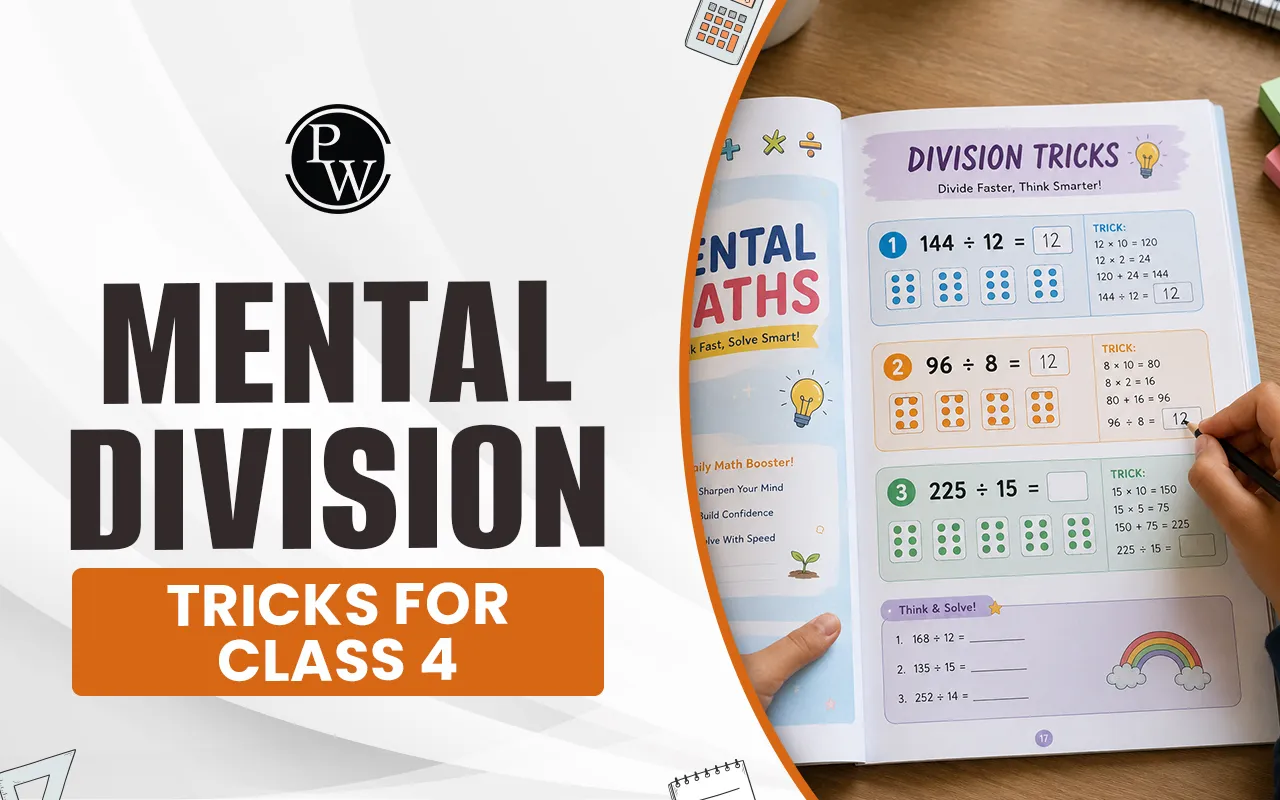
Suppose you're in a maths test, and you have a huge number to divide. You dread the long and tedious task of dividing the old-fashioned way. This process is a daily challenge for many students in class 4. The key to making this a fun challenge is to understand division tricks, class 4.
Memorising tables will help you save time and avoid calculation mistakes. This article covers some of the tricks you can use to be a wizard at mental maths.
What are Division Tricks?
The techniques for class 4 division tricks are mental strategies to determine how many times one number goes into another without using the long division bracket. To a 9 or 10-year-old, division is the inverse operation of multiplication. Tricks go beyond the school-curriculum concepts of "sharing" or "grouping" and incorporate number properties.
These tricks involve simplifying the problem. Instead of 196 ÷ 3 being a huge problem, a student using division sees it as two smaller, more manageable problems. With these techniques, students no longer fear numbers and start to play with them as puzzle pieces. This is an important skill to develop as students move on to topics like fractions and decimals in later years.
Best Division Tricks Class 4
Fast division tricks are similar to a magic trick. It's easy once you know the trick. These are the best ways for Class 4 learners to learn – from visuals to division concepts.
1. The Multiplication Reverse Trick
One of these is often called the "Think Multiplication" strategy. Dividing is the opposite of multiplying, so you can solve most basic division problems by asking a simple question.
The Logic: When you ask yourself, 'What is 24 divided by 6?' ask yourself, 'What times 6 equals 24?'
For example: 24 ÷ 6 =?
-
Think: 6 x 1 = 6, 6 x 2 = 12, 6 x 3 = 18, 6 x 4 = 24
Answer: 4.
This trick is the fastest way to handle single-digit divisors.
2. The Grouping Method
Visual understanding is key for younger students. The grouping method is used to "see" the division occurring.
The Logic: Let's say you have some number of objects, and you have to arrange them into certain piles.
Example: 24/4
-
Draw 24 dots or pebbles and group them into 4
-
Count the groups. There are 6 groups in all
Answer: 6
3. Break the Number Trick
Large numbers may be daunting on the page. The “Break the Number” trick helps make them less frightening by breaking the number into “friendly” numbers that are easier to divide.
The Logic: Split a big number into two numbers you can divide in your head.
Example: 48/4
-
Break 48 into 40 and 8
-
40 / 4 = 10
-
8 / 4 = 2
-
Add the results: 10 + 2 = 12
Answer: 12
Read More - 10-Second Addition Tricks for Class 1
4. The Number Line Jump
This method is perfect for students who like to move or visualise paths. It sees division as repeated subtraction or as "jumps".
The Logic: Start at 0 and add the divisor until you reach the total. Count the number of jumps it took.
Example: 20/5
-
Start at 0, then go to 5, then to 10, then to 15, then to 20
-
This is a sum of 4 jumps
Answer: 4
5. The Remainder Trick
Numbers aren’t always correct. Here, the idea of the “remainder” comes in handy. It makes getting to the "leftover" parts a breeze.
The Logic: Take the number below your number but closest to it, and subtract it from your number.
Example: 17/5
-
5 x 3 = 15. The numbers closest to 17 without exceeding it are in the set {14, 15, 16, 17, 18}.
-
Subtract: 17 - 15 = 2
Answer: 3 with a remainder of 2
6. Using Vedic Maths Division
Vedic maths division has special techniques for division. One popular 4th-grade division fact is dividing by 5. You do not divide, you multiply!
The Logic: To divide any number by 5, multiply it by 2 and then divide by 10 (or move the decimal one place to the left).
Example: 140/5
-
Double 140: 140 x 2 = 280
-
Divide by 10: 28.0
Answer: 28
Read More - Mental Division Tricks for Class 3
Practice Sheet for Division Tricks Class 4
These shortcuts need to be practised until you can use them automatically to master division. Use the discussed logics to solve these problems.
Mental Math Speed Drill
-
128 ÷ 4
-
35 ÷ 5
-
96 ÷ 3
-
180 ÷ 5
-
22 ÷ 4
-
25 ÷ 5
-
440 ÷ 10
Word Problems
-
The Chocolate Share: You are sharing 84 chocolates with 4 friends. How many chocolates does each friend receive?
-
The Sticker Collection: Sarah has 125 stickers. She would like to place them equally in 5 albums. How many stickers will each album contain?
-
The Classroom Rows: 48 students are in a classroom. How many rows of 4 will the teacher have if he or she chooses to arrange the students in rows of 4?
-
The Marble Game: Rahul has 17 marbles in the Marble Game. He wants to give 5 marbles to each of his friends. How many marbles are left?
Benefits of Division Tricks Class 4
Why use these fast division tricks when students have calculators? The advantages don't end with just writing the right answer in a notebook.
-
Boosts Academic Confidence: If a student can work out a problem without even picking up a pencil before other students, it gives the student a lot of self-confidence.
-
Enhances Concentration: Mental maths division involves keeping numbers in your 'working memory'. This will make the brain more likely to concentrate on more complex processes.
-
Saves Time in Exams: The division tricks for Class 4 will save time during a timed class test, allowing more time for other answers or a more difficult word problem.
-
Real-World Application: Division can also be used in the real world, such as when dividing pizza slices, sharing toys, or dividing pocket money. These daily tasks are simple with a quick mental calculation.
-
Prepares for Advanced Math: Vedic maths is introduced early in division, preparing students for the logic used in competitive exams and higher maths in STEM.
How Does CuriousJr Help with Class 4 Mental Maths
CuriousJr online mental maths class knows that repeating facts and information can be boring. They convert mental calculations into a pastime. The platform is all about logic and interactive problem-solving to make remembering division tricks in class 4 easy and fun.
-
Gamified Learning: They turn division problems into game levels. Students will need to employ division tricks to keep things moving.
-
Visual Aids: Curious Jr uses visuals of "grouping" and “number line" approaches for participants who are not comfortable with abstract numbers.
-
Skill Progression: Tricks of multiplication reversal are introduced first, and then Vedic maths of division is introduced gradually as students become confident.
-
Focus on Logic: Instead of having children memorise tables, Focus on Logic teaches them how to "break apart" numbers, giving them a more useful, longer-term skill