Perpendicular Bisector: Definition, Properties, and Practical Examples
 Nikita Aggarwal30 Mar, 2026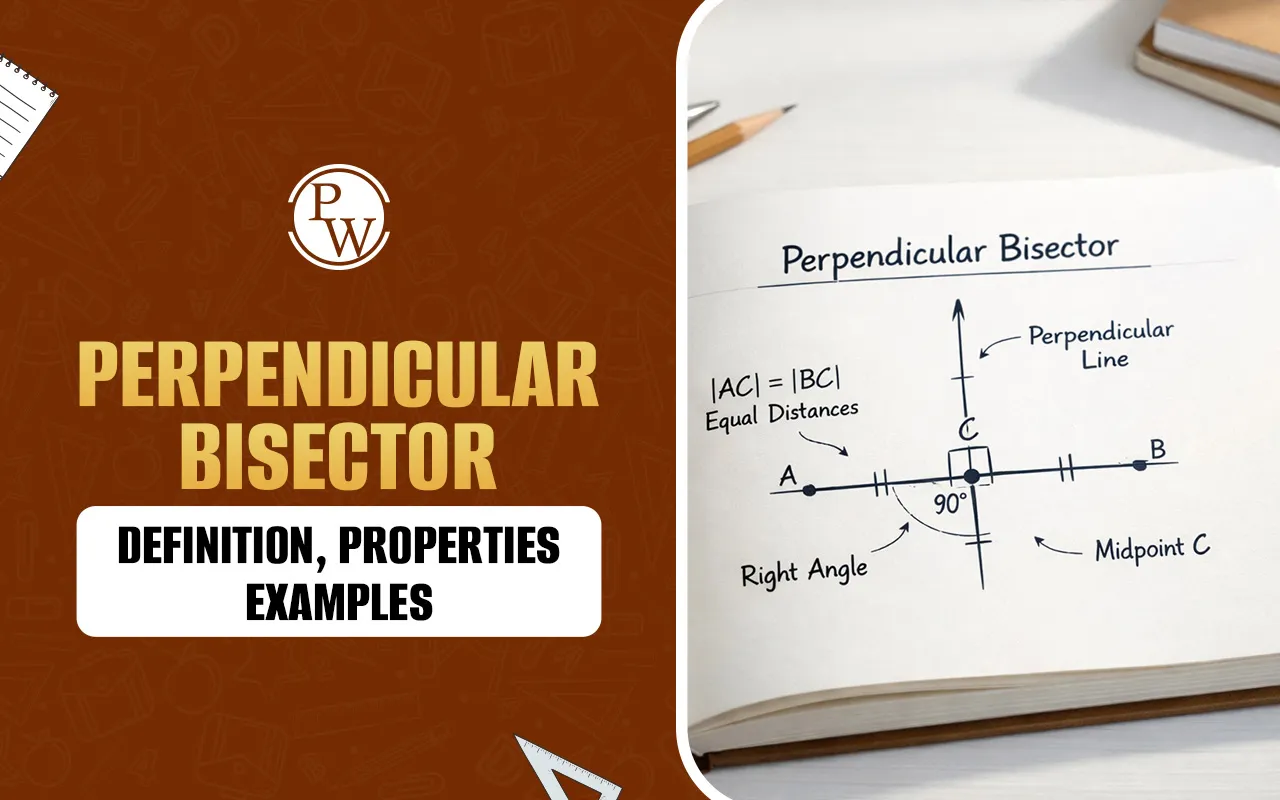
What is Perpendicular Bisector?
To understand this concept, it helps to break the name into two simple parts. "Perpendicular" means that two lines meet at a right angle (90 degrees), just like the corner of a square or a book. "Bisector" comes from "bi" (meaning two) and "sect" (meaning to cut). Essentially, it means to cut something into two equal pieces.
Perpendicular Bisector Definition
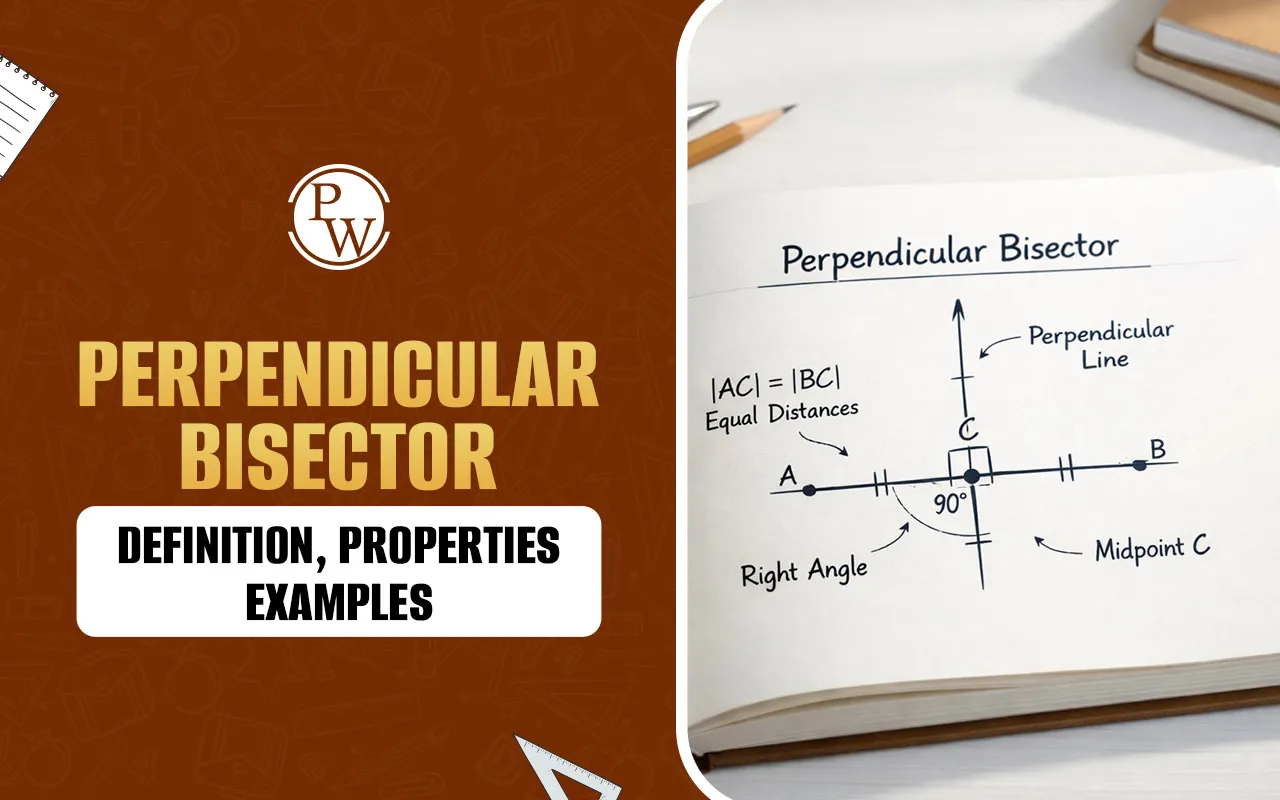
In perpendicular bisector in maths terms, it is a line, ray, or segment that passes through the midpoint of a line segment and is perpendicular to it. It does two jobs at once: it finds the exact middle and it stands perfectly upright at a 90-degree angle.
The Perpendicular Bisector Theorem
This theorem explains the unique relationship between the points on a bisector and the segment it cuts. Understanding this logic is vital for solving complex geometry proofs.
-
Distance Property: The perpendicular bisector makes every point on it the same distance from the two ends of the original line section
-
Equidistance: Because of this property, we say that every point on the bisector is "equidistant" from the endpoints.
-
The Converse Theorem: Logic also works in reverse. If you find a point that is equidistant from the two endpoints of a segment, then that specific point must lie on the perpendicular bisector.
Perpendicular Bisector of a Triangle
The application of perpendicular bisectors to triangles shows multiple hidden properties which determine the exact center point of the shape.
-
A triangle contains three sides which generate three perpendicular bisectors that split each side into two equal segments. The lines of each perpendicular bisector extend through the midpoint of their corresponding side while maintaining a 90-degree intersection.
-
The Circumcenter: If you draw all three straight bisectors of a triangle, they will always meet at the same point. The circumcenter is the place where these lines meet.
-
The Circle Secret: The circumcenter is the middle point of the circle that goes around all three points of the triangle. This circle is called the circumcircle.
-
Location Tip: The circumcenter is in a different place for each type of triangle you are working with:
-
Acute Triangle: The circumcenter is located inside the triangle.
-
Obtuse Triangle: The circumcenter is located outside the triangle.
-
Right Triangle: The circumcenter sits exactly on the hypotenuse (the longest side).
Read More - Right Angle Triangle: Definition, Properties, Formula & Examples
How to Construct a Perpendicular Bisector ?
Drawing a perpendicular bisector accurately requires a compass and a ruler. You don’t even need a ruler to measure the middle, just a compass and a little care:
-
Step 1: Set Your Anchor Place the sharp point of your compass on one endpoint of the line segment (let's call it Point A).
-
Step 2: Adjust the Width Open your compass so that the pencil reaches more than halfway across the line. If it’s too short, the arcs won't meet!
-
Step 3: Swing the Arcs The large arc needs to extend above and below the line segment because the compass width must remain unchanged. The shape of the object needs to appear as a vertical C shape.
-
Step 4: Repeat from the Other Side The sharp point of the compass must be moved to the other endpoint which is Point B. The same width should be maintained to create a second arc. The two arcs will intersect at two points which include one point above the line and one point below the line.
-
Step 5: Connect the Crosses Use your straightedge to draw a line connecting the two points where the arcs intersect.
The Result: This new line is your perpendicular bisector. It hits the original segment at a perfect 90° angle and divides it into two identical length
Perpendicular Bisector Properties
You can identify a true perpendicular bisector by looking for these specific characteristics:
-
The Midpoint Rule: The bisector must pass through the exact centre point of the line segment.
-
The 90-Degree Rule: It must form a right angle where it hits the segment.
-
Congruent Segments: It divides the original line into two identical lengths.
-
Symmetry: The line acts as a mirror, making the two halves of the segment perfectly symmetrical.
Read More - Cartesian Plane - Definition, Quadrants, Examples
Perpendicular Bisector Examples
Let’s see how we use a perpendicular bisector in real geometry problems.
Example 1: Dividing a Segment
Imagine you have a line segment AB that is 10 cm long. If you draw a perpendicular bisector through it:
-
It will cross segment AB at the 5 cm mark.
-
The angle where the lines cross will be exactly 90 degrees.
-
The two new segments created (let's call the middle point M) will be AM = 5 cm and MB = 5 cm.
Example 2: The Triangle Secret
If you take any triangle and draw the perpendicular bisectors for all three of its sides, they will all meet at one single point. This special spot is called the circumcentre. It is the perfect centre point if you wanted to draw a circle that touches all three corners of the triangle.
Make Maths Easy and Enjoyable with CuriousJr
CuriousJr helps children build a strong foundation in maths by removing fear and boosting confidence. Our Mental Maths online classes for students from Classes 1 to 8 are designed to improve speed, accuracy, and logical thinking through simple techniques and interactive learning.
With a dual-mentor system, students attend engaging live classes and receive dedicated support for doubt-solving after every session. Animated lessons, fun activities, and exciting challenges make maths easy to understand and fun to learn.
Parents stay updated with regular progress reports and review sessions, ensuring complete transparency in their child’s learning journey.
Book a demo class today and discover how CuriousJr makes maths simple, engaging, and confidence-building for your child.