Cartesian Plane - Definition, Quadrants, Examples
 Shivam Singh20 Sept, 2025
What is Cartesian Plane?
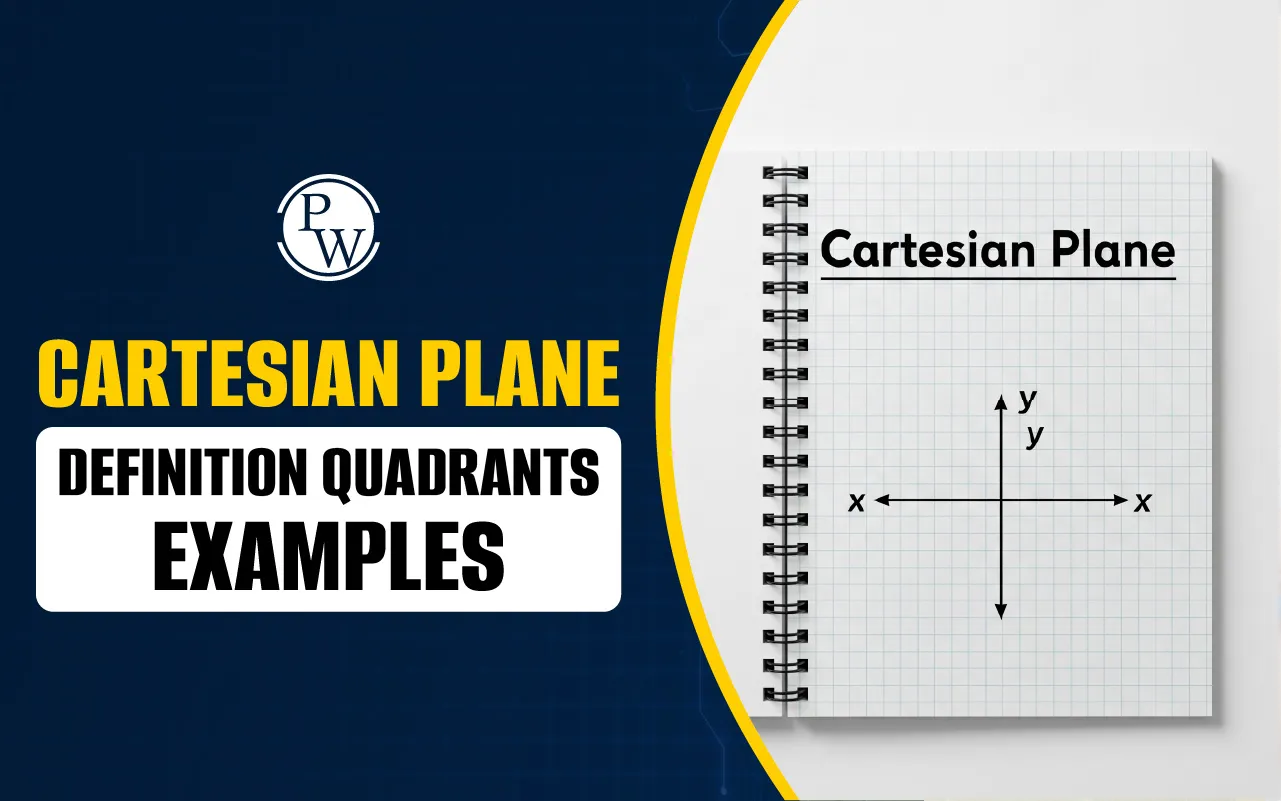
What is the Cartesian Plane? It is a commonly asked question among students when learning about coordinate geometry. The Cartesian Plane is a flat surface formed by two number lines that cross each other at right angles. One line goes sideways, called the x-axis, and the other goes up and down, called the y-axis.
The Cartesian Plane was introduced by the French mathematician René Descartes in the 17th century. It helps us connect two branches of math, which are Euclidean geometry and algebra, by showing how numbers can represent points on a plane. Keep reading to learn more about Cartesian plane quadrants and graphs, with examples.
Read more: Construction in Maths
Cartesian Plane Definition
As per the Cartesian plane definition, it is a plane made by two number lines that are perpendicular to each other. The horizontal line is called the x-axis, and the vertical line is called the y-axis. They meet at a specific point, known as the origin, which is written as (0, 0). This makes it easy to locate any point on the plane and also helps with drawing Cartesian plane graphs and understanding quadrants.
Parts of Cartesian Plane
The Cartesian Plane has three main parts that help us locate points and draw graphs easily, which are:
-
Axes: These are the two straight lines that cross each other at right angles. The horizontal line is called the x-axis, and the vertical line, which is perpendicular to it, is called the y-axis.
-
Origin: The point where the x-axis and y-axis meet is called the origin. Its coordinates are (0, 0). The origin divides both axes into two equal halves.
-
Quadrants: The intersection of the x-axis and y-axis divides the plane into four sections called quadrants.
-
Coordinate of a Point: The coordinate of a point is like the address of that point in space. It helps us know exactly where the point is.
Read more: Multiplying Decimals
What are Cartesian Plane Quadrants?
When the x-axis and y-axis cross each other, they divide the Cartesian Plane into four infinite regions, which are known as quadrants. Each quadrant is made by the halves of the axes and can extend endlessly.
Cartesian Plane Quadrants can be numbered from I to IV in an anti-clockwise direction, starting from the top right. Every quadrant has a different combination of positive and negative values for x and y, such as:
-
First Quadrant (I): Both x and y are positive, written as (+, +).
-
Second Quadrant (II): x is negative and y is positive, written as (-, +).
-
Third Quadrant (III): Both x and y are negative, written as (-, -).
-
Fourth Quadrant (IV): x is positive and y is negative, written as (+, -).
In the Cartesian Plane quadrants, the positive direction goes upwards and to the right, while the negative direction goes downwards and to the left. By looking at the signs of a point, we can easily tell which quadrant it is in.
Read more: 30-60-90 Triangle
How to Plot Points on Cartesian Plane?
Understanding how to plot points on a Cartesian Plane is very important because questions on this topic are generally asked in school exams. So, in order to plot points on a Cartesian Plane, always start from the origin, which is (0, 0).
Every point is written as an ordered pair (x, y), where x shows how far to move left or right, and y shows how far to move up or down. Here are the steps to plot a point, for example: To plot P(-5, 8) on the Cartesian plane, we will follow these steps:
-
Step 1: Check the signs of x and y: It is important because it tells us which quadrant the point will be in. For P(-5, 8), x is negative and y is positive, so the point is in the second quadrant.
-
Step 2: Move along the x-axis: Start from the origin and move 5 units to the left because x = -5. Draw a vertical line at this position.
-
Step 3: Move along the y-axis: From the origin, move 8 units up because y = 8. Draw a horizontal line at this position.
-
Step 4: Mark the point: The intersection of the vertical and horizontal lines is the point P(-5, 8).
Key point to note here:
-
If a point is like (0, y), it means it is directly on the y-axis at a distance y from the x-axis.
-
If a point is like (x, 0), it means it is directly on the x-axis at a distance x from the y-axis.
Read more: Brackets in Maths
What is Cartesian Plane Graph?
Cartesian Plane Graph shows the relationship between two numbers or variables. When we have an equation with two variables, we need two axes: the x-axis and the y-axis to draw its graph. The Cartesian Plane Graph helps us see how the values of x and y are connected. To draw a graph for an equation in two variables, we follow these steps:
-
Choose a value for x.
-
Find the matching value of y using the equation.
-
Repeat this a few times to get several points.
-
Connect the points properly to make the graph.
Different equations make different shapes on the graph. For example:
-
y = mx + c: This is a straight line.
-
(x - h)² + (y - k) ² = r²: This gives a circle with center at (h, k) and radius r.
-
y² = 4ax: This makes a parabola.
That’s how, by looking at the type of equation and its values, we can draw lines, curves, circles, or parabolas on the Cartesian Plane Graph.
Read More: Numerator and Denominator
Cartesian Plane Examples With Solutions
Here are some Cartesian Plane examples with solutions to help you understand how to plot points and identify quadrants:
Example 1: Plot the point (4, -5) on the Cartesian Plane.
Solution: The point is of the form (+, -), so it lies in the fourth quadrant. Start at the origin, move 4 units to the right along the x-axis, then 5 units down along the y-axis. The intersection is the point (4, -5).
Example 2: Plot the point (-6, 3) on the Cartesian Plane.
Solution: The point is of the form (-, +), so it lies in the second quadrant. Start at the origin, move 6 units to the left along the x-axis, then 3 units up along the y-axis. The intersection is the point (-6, 3).
Example 3: Identify the quadrant of the point (-2, -4).
Solution: Since both x and y are negative (-, -), the point lies in the third quadrant.
Also read: 2 Digit Subtraction
Make After-School Learning Easy & Effective for Your Child With CuriousJr
Do you spend hours helping your child finish their homework after school, only to find that they still do not fully understand the concepts? This is a common challenge for many parents.
CuriousJr's Maths Online Classes are designed to make learning easier and more effective. These online tuition classes follow your child’s school syllabus and give them extra support to help them stay confident and prepared for exams. Here is what CuriousJr's Maths Online Tuition Classes offers:
-
Live classes for engaging and fun learning
-
Two-teacher model for improving the understanding of basic concepts and clearing all doubts
-
Daily practice and assignments to strengthen concepts
-
Homework help whenever they need it
-
Regular feedback and performance tracking tools to help parents know their child's improvement and learning journey
-
Flexible timings after school, so your child can learn without affecting their daily routine
So, why wait? Book a demo class today and give your child that much-needed, reliable academic support to improve their maths learning right from the comfort of your home.