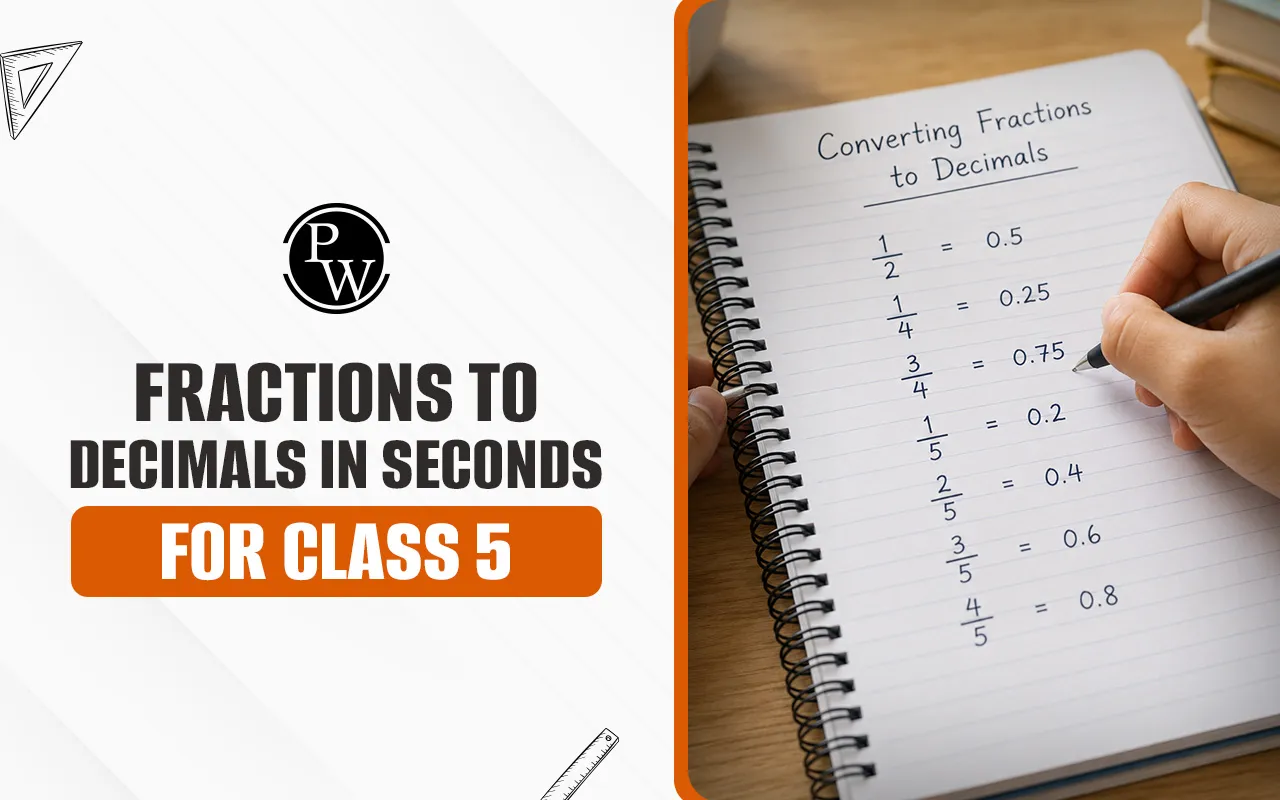
Fractions to Decimals in Seconds for Class 5
 Nikita Aggarwal21 May, 2026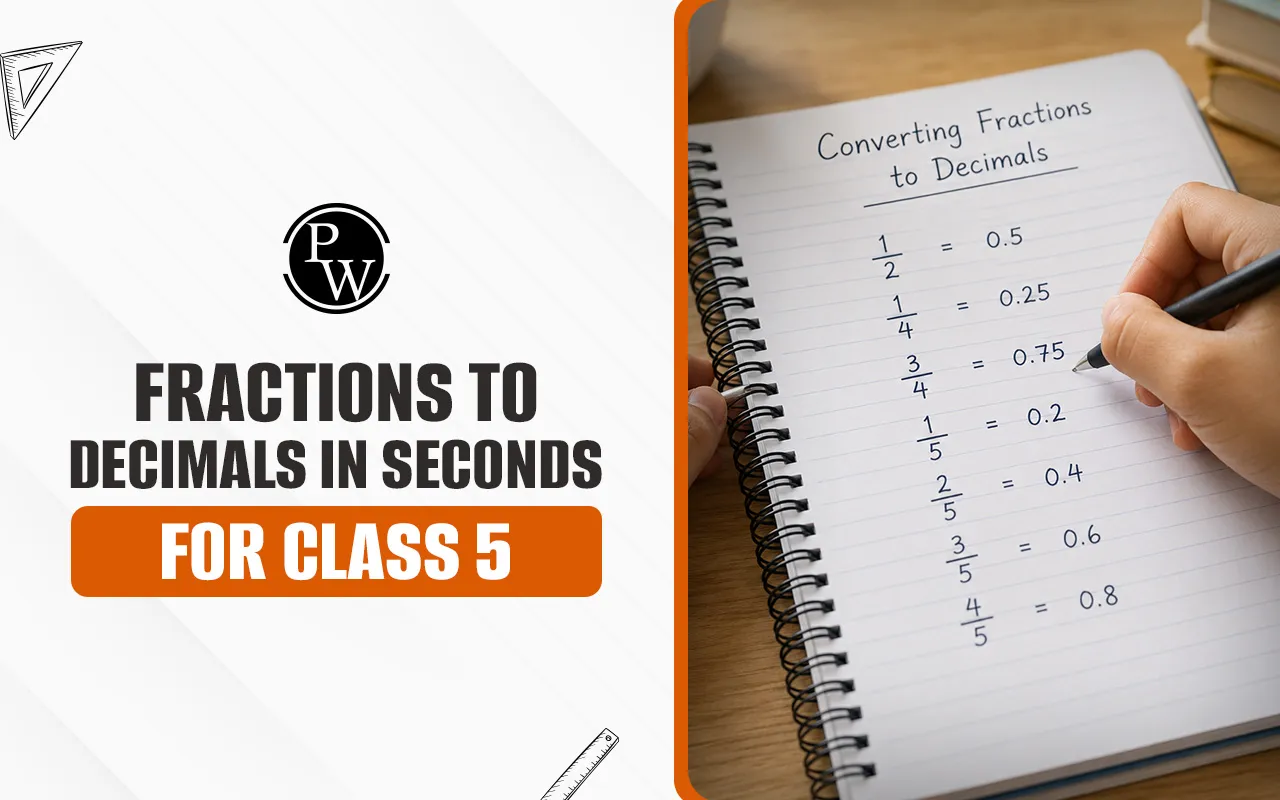
Importance of Fractions to Decimals in Seconds
fractions to decimals in seconds, a note on shortcut approaches for transforming fractions into decimal representations without expending time through extended division. This approach aims to identify common fractional values, equivalent fractions, and simple tricks for instant answers, rather than traditional long division each time. When speed and accuracy are critical in an exam perspective, it is particularly useful.
Practising these can help learners easily generate the decimal equivalents of any fraction (e.g., 1/2, 1/4, or even 3/5) in a matter of seconds. This will not only help you save time but also reduce the chances of calculation errors. This helps in improving overall arithmetic skills and reduces the time taken to solve percentage, ratio, and data interpretation questions.
Tricks for Fractions to Decimals in Seconds
The denominator is the key to quickly calculating fractions. Once you turn that bottom number into 10, 100, or even a thousand, you have already made it effortless. These are the most practical ways to convert decimals that maths experts will tell you.
1. The Denominator 10, 100, 1000 Trick
This is the simplest yet strongest toolset out there. The rule is simple: only move the decimal point.
-
Count the Zeros: Look at how many zeros are in the denominator.
-
Shift Left: Move the decimal point in the numerator to the left so many spaces.
-
Examples:
-
7/10 becomes 0.7 (one zero, one shift).
-
45/100 becomes 0.45 (two zeros, two shifts).
-
125/1000 becomes 0.125 (three zeros, three shifts).
2. The Half (1/2) Trick
Just keep in mind that when you see a 2 at the bottom, every half is 0.5.
-
If the numerator is 1, the answer is 0.5.
-
If the numerator is 3 (3/2), think of it as 1.5.
-
Essentially, you are just dividing the top number by 2 to get your result.
3. The Quarter (1/4) Trick
It is like you are working with money, but instead of making dollars, they are quarters! A quarter is always 0.25.
-
1/4 = 0.25
-
2/4 = 0.5 (because it is the same as 1/2)
-
3/4 = 0.75
-
The Pattern: You add 0.25 for every quarter. Fraction-to-decimal conversion tricks are simple because it is 25, 50, and then back to multiply up (75).
4. The Denominator 5 Tricks
So, if it is 5 in your denominator, you have to make it a 10.
-
Double everything: Multiply both the top and bottom by 2.
-
Example: For 2/5, multiply by 2 to get 4/10. Now, shift the decimal to get 0.4.
-
Example: For 4/5, multiply by 2 to get 8/10, which equals 0.8.
Read More - 10-Second Addition Tricks for Class 6
5. The Divide by 8 Trick
An '8 too low' means divide by 2 three times.
-
Memorise the base: 1/8 is always 0.125.
-
Add it up:
-
2/8 is 0.25.
-
3/8 is 0.375.
-
5/8 is 0.625.
-
Remembering the 0.125 jump is a key part of Vedic maths fractions logic.
7. Common Fractions Trick
Knowing the answer is sometimes the quickest response. This type of question is found very often in mental maths:
-
1/5 = 0.2
-
2/5 = 0.4
-
3/5 = 0.6
-
4/5 = 0.8
Practise Sheet for Fractions to Decimals in Seconds
If you practice these shortcuts until they come naturally, there is no way you can go wrong when converting fractions to decimals! You can practice these exercises using the aforementioned mental methods.
Level 1: The Easy Shifts
-
8/10 = _______
-
67/100 = _______
-
9/100 = _______ (Careful with the zeros!)
-
452/1000 = _______
Level 2: The Multipliers
-
3/5 = _______
-
6/25 = _______
-
11/50 = _______
-
2/5 = _______
Level 3: The Advanced Quarters and Eighths
-
3/4 = _______
-
5/8 = _______
-
1/4 = _______
-
7/8 = _______
Answer Key for Quick Checking:
-
Level 1: 0.8, 0.67, 0.09, 0.452
-
Level 2: 0.6, 0.24, 0.22, 0.4
-
Level 3: 0.75, 0.625, 0.25, 0.875
Read More - Mensuration Tricks Using Mental Maths for Class 8
Things to Remember in Fractions to Decimals in Seconds
These shortcuts for fast fraction calculations are super handy, but you cannot skip accuracy if you follow these few golden rules.
-
The Golden Balance: If you multiply the denominator by 10 or 100, multiply by exactly that same number in the numerator. It is incorrect to multiply something solely by the bottom of the denominator.
-
Watch the Zero Gap: When converting 7/100, remember that two zeros mean two decimal places. Since 7 is only one digit, you must add a zero in front of it: 0.07.
-
Simplify Whenever Possible: Before attempting a decimal conversion, check whether there is scope for this fraction. That is, you already know that 5/10 = 1/2, which itself is equal to 0.50
-
Vedic Visualisation: In Vedic maths, we must imagine the numbers as wholes. Transform 1/4 from a maths problem to a "quarter" of something; for instance, your head instantly goes an easy way, so the response will be 0.25 already!
-
Practice the "Base 10" Mindset: Always reflect on "What is this denominator near to – 10, or a close cousin of that?" For example, when the denominator is 20, you know it equals 100/5, and therefore multiplying by 5.
How Does CuriousJr Help with Class 5 Mental Math?
Class 5 mental maths is not just about rote learning tables; it also requires an interactive setup that brings numbers into play. This is where CuriousJr online mental maths class fits in because it provides structured pathways designed for young brains.
-
Gamified Learning: No one likes those boring calculations, and who wants to learn fractions to decimals in seconds as if it were a difficult task?
-
Bite-Sized Lessons: The platform breaks down complex decimal methods into micro-lessons that fit within students' attention spans.
-
Visual Aids: These interactive tools help students visualise the part-whole relationship, reinforcing key concepts such as mental maths.
-
Logic Over Rote: This approach urges children to think about the "why" behind shortcuts in areas like mathematics, which helps information last longer in memory.
-
Real-World Application: CuriousJr connects maths problems with real-life experiences, helping students see how these skills can assist with shopping, coding, and developing logical thinking.