10-Second Addition Tricks for Class 6
 Nikita Aggarwal21 May, 2026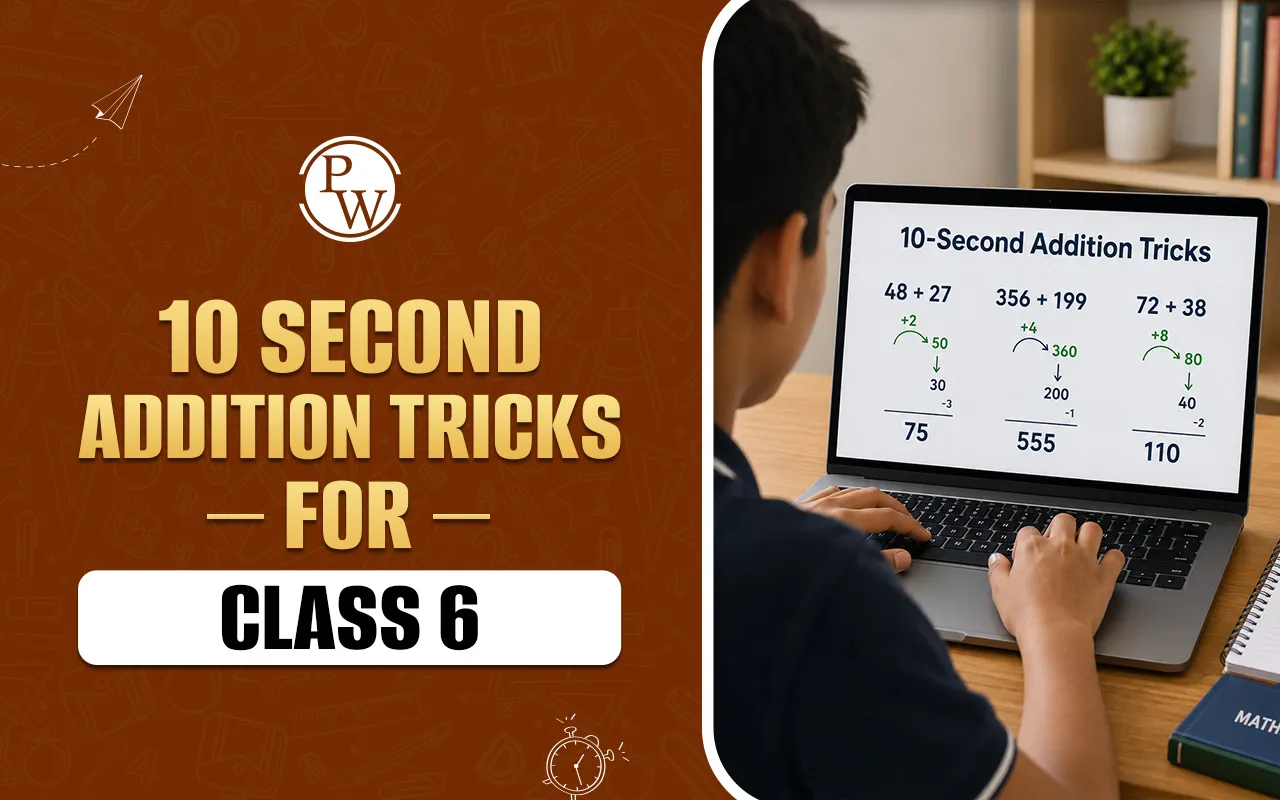
What are Addition Tricks for Class 6?
If you tried to learn how to add numbers when you were first learning in school, it was probably by overlapping the digits of two numbers and starting at one end (typically the right) and moving towards the left. Though this method is very reliable, it is also among the slowest available. Tricks of addition for class 6 are techniques that help you tackle numbers mentally.
These tricks work by exploiting the fact that our brains process "numbers which are easy to remember" — like 10, 50, or 100 — faster than random ones. For example, the number can be as low as 47 and as high as 89. Using fast addition tricks, you can learn to round numbers by breaking them into groups of ten. This method is especially important for sixth graders who are beginning to encounter competitive tests and higher-order word issues that require rapid thought.
7 Best Addition Tricks for Class 6
You need a bunch of tools to learn how you can become a human calculator. So, one trick could be more effective than another, depending on the numbers you study. These are the ultimate fast-addition tricks you need to learn.
1. The Left-to-Right Strategy
We add from right to left on paper, but we read and think from left to right. This trick is how your brain naturally works.
-
How it works: When adding 64 + 25, start with the tens.
-
Add 60 + 20 = 80.
-
Then add the units: 4 + 5 = 9.
-
Total: 80 + 9 = 89.
-
Why it helps: It provides the "headlines" of the answer right away.
Read More - Learn Subtraction without Borrowing (Class 6)
2. The Compensation Method
This method helps to learn more about numbers near multiples of 10 (19, 38, 99, etc.).
-
How it works: To add 58 + 34, treat 58 as 60.
-
Add 60 + 34 = 94.
-
That is when you add 2 to arrive at 60 and then subtract that 2 from the answer.
-
Total: 94 - 2 = 92.
3. Partitioning (Splitting)
Split numbers into expanded forms (hundreds, tens and units). It works very well for Class 6 mental maths with three-digit numbers.
-
How it works: Add 235 + 142.
-
Split them: (200 + 100) + (30 + 40) + (5 + 2).
-
Add the groups: 300 + 70 + 7.
-
Total: 377.
4. Making Tens
The number 10 is the only digit your brain can process faster. Find pairs within the list of numbers that sum to 10.
-
Friendly Pairs: (1,9), (2,8), (3,7), (4,6), and (5,5).
-
Example: Add 7 + 4 + 8 + 3 + 6 + 2.
-
Group them: (7+3) + (4+6) + (8+2).
-
Total: 10 + 10 + 10 = 30.
5. The "Jumping" Method
Leave the first number as is, "jumping" with parts of the second. This is a widely used technique in Vedic maths.
-
Example: 56 + 38.
-
Start at 56. Jump by the tens of 38: 56 + 30 = 86.
-
Now jump by the remaining units: 86 + 8 = 94.
6. Double and Adjust
This technique is to be used only when the numbers are very close. If you know your doubles, the answer is basically immediate.
-
Example: 25 + 26.
-
Think: (25 + 25) + 1.
-
Total: 50 + 1 = 51.
-
Example 2: 49 + 51.
-
Think: 50 + 50 = 100.
Read More - Why Many Students Face Multiplication Problems in Class 6
Addition Tricks Practice Questions
Try out your new skills. Again, you should try to solve these using the tricks above instead of writing them down.
Mental Addition Challenges
-
Add 72 + 17 using the left-to-right method.
-
Add 39 + 45 using the compensation method.
-
Add 124 + 312 using partitioning.
-
Add 8 + 6 + 2 + 4 using the Making Tens method.
-
Add 66 + 67 using the Double and Adjust trick.
Fill in the Blanks (Speed Round)
-
To add 98 + 45 quickly, I can add 100 + 45 and then subtract __________.
-
The "friendly pair" for the number 7 to make a ten is __________.
-
In the partitioning method, 543 is split into 500 + __________ + 3.
-
Adding from __________ to __________ is often faster for mental calculation than the traditional way.
-
If I add 25 + 24, I can double 25 and subtract __________.
Multiple Choice Questions (MCQs)
Q1. What is the most efficient way to add 199 + 350?
a) Traditional carry-over
b) Compensation (200 + 350 - 1)
c) Partitioning
d) Jumping
Q2. Using the Making Tens strategy, what is the sum of 5 + 3 + 5 + 7 + 2 + 8?
a) 25
b) 28
c) 30
d) 32
Q3. Which method involves keeping the first number whole and adding the tens of the second number first?
a) Partitioning
b) Doubling
c) Jumping
d) Vedic Spark digit
Q4. What is the mental sum of 85 + 47 using left-to-right addition?
a) 122
b) 132
c) 142
d) 112
Q5. If a sum is 15, which digit do you keep in your mind for the next step?
a) 1
b) 10
c) 5
d) 15
Benefits of Addition Tricks for Class 6
What are these methods, and why should you learn them when the calculator is available? These are related to the overall maturation of your brain as well as to how you ended up doing.
-
Reduces Exam Anxiety: If you can perform fast maths, you do not freak out when seeing a lengthy paper. You might spend less time on basic maths and more on tricky questions.
-
Eliminates Carry-over Errors: This is one of the most common errors committed in Class 6 maths, where a student forgets to "carry the 1". Mental tricks skip this step completely.
-
Sharper Memory: This is very helpful if you not only practise mental maths class 6 but also memory retention in other subjects like science and English.
-
Real-world Readiness: If you were at a store counting coins or needed to sum up points in an ongoing football match, a hand with stacks of papers and pens isn't always available. These tricks are life skills.
-
Number Fluency: You begin to recognise numbers as collections rather than just symbols. This really helps a lot when it comes time to learn algebra.
How Does CuriousJr Help with Class 6 Mental Maths?
It takes practice to master those tricks, and CuriousJr online mental maths classes give you a great reason to make that practice fun. In place of a textbook, students engage with tools crafted for the 21st-century learner.
-
Gamified Practice: Turn squares for class 6 tricks in addition into challenges where you can boost speed and accuracy with rewards.
-
Visual Learning: The platform's visual number bonds show how numbers split to form new ones, providing a visual representation of Vedic addition.
-
Progress Reports: These show you how well your calculation speed is improving from one day to another—something that also motivates you to learn the things even more.
-
Bite-sized Lessons: No complex strategy is missed by training you on small pieces; deliver dozens of strategies in 2-minute videos and teach one trick at a time; therefore, it never feels overwhelming.