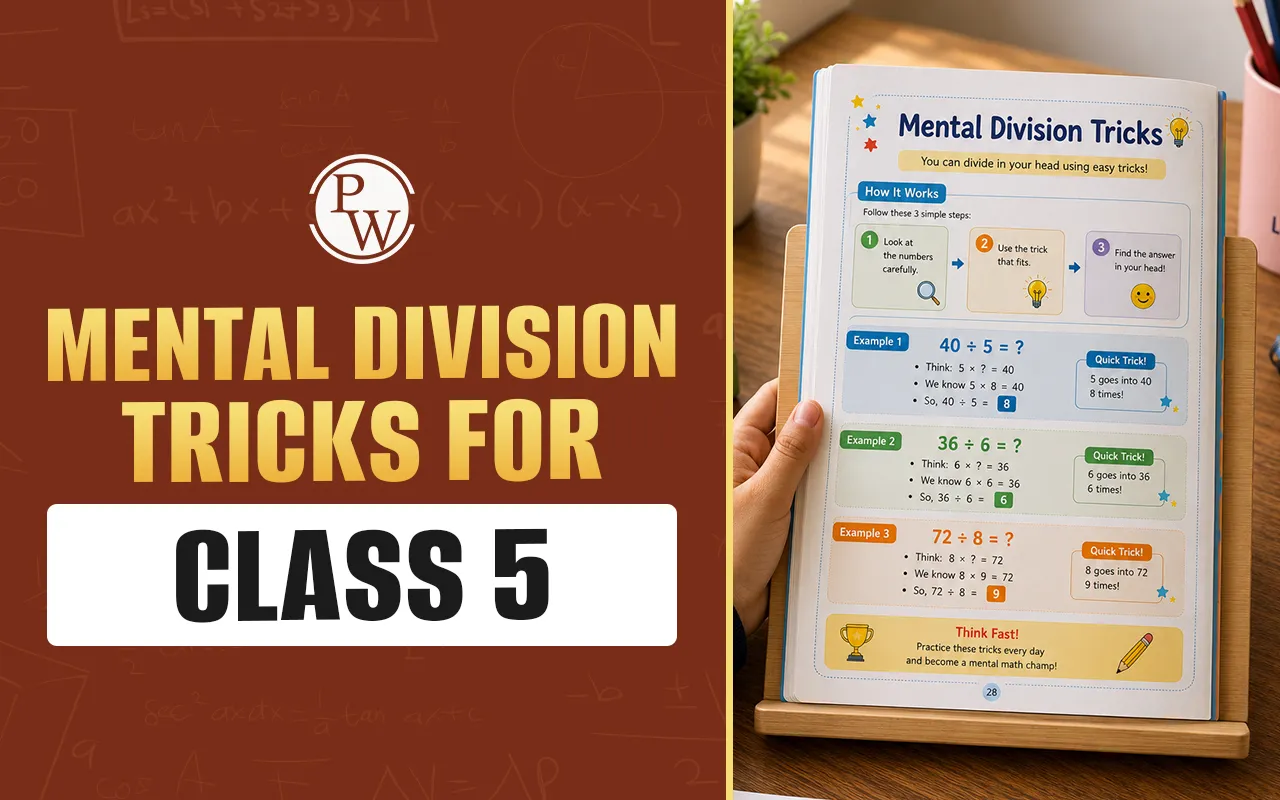
Mental Division Tricks for Class 5
 Nikita Aggarwal21 May, 2026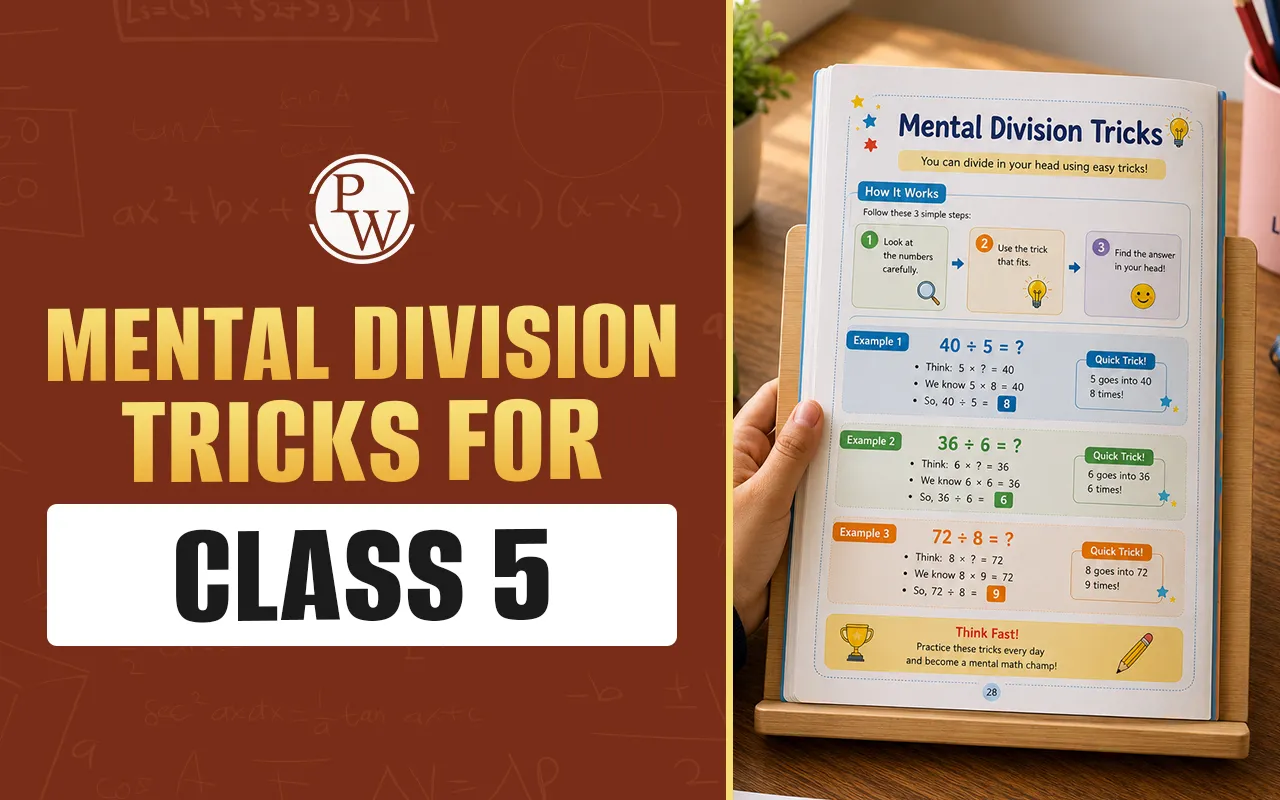
What are Division Tricks?
Division is the act of dividing a whole number into equal parts. The concept is simple, but the numbers in Class 5 begin to increase, and occasionally the numbers are three or four digits long. Division tricks class 5 are mental strategies a student can use to skip the long division process.
These tricks are based on the core idea of Vedic maths: viewing numbers as flexible entities and not blocks. Rather than estimating how many times the divisor is contained in the dividend, these hacks employ logic, such as doubling, halving, or decomposing a number into friendly factors.
The aim of mental maths division is to build up “number sense”, for example, recognising patterns and relationships between numbers. Once a pupil has learnt these fast division tricks, they won't spend as much time learning how to write the answer and more time on the reasoning behind the question.
Best Division Tricks Class 5
A set of math strategies is a toolkit that is necessary for becoming a math expert. One of the hacks may be quicker than the other, depending on what numbers you're working with. Class 5 learners should practice these most effective techniques.
The Divided by 10, 100, and 1000 Shortcut
This method is the greatest time saver! You don't have to "calculate" anything when you divide by 10, 100 or 1000. It's just a matter of moving the decimal to the left according to the number of zeros in the divisor.
-
Divide by 10: Shift decimal point 1 place to the left
-
Divide by 100: Move the decimal point two places to the left.
-
Divide by 1000: Move the decimal point three places to the left.
Example:
-
560 / 10 = 56
-
4200 / 100 = 42
-
8000 / 1000 = 8
The Factor Break Trick
Occasionally, it is difficult to divide by a large number, but easier to divide by two smaller numbers. The factor-break trick consists of factoring the divisor.
-
Step 1: Find two numbers that multiply to give you your divisor.
-
Step 2: Divide the dividend by the first factor.
-
Step 3: Divide that result by the second factor.
Example: Divide 144 by 12.
Instead of the 12 times table, use factors 3 and 4 (since 3 x 4 = 12).
144 / 3 = 48
48 / 4 = 12
The answer is 12. This is much easier to work out mentally!
The Split Smartly Trick
When a dividend is too large to be divided, it can be divided into two factors that are readily divisible by the divisor. This calculation is an integral part of fast division tips.
Example: Divide 135 by 5.
-
Split 135 into 100 and 35
-
100 / 5 = 20
-
35 / 5 = 7
-
Add the results: 20 + 7 = 27
It can be applied to nearly any number. For 168/6, you could split 168 into 120 and 48. Since 120 / 6 = 20 and 48 / 6 = 8, the answer is 28.
The Quotient Check Trick
The one thing that you might worry about in mental maths is whether your answer is correct. Using the quotient check trick, we verify that the work is done by multiplication.
-
The Rule: Divisor x Quotient + Remainder = Dividend.
-
If you divided 25 by 4 and got 6 with a remainder of 1, check it: (4 x 6) + 1 = 25.
-
If the numbers match, your division is perfect.
Dividing by 5: The Double and Drop Rule
Popular Vedic Math Division Trick. Since 5 is half of 10, dividing by 5 is the same as doubling the number and then dividing it by 10
-
Step 1: Multiply the number by 2
-
Step 2: Move the decimal point one place to the left (divide by 10)
Example: 145 / 5
-
Double 145 = 290
-
Drop the zero (move decimal) = 29
Read More - Fractions to Decimals in Seconds for Class 5
Practice Sheet for Division Tricks Class 5
Practice is what turns a “trick” into a skill. Try to solve these problems using the specific rapid division tricks mentioned above. Try to avoid using a pencil and paper for the actual calculation.
Set A: Shortcut for 10, 100, 1000
-
950 / 10 = ____
-
7400 / 100 = ____
-
12000 / 1000 = ____
-
45 / 10 = ____
Set B: The Factor Break Trick
-
168 / 12 = ____ (Hint: Use factors 6 and 2.)
-
144 / 16 = ____ (Hint: Use factors 4 and 4.)
-
210 / 14 = ____ (Hint: Use factors 7 and 2.)
Set C: Split Smartly Method
-
126 / 3 = ____ (Split into 120 and 6)
-
448 / 4 = ____ (Split into 400 and 48)
-
515 / 5 = ____ (Split into 500 and 15)
Set D: Double and Drop (Dividing by 5)
-
32 / 5 = ____
-
110 / 5 = ____
-
421 / 5 = ____
(Answers: Set A: 95, 74, 12, 4.5; Set B: 14, 9, 15; Set C: 42, 112, 103; Set D: 6.4, 22, 84.2)
Read More - 10-Second Addition Tricks for Class 5
Benefits of Division Tricks Class 5
Learning division tricks in Class 5 is not just about speed. It alters how the brain of a student processes mathematical information.
-
Reduces Exam Stress: When a student knows they can solve 850 / 5 in 5 seconds, they don’t panic when they see a long word problem. Quick division tricks serve as a safety net.
-
Improved Concentration: Mental maths requires keeping numbers in your head. This helps across the board, not just in maths, since it builds working memory and attention.
-
Logical Reasoning: Techniques such as the “Factor Break” or “Split Smartly” help students develop the ability to find relationships between numbers. This type of reasoning is the basis for the algebra and geometry you will study in later grades.
-
Competitive Exam Preparation: Olympiads and entrance exams are often won by students who can do calculations fast. Vedic maths gives the students a great edge over students using traditional methods.
How Does CuriousJr Help with Class 5 Mental Maths?
CuriousJr online mental maths classes make learning maths easier and fun for students with the best study materials and resources:
-
Interactive Learning: Students play with digital tools that show how numbers move rather than reading rigid rules. For example, they can see the decimal point "jump" when they are practising the "divided by 10, 100, 1000" shortcut.
-
Personalised Practice: Each child has their own “ah-ha” moment. CuriousJr has practice problems that adjust to a student's skill level, so a student learns the split-smartly trick before moving on to harder Vedic maths.
-
Visuals: Division is a concept many students struggle with because they can’t “see” it. CuriousJr uses visual aids to illustrate the factor-break trick so that visual learners can see how a divisor is broken apart.
-
Immediate Feedback: One of the best ways to learn mental maths is to get immediate feedback on whether you are right or not. CuriousJr provides instant corrections and explanations so students don’t repeat the same mistakes.