10-second addition tricks for Class 7
 Nivedita Dar15 May, 2026
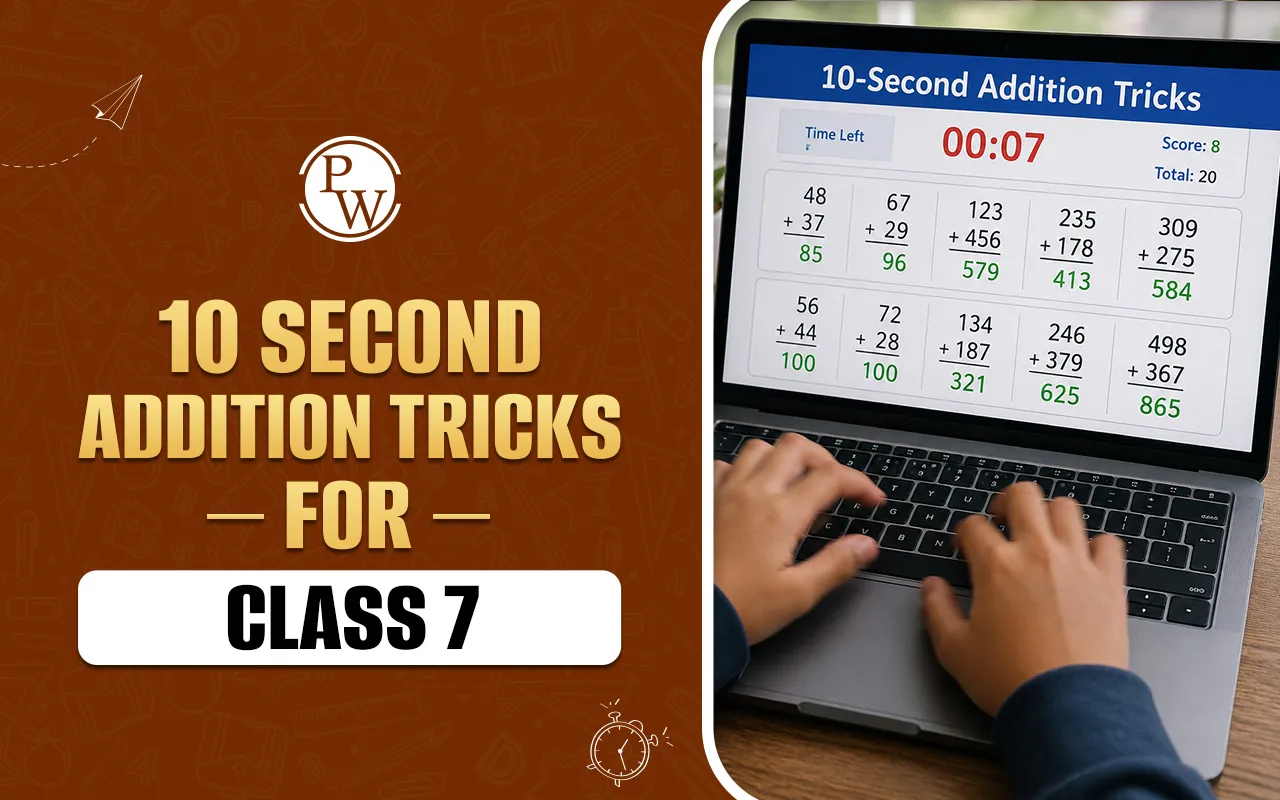
Mathematics can be like a race against time, and most of the time when you take a timed exam, a long list of sums confronts you. When you find yourself tallying on your fingers or scratching your head over columns of figures, you are not alone. By learning the addition tricks for class 7, you can become a fast calculator and a master of mental mathematics.
As this guide will explain, certain tricks can turn you into a slow calculator, into a mental expert at maths, making your homework quicker and your exams far easier to handle.
Addition tricks for Class 7 overview
In the higher secondary level of education, the difficulty of mathematical problems will grow. You are no longer adding simple integers, but you're working with decimals, percentages and algebraic expressions where the basic arithmetic is only part of a bigger problem.
Taking 2 minutes to do a simple arithmetic operation is illogical for the question. By teaching your brain to learn quick addition tricks, you'll be able to concentrate on the "why" of the problem instead of the "how" of the arithmetic. Efficiency in calculating is a basic skill that is essential for being a successful student and is a key differentiator for high-performing students in the class. It develops number fluency to allow you to see what you need to do before raising a pencil to paper.
Here are some 10-second addition tricks for Class 7
Addition can be quickly mastered using a toolkit of strategies such as the left-to-right method and maths addition to round. Such techniques as decomposition, finding ten-pairs, and near-doubles are useful in the simplification of large numbers. Compensation of decimals and division of numbers aims to make friendly totals and make mental calculations quick and easy.
The Left-to-Right Addition method
In primary school, most of us are taught to add right to left and to carry numbers over in the process. Although this technique is very effective on paper, it is in fact very sluggish at mental calculations. Adding left to right is one of the best methods of doing mental maths.
How it Works
Through your brain, when you see numbers, your brain naturally reads them in a left-to-right pattern (hundreds, then tens, then units). In putting in this order, you work out the greatest parts of the number first.
Example: Add 45 + 38
-
Step 1: Do you see tens in place? 40 + 30 = 70
-
Step 2: Consider the units place. 5 + 8 = 13
-
Step 3: Combine them. 70 + 13 = 83.
This technique eliminates confusion about carrying over by creating the number as you progress.
The "Rounding" Technique
Vedic maths addition provides an outstanding method for simplifying numbers that are relatively close to a multiple of ten. This is referred to as the "give and take" technique or the rounding trick. It is very handy when a number ends in 7, 8, or 9.
The Rounding Method Steps:
-
Find the nearest multiple of ten (e.g., 19, 28, 37).
-
Round up that number to the nearest ten.
-
Subtract the other value with the rounded number.
-
Take the difference between what you added when you were rounding.
Example: 56 + 29
-
29 is very close to 30.
-
Add 56 + 30 = 86.
-
Now add -1, since you added 1 more to make 29 into 30.
-
86 - 1 = 85.
Using this trick makes fast addition tricks feel automatic because adding multiples of ten is something our brains do almost instantly.
Read More - Learn Subtraction without Borrowing (Class 1)
Breaking down Larger Numbers
When faced with three-digit numbers, breaking down large numbers is a useful tool. It keeps the mental load light.
-
Step 1: Break both numbers into hundreds, tens, and units.
-
Step 2: Add the hundreds, then the tens, and then the units.
-
Step 3: Sum the totals.
Example: 245 + 132
-
Hundreds: 200 + 100 = 300.
-
Tens: 40 + 30 = 70.
-
Units: 5 + 2 = 7.
-
Final: 377.
Finding perfect pair that make ten
One of the quickest ways to improve mental maths class 7 skills is to recognise "ten pairs". Scan a list of numbers to find "ten pairs" first. This "bridges" your way to the next multiple of ten
Common Ten-Pairs:
-
1 and 9
-
2 and 8
-
3 and 7
-
4 and 6
-
5 and 5
Example: 7 + 4 + 3 + 2 + 6
-
Identify pairs: (7+3) and (4+6).
-
Calculation: 10 + 10 + 2 = 22.
By scanning for these pairs, you reduce the number of individual operations your brain has to perform.
Adding Multiples of 100
When adding numbers like 300 and 500, ignore the zeros and add the first digits. This is a fast addition tricks used in addition
-
Step 1: Identify the non-zero digits (3 and 5).
-
Step 2: Add 3 + 5 = 8.
-
Step 3: Place two zeros at the end to get 800.
Read More - Speed Maths Test for Class 8 (Try Now)
Adding 9 by Adding 10
Whenever you see a 9, don't add it. Add 10 and then take away 1. It is much faster for your brain to process.
Example: 74 + 9
-
Think: 74 + 10 = 84.
-
Subtract 1: 83.
Balancing Large Sums
When adding numbers like 98 + 47, move 2 from 47 to 98 to make it a perfect 100.
-
Step 1: Identify the 98 needs 2.
-
Step 2: The 47 becomes 45.
-
Step 3: 100 + 45 = 145.
Practice Plan for Quick Addition Tricks for Class 7
Here are a few tips to get better at mental maths –
-
Start with 5 sums every day using the left-to-right method.
-
Practise rounding numbers that end in 8 or 9.
-
Look for pairs that make 10 in every number list.
-
Try adding grocery bills, page numbers or scores mentally.
-
Time yourself once a week to check whether your speed is improving.
Benefits of Addition tricks for class 7
Why do you ever bother to learn how to add numbers fast when there are calculators everywhere? The solution is in cognitive development. When you are able to do mental arithmetic in a short time, you can free up brain space to concentrate on the logical aspect of a problem.
-
Improved Confidence: The ability to shout out an answer prior to others opening their notebooks fosters a good rapport with numbers.
-
Better Exam Performance: The speed is an enormous element of competitive tests. Each second saved on an effortless amount would be a second saved on a challenging word problem.
-
Real-World Utility: Whether it is calculating discounts in a shop or splitting a bill with friends, addition is one of the skills in life that you will use on a daily basis.
-
Cognitive Agility: Mental maths is like a brain workout, and recent research has shown that performing mental maths helps to stimulate the brain's memory and concentration.
How CuriousJr Helps with Class 7 Mental Maths?
With CuriousJr's specialised learning tools, Mental Maths Class 7 is fun! CuriousJr online Mental Maths classes offer to students interactive materials on Vedic maths addition and logic puzzles so that they can visualise numbers and don't memorise. They do this work by developing a ‘maths superpower' in the following ways:
-
Easy Step-by-Step Learning: The course builds on zero-level foundations (number bonds, for example) to more complex operations such as multiplication and division.
-
Interactive Activities: Puzzles, sequencing and memory games make practice fun, not a chore.
-
Personalised Attention: One-to-one support and homework help from mentors, filling in learning gaps as they arise.
-
Performance Tracking: Parents and students can observe improvements in speed and accuracy with daily quizzes & progress insights.
-
Over 50 Maths Tricks: The program covers a vast range of shortcuts that are applicable both in school exams and everyday situations.