What are Double Angle Formulas with Examples
 Nikita Aggarwal30 Mar, 2026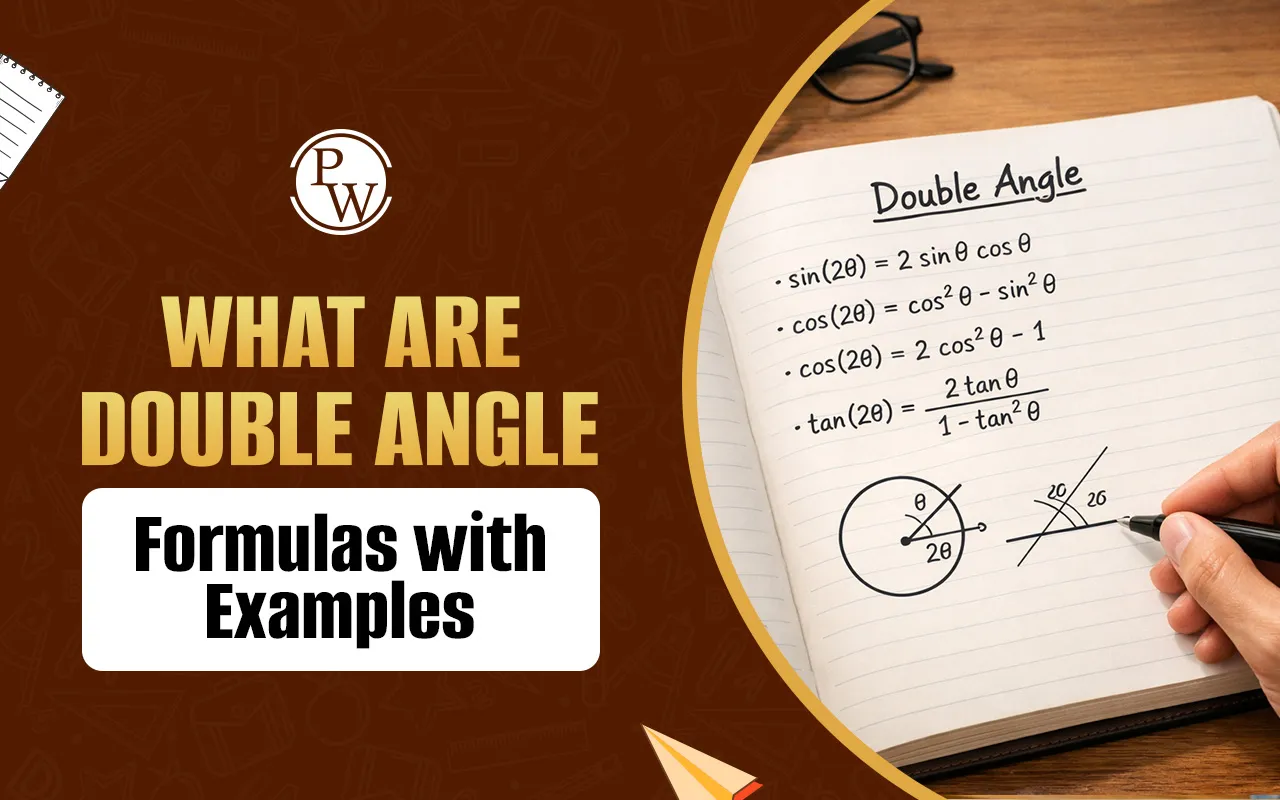
What Are Double Angle Formulas?
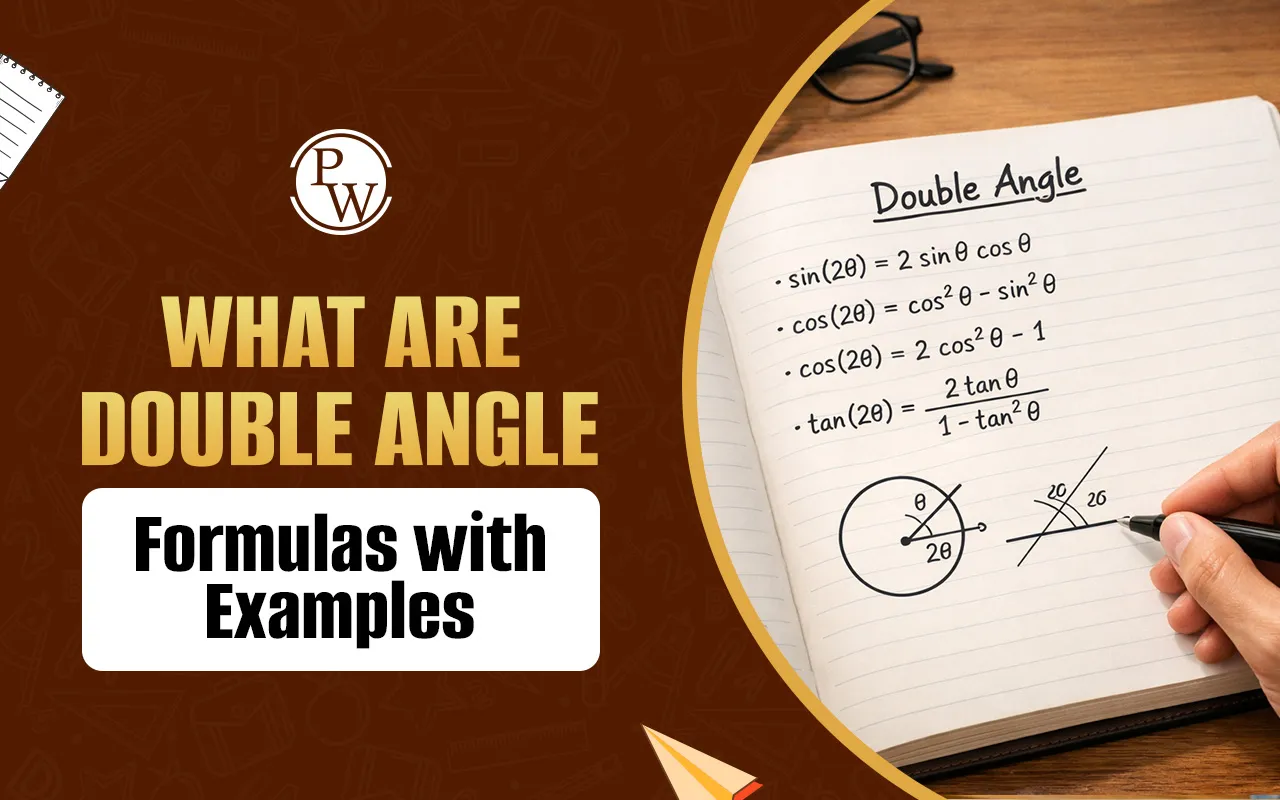
In trigonometry, double angle formulas definition refer to identities that represent trigonometric functions of 2θ in terms of functions of θ. These are special cases of the sum formulas. These shortcuts help students to decrease the power of a trigonometric expression or evaluate an expression for non-standard angles without the use of a calculator.
Double Angle Formulas for Students
When learning double angle formulas in maths, you’ll mainly work with three core functions. Each one looks slightly different and is useful in its own way.
1. The Sine Double Angle Formula
This is the most straightforward of the set. It converts the sine of a double angle into a simple product of the single angle's sine and cosine.
-
Identity: \sin(2\theta) = 2 \sin\theta \cos\theta
2. The Cosine Double Angle Formula
The cosine version offers three variations. There is a requirement if one knows the sine value or the cosine value. In the best scenario, one may already know both.
-
Base Version: cos(2θ) = cos²θ – sin²θ
-
Cosine-Only Version: cos(2θ) = 2 cos²θ – 1
-
Sine-Only Version: cos(2θ) = 1 – 2 sin²θ
3. The Tangent Double Angle Formula
This formula is particularly useful in coordinate geometry and calculus when dealing with the slopes of lines or tangents to curves.
-
Identity: tan(2θ) = (2 tan θ) / (1 – tan² θ)
Alternate Forms and Applications
In addition to the standard formulas, double angle identities can also be expressed using tangent:
-
Sine: sin(2θ) = (2 tan θ) / (1 + tan² θ)
-
Cosine: cos(2θ) = (1 – tan² θ) / (1 + tan² θ)
This particular form of the equation proves useful because it allows for calculations based purely on tan values without requiring any knowledge of sin or cos values.
Applications: Double angle formulae are used to make expressions simpler, solve integrals, and establish other identities like triple angle formulae. They can be used to find unknown values in coordinate geometry and physics. The variations of double angle formulae need to be practiced to solve problems quickly. This will make them simpler to answer in an examination.
Double Angle Formulas Examples and Solutions
To understand how these concepts work in actual situations, you will have to look at double-angle formulas examples, which students typically appear in their school and college assessments.
Example 1: Calculating Sine Values
Problem: Given that cosθ = 4/5 and the angle is in the first quadrant, find the value of sin(2θ).
Solution Steps:
-
Find Sine: Using the identity sin²θ + cos²θ = 1, we find that sinθ = 3/5.
-
Apply Formula: sin(2θ) = 2 sinθ cosθ.
-
Substitute: 2 × (3/5) × (4/5) = 24/25.
-
Result: sin(2θ) = 0.96.
Example 2: Finding Tangent of a Double Angle
Problem: If tanθ = 1/2, find the value of tan(2θ).
Solution Steps:
-
Apply Formula: tan(2θ) = (2 tanθ) / (1 - tan²θ).
-
Substitute: (2 × 0.5) / (1 - (0.5)²).
-
Simplify: 1 / (1 - 0.25) = 1 / 0.75.
-
Result: tan(2θ) = 4/3.
Read More - Function Formulas – List of Key Function Formulas
Summary Table of Identities
|
Trig Function |
Standard Double Angle Formula |
Key Alternative Form |
|
Sine |
2 sin θ cos θ |
(2 tan θ)/(1 + tan² θ) |
|
Cosine |
cos²θ – sin²θ |
2 cos²θ – 1, 1 – 2 sin²θ, (1 – tan² θ)/(1 + tan² θ) |
|
Tangent |
(2 tan θ)/(1 – tan² θ) |
N/A |
Read More - Rectangle: Definition, Formula and Examples
Common Mistakes to Watch Out For
-
Sign Errors: In the tangent formula, the denominator is 1 - \tan^2\theta. Do not confuse this with the denominator for the sine-tangent identity, which uses a plus sign.
-
Misplacement of 2: Most people get this wrong: they think that \sin(2\theta) = 2\sin\theta, which is not true. This is not right. You don't multiply with the 2, it's used as a coefficient for the sum of sine and cosine.
-
Ignoring Quadrants: Always check which section the angle is in when going from a double angle to a single angle. The answer to this question tells you whether your result should be good or negative.
Being proficient in these identities is the first step for any student looking to succeed in advanced mathematics. Dividing a line like this yields simpler linear equations for numerical solutions and produces a proof problem.
Make Maths Simple and Fun with CuriousJr
CuriousJr helps children develop a strong foundation in maths by reducing fear and building confidence. Our Mental Maths online classes for students from Classes 1 to 8 focus on improving speed, accuracy, and logical thinking through easy techniques and interactive learning.
With a dual-mentor approach, students attend engaging live classes and get dedicated support for doubt-solving after each session. Animated lessons, fun activities, and exciting challenges make maths easy to understand and enjoyable to learn.
Parents receive regular progress updates and review sessions, ensuring full transparency in their child’s learning journey.
Book a demo class today and see how CuriousJr makes maths simple, engaging, and confidence-building for your child.