Difference Between Cube and Cuboid
 Nikita Aggarwal30 Mar, 2026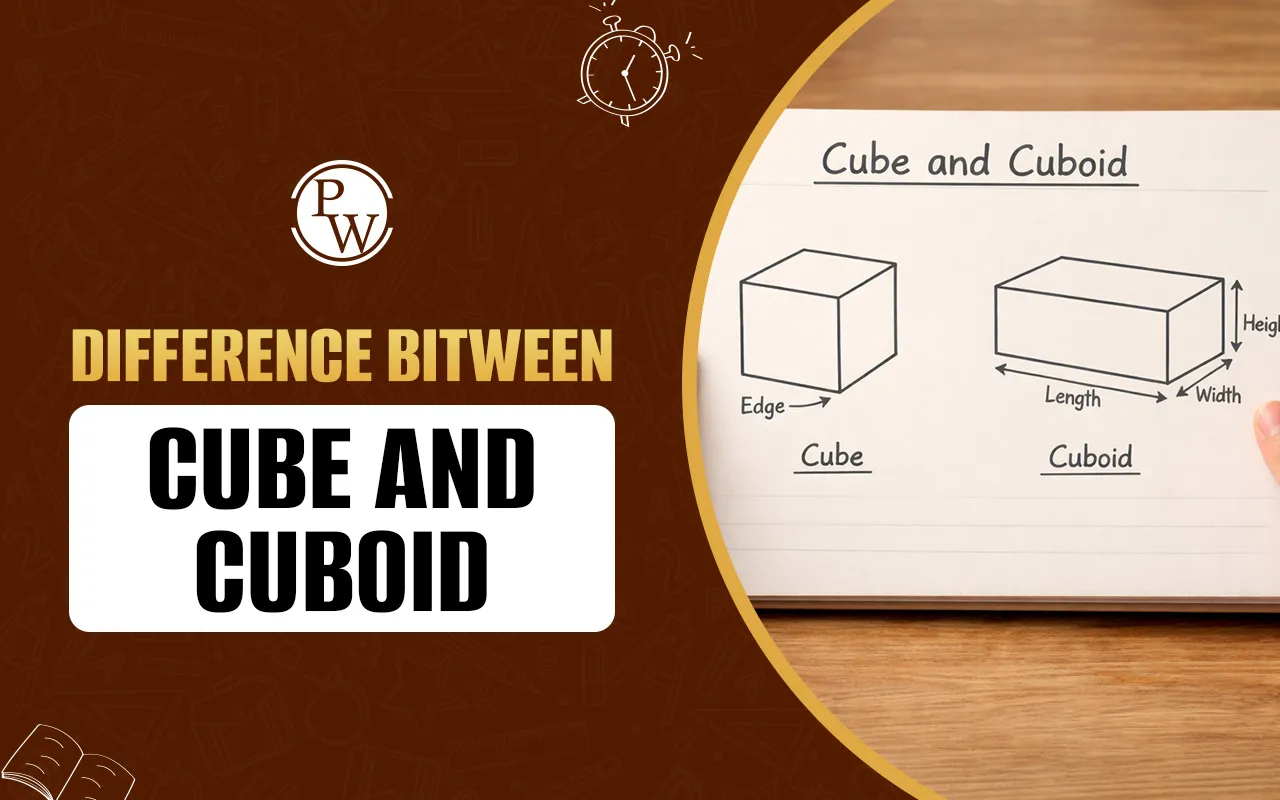
What is a Cube?
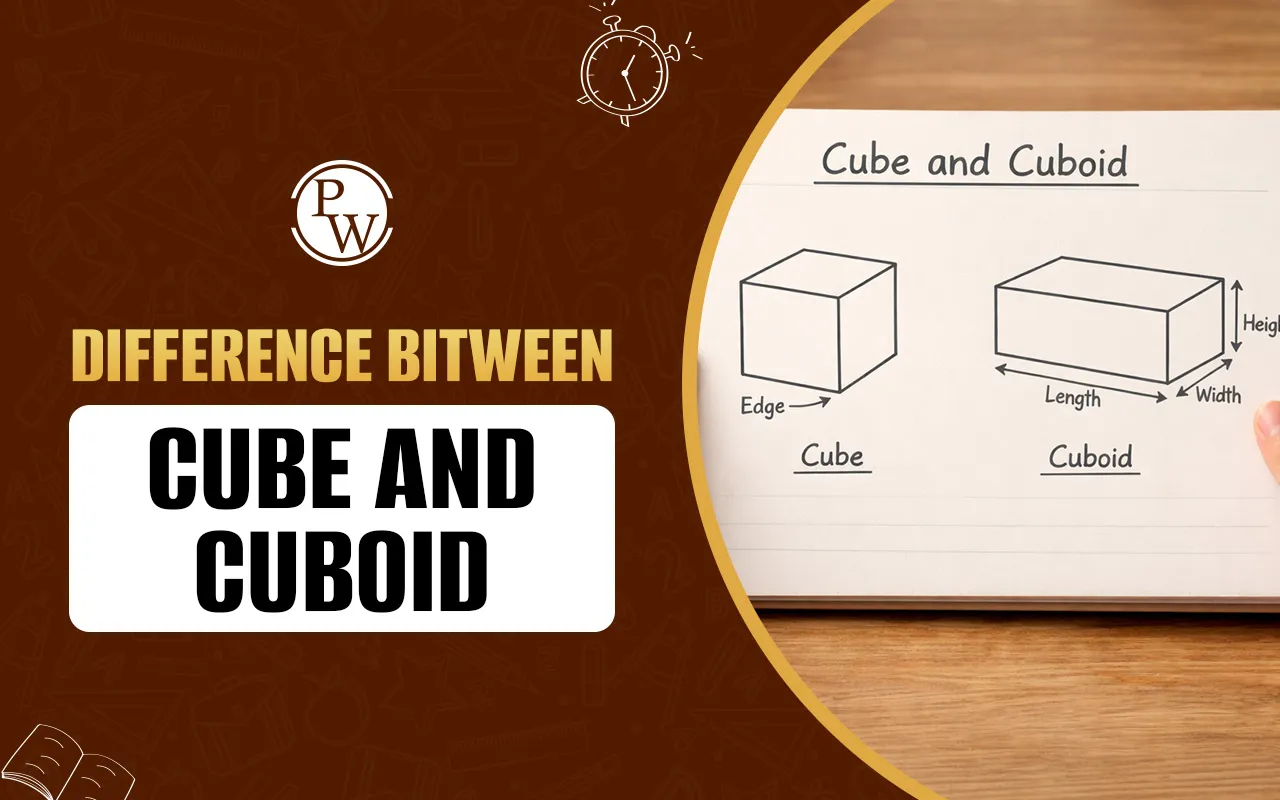
A cube is a three-dimensional solid shape bounded by six square faces. The most important thing to remember about a cube is that every single one of its sides is exactly the same length. Because all faces are squares, the length, width, and height are identical.
-
Example: A standard playing dice or a Rubik's cube.
What is a Cuboid?
A cuboid is also a three-dimensional solid, but its faces are rectangles. In a cuboid, the opposite faces are equal, but the overall length, width, and height are usually different. While a cube is perfectly symmetrical, a cuboid is often stretched out.
-
Example: A brick, a cereal box, or a pencil case.
Read More - Difference Between Percentage and Percentile, Rules, Examples
Properties of a Cube and Cuboid
While they share some traits, the physical dimensions are what set them apart. Use this table to see the cube vs cuboid comparison clearly.
|
Feature |
Cube |
Cuboid |
|
Shape of Faces |
All 6 faces are Squares. |
All 6 faces are Rectangles. |
|
Side Lengths |
All sides are equal (Length = Width = Height). |
Sides can be different (Length, Width, and Height vary). |
|
Symmetry |
Highly symmetrical in all directions. |
Less symmetrical; stretched appearance. |
|
Diagonal Lengths |
All 4 space diagonals are equal. |
All 4 space diagonals are equal. |
|
Relationship |
A cube is a special type of cuboid. |
A cuboid is not necessarily a cube. |
Difference Between Cube and Cuboid with Examples
To truly understand what is the difference between cube and cuboid, let’s look at how we measure them in real life.
The Dice vs The Matchbox
If you measure a dice, you might find it is 2 cm long, 2 cm wide, and 2 cm high. Because all numbers are the same, it is a cube. However, a matchbox might be 5 cm long, 3 cm wide, and 1 cm high. Since the numbers are different, it is a cuboid.
Volume and Formulas of Cube and Cuboid
The math we use also changes based on their sides:
-
Volume of a Cube: Side x Side x Side.
-
Volume of a Cuboid: Length x Width x Height.
Read More - Numerator and Denominator: Definition and Difference
How to Identify Cube or Cuboid?
When you are looking at a 3D object, ask yourself these three questions:
-
Are all the faces flat? (Both have flat faces).
-
Are all the edges the same length? (If yes, it is a cube).
-
Are the faces shaped like rectangles or squares? (Squares mean cube; rectangles mean cuboid).
Remember, every cube is technically a cuboid because a square is a special type of rectangle. But not every cuboid can be a cube!
Make Maths Simple and Fun with CuriousJr
CuriousJr helps children develop a strong foundation in maths by reducing fear and building confidence. Our Mental Maths online classes for students from Classes 1 to 8 focus on improving speed, accuracy, and logical thinking through easy techniques and interactive learning.
With a dual-mentor approach, students attend engaging live classes and get dedicated support for doubt-solving after each session. Animated lessons, fun activities, and exciting challenges make maths easy to understand and enjoyable to learn.
Parents receive regular progress updates and review sessions, ensuring full transparency in their child’s learning journey.
Book a demo class today and see how CuriousJr makes maths simple, engaging, and confidence-building for your child.