Zero Divided by a Number
 Amit Lingwal19 Jan, 2026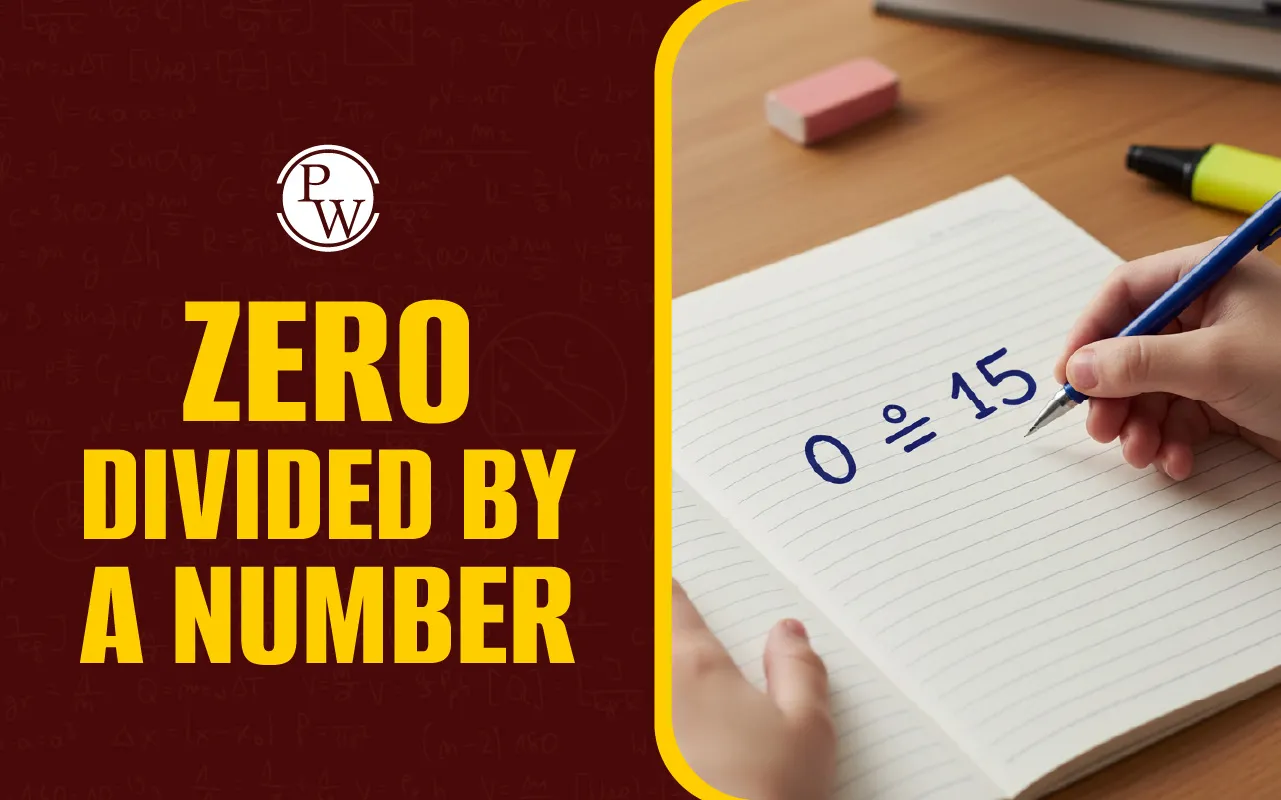
]Zero divided by a number: Division is one of the most basic operations in mathematics. But students can often get confused when zero is involved in the division process. What happens when zero is divided by any number, or what is the result if a number is divided by zero?
These are not just tricky questions or classroom puzzles for learners but also link to some important concepts in mathematics including high-level math. Here, we will clarify the concept of zero divided by any number, or dividing a number by zero through applicable rules so that students can handle any math problems involving zero division accurately and confidently.
What is Zero Divided by Any Number?
The concept of division states that it is the process of splitting a number into equal parts.
For example: 20 ÷ 4 = 5
In other way, we can write: 20 = 4 x 5
There can be instances when zero is divided by any number other than zero.
It can be written as 0 ÷ n where n is a non-zero number.
Therefore, we have to find the number which gives the value of zero when multiplied with n.
The answer is always zero.
For example,
0 ÷ 3 = 0, because 3 x 0 = 0
0 ÷ 56 = 0, because 56 x 0 = 0
0 ÷ 999 = 0, because 999 x 0 = 0
It applies the basic concept of zero property of multiplication which states that
a x 0 = 0, where a is any number.
So, the rule is: Zero divided by any number (except zero) is always zero.
This makes sense because if we have nothing (zero) and we try to share it among any number of groups, each group will receive nothing.
Read More: Math Quotes to Motivate Every Student
What is a Non-zero Number Divided by Zero?
There can be another possibility - what if we divide a nonzero number by zero?
It can be written as n ÷ 0 where n is a non-zero number
According to the definition of division, it means we have to find a number p such that 0 x p = n
But as per zero property of multiplication, whenever we multiply any number with zero, the result is always zero as per the zero property of multiplication. So, no number p exists that satisfies this condition.
Therefore, we can say: Any number divided by zero is undefined.
Examples:
-
7 ÷ 0 is Undefined
-
−100 ÷ 0 is Undefined
-
2500 ÷0 is Undefined
Read more: Successor and Predecessor
What is Zero Divided by Zero?
It can be written as: 0 ÷ 0
Using the definition of division, we are looking for a number m such that:
0 x m = 0
This condition is true for every possible number.
For example:
-
0 × 2 =0
-
0 x 142 = 0
-
0 x (−60) = 0
This means the result could be any number. Since we can’t get any definite values, the result is indeterminate.
So, we can say, Zero divided by zero is indeterminate.
Read More: Is My Child Losing Interest in Maths?
Key Points about Zero Division
-
When we divide zero by a number, the answer is zero.
-
When a number is divided by zero, the result is undefined as no number exists that can satisfy the condition.
-
When zero is divided by zero, any number satisfies it, creating indeterminate solutions.
Read More: Quick Calculation Techniques
Division with Zero Real-life Examples
Some real-world analogies can make it easier for your child to understand the concept of division involving zero. Let’s look at the following examples:
Zero Divided by Any Number Example
Imagine you have finished all the chocolates and you want to share chocolates among 3 friends. So, each friend gets nothing.
It means 0 ÷ 3 = 0.
A Number Divided by Zero Example
Suppose you have 20 chocolates, but there is no one to share them with. How can you divide chocolates among zero people? It makes no sense, so it is undefined.
So, 20 ÷ 0 = undefined.
Zero Divided by Zero Example
In case of zero chocolates and zero people, how many chocolates does each person get? This is tricky, because the result may be “0” or may be “any number.” This shows why 0 ÷ 0 is indeterminate.
Why Learning Division with Zero Is Important for Students
Learning the concept of division with zero helps students in many ways, as mentioned below:
-
Prevents mistakes in exams: Learning the concept can help your child avoid losing marks by incorrectly handling zero in division.
-
Simplify algebraic concepts: Division rules by zero build a foundation for understanding and solving equations and inequalities in algebra.
-
Connects to advanced math: Understanding zero division prepares students for advanced math like calculus, where indeterminate forms apply frequently.
Zero is a unique number that plays a significant role in mathematics. When it comes to division, zero gives some typical results that remain universal. A clear understanding of the logic behind the zero division rules can help students handle division with zero confidently, whether it’s in simple arithmetic or higher math.
Also read: 30-60-90 Triangle
Make Maths Learning Easier and Fun for Your Child with CuriousJr
Is your child finding Maths difficult to understand? Do they lose confidence when solving problems or feel stressed before exams? Many children face these challenges because Maths is a subject that needs more than just practice.
It requires clear explanations, regular guidance, and the right learning approach. Without proper support, even bright students can struggle to grasp concepts and may lose marks in tests.
At CuriousJr, we make Maths learning simple, clear, and fun. Our Online Maths Classes give your child the confidence to solve problems step by step. Here is what we offer in our classes:
-
Two Teacher Model: One teacher explains while another clears doubts instantly during and after class,
-
Step by Step Learning: We teach concepts slowly and clearly with easy examples.
-
Interactive Visuals and Fun Activities: Our methods keep children engaged and motivated to learn.
-
Homework Assistance: We help children complete and understand their schoolwork better.
-
Parent Progress Updates: We share regular reports so you can track your child’s growth and performance.
Book a demo class today and experience the difference with CuriousJr.