
(a + b)³ Formula: A Plus B Whole Cube Formula
 Shivam Singh27 Sept, 2026
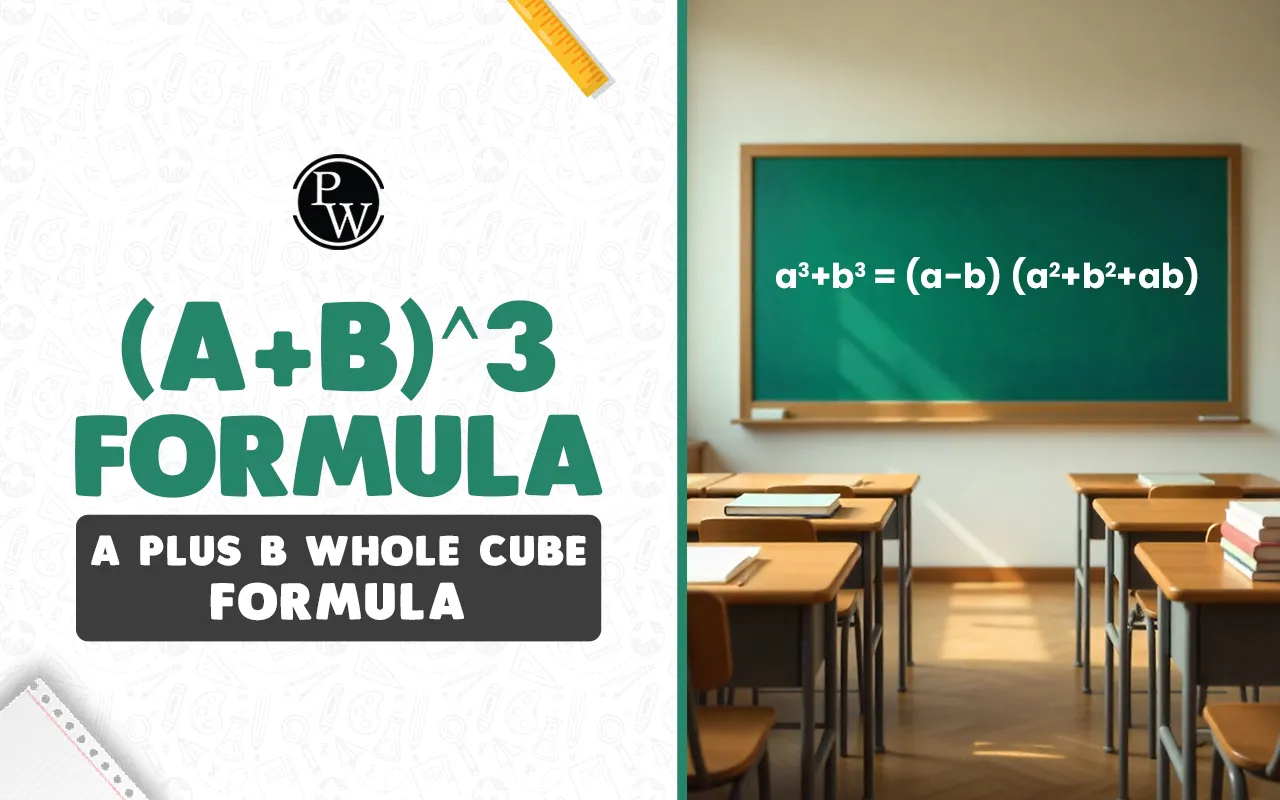
The (a + b)³ formula, also called the a plus b whole cube formula, is used to expand the cube of the sum of two terms. The formula is:
(a + b)³ = a³ + 3a²b + 3ab² + b³
It helps students expand algebraic expressions quickly without multiplying the same binomial three times.
(a + b)³ Formula
The (a + b)³ formula is:
(a + b)³ = a³ + 3a²b + 3ab² + b³
Here:
-
a³ is the cube of the first term.
-
3a²b is the second term.
-
3ab² is the third term.
-
b³ is the cube of the second term.
The coefficients in the expansion are 1, 3, 3, 1.
A Plus B Whole Cube Formula
The a plus b whole cube formula is another way of writing the same identity:
(a + b)³ = a³ + 3a²b + 3ab² + b³
For example:
(x + 2)³ = x³ + 6x² + 12x + 8
This identity is useful when expanding algebraic expressions containing a binomial raised to the power of 3. CuriousJr helps students understand and apply this identity through simple examples.
(a + b)³ Formula Expansion
To understand the expansion, start with:
(a + b)³ = (a + b)(a + b)(a + b)
First multiply two brackets:
(a + b)(a + b) = a² + 2ab + b²
Now multiply by the third bracket:
(a² + 2ab + b²)(a + b)
Expanding and combining like terms gives:
a³ + a²b + 2a²b + 2ab² + ab² + b³
Therefore:
(a + b)³ = a³ + 3a²b + 3ab² + b³
How to Use the (a + b)³ Formula
Follow these steps to use the formula:
-
Identify the values or terms represented by a and b.
-
Write the identity (a + b)³ = a³ + 3a²b + 3ab² + b³.
-
Substitute the values of a and b.
-
Calculate each term.
-
Combine the terms to get the final expression.
Example 1: Expand (2 + 3)³
Here, a = 2 and b = 3.
Using the formula:
(2 + 3)³ = 2³ + 3(2²)(3) + 3(2)(3²) + 3³
= 8 + 36 + 54 + 27
= 125
Therefore:
(2 + 3)³ = 125
Example 2: Expand (x + 2)³
Here, a = x and b = 2.
Using the formula:
(x + 2)³ = x³ + 3(x²)(2) + 3(x)(2²) + 2³
= x³ + 6x² + 12x + 8
Therefore:
(x + 2)³ = x³ + 6x² + 12x + 8
Example 3: Expand (3 + y)³
Here, a = 3 and b = y.
Using the formula:
(3 + y)³ = 3³ + 3(3²)(y) + 3(3)(y²) + y³
= 27 + 27y + 9y² + y³
Therefore:
(3 + y)³ = 27 + 27y + 9y² + y³
Read More: a^2 + b^2 Formula
What Is the Formula of (a + b)³?
The formula of (a + b)³ is:
(a + b)³ = a³ + 3a²b + 3ab² + b³
It represents the cube of the sum of a and b. The four terms in the expansion contain the cubes of the individual terms and the two middle terms formed using both a and b.
(a + b)³ Formula Coefficients
The coefficients of the expansion are:
|
Term |
Coefficient |
|
a³ |
1 |
|
3a²b |
3 |
|
3ab² |
3 |
|
b³ |
1 |
So, the coefficient pattern is:
1, 3, 3, 1
The powers of a decrease from 3 to 0, while the powers of b increase from 0 to 3.
(a + b)³ and (a - b)³ Formulas
The GSC data also shows strong searches for the related (a - b)³ identity. It is useful to know the difference between the two formulas.
(a + b)³
(a + b)³ = a³ + 3a²b + 3ab² + b³
All terms in the expansion are positive when a and b are positive quantities.
(a - b)³
(a - b)³ = a³ - 3a²b + 3ab² - b³
The signs alternate in this expansion.
Do not confuse the two identities while solving algebraic expressions.
Difference Between (a + b)³ and (a - b)³
|
Formula |
Expansion |
|
(a + b)³ |
a³ + 3a²b + 3ab² + b³ |
|
(a - b)³ |
a³ - 3a²b + 3ab² - b³ |
The main difference is the signs of the terms. For (a + b)³, the expansion contains positive terms. For (a - b)³, the signs alternate.
A Cube Plus B Cube
The cube of a sum should not be confused with the sum of two cubes.
For the cube of a sum:
(a + b)³ = a³ + 3a²b + 3ab² + b³
For the sum of cubes:
a³ + b³ = (a + b)(a² - ab + b²)
These are different algebraic identities and are used in different types of problems.
How to Remember the (a + b)³ Formula
Use this pattern to recall the identity:
First cube + 3 × first square × second + 3 × first × second square + second cube
So:
(a + b)³
becomes
a³ + 3a²b + 3ab² + b³
A quick way to check the expansion is to remember the coefficient pattern:
1 → 3 → 3 → 1
Also check that the total power of a and b in each term is 3.
Read More: A^2-B^2 Formula
Common Mistakes in the (a + b)³ Formula
Students often make these mistakes while using the whole cube formula:
-
Writing a³ + b³ as the complete expansion of (a + b)³.
-
Forgetting the coefficient 3 in the middle terms.
-
Writing 3a²b², which has total power 4 instead of 3.
-
Confusing the signs in (a + b)³ and (a - b)³.
-
Leaving out the final term b³.
For example, the incorrect expansion:
(a + b)³ = a³ + b³
misses the two middle terms.
The correct expansion is:
(a + b)³ = a³ + 3a²b + 3ab² + b³
Quick Revision of (a + b)³ Formula
|
Point |
Formula / Fact |
|
Whole cube |
(a + b)³ |
|
Expansion |
a³ + 3a²b + 3ab² + b³ |
|
Coefficients |
1, 3, 3, 1 |
|
First term |
a³ |
|
Second term |
3a²b |
|
Third term |
3ab² |
|
Last term |
b³ |
|
Related identity |
(a - b)³ = a³ - 3a²b + 3ab² - b³ |





A plus B whole cube formula FAQs
What is the (a + b)^3 formula?
What is the a plus b whole cube formula?
What are the coefficients in the (a + b)^3 expansion?
What is the formula for (a - b)^3?






Get Free Counselling Today
and Clear up all your Doubts
 Live & recorded classes available at easeDashboard for progress trackingLakhs of practice questions

