Substitution Method - Definition, Steps, Examples
 Shivam Singh20 Jan, 2026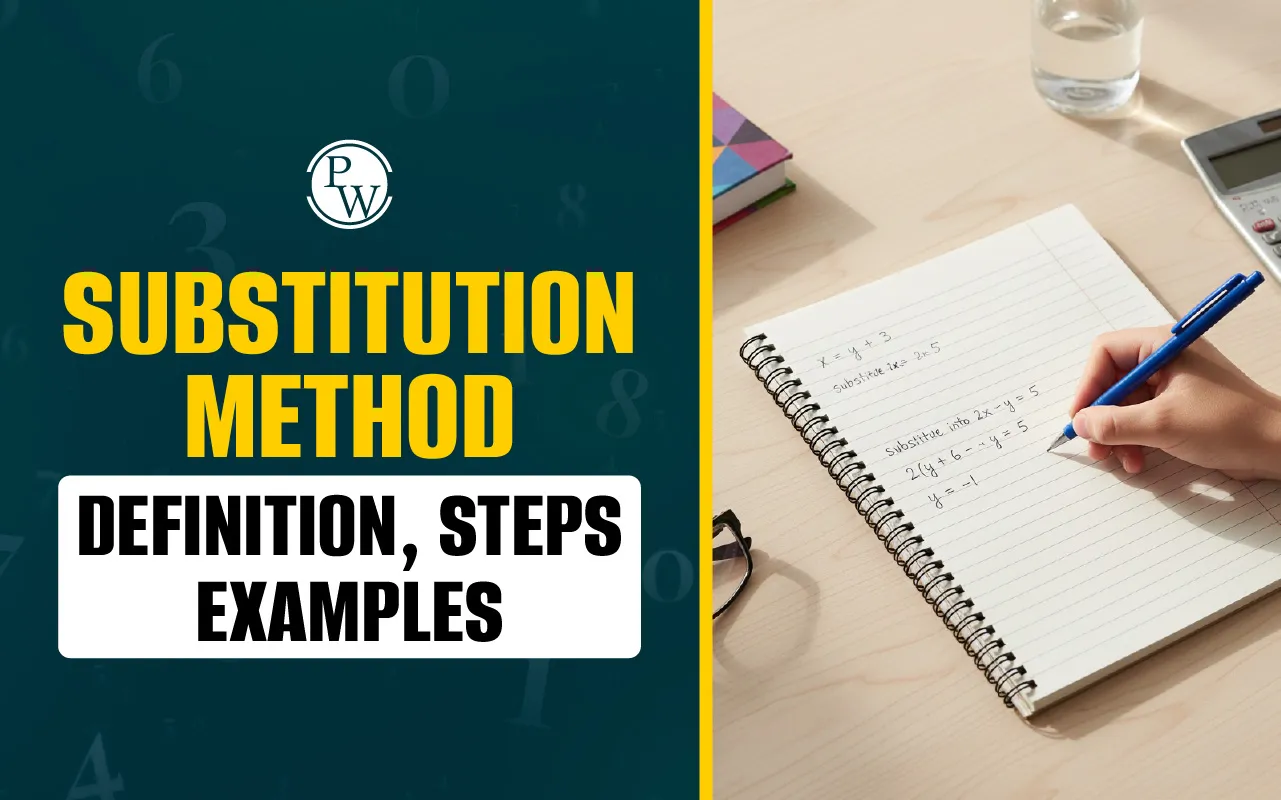
What is Substitution Method?
What is substitution method? It is a commonly asked question among students when learning about algebraic methods of solving linear equations. The substitution method is an easy method to solve a system of linear equations in two variables. In this method, we first find the value of one variable from one equation and then put, or substitute, that value into the second equation. This helps us find the value of the other variable.
Substitution method is very useful when one of the variables in an equation is already simple, like having a coefficient of 1. It is an effective technique for solving equations that makes solving math problems faster and easier. So, keep reading to learn more about the substitution method.
Read More: Cartesian Plane
How to Solve Systems of Equations by Substitution Method?
The substitution method helps us solve two equations with two unknown numbers step by step. Here’s how you solve systems of equations by substitution method:
-
Look at the equations carefully: First, check the given equations. If there are brackets, etc., simplify them first, so it becomes easy to solve the rest.
-
Solve one equation for one variable: Pick one equation and make one variable (x or y) the subject. It is better to choose the variable that is easier to handle. For example, if the equation is x + y = 5, it is easy to write x = 5 – y.
-
Substitute in the second equation: Take the value you found for the variable and put it in the other equation in place of that variable. This gives you a new equation with only one variable.
-
Solve the new equation: Now do the math to find the value of the remaining variable. For example, after substituting, you may get 3y – 2 = 4, then solve to find y.
-
Find the first variable: Finally, put the value you found back into any of the original equations to get the value of the first variable.
To understand how to solve equations by substitution method more clearly, let’s take an example and solve it step by step.
Ques. Solve the system of equations by substitution method:
-
x + y = 7
-
x – y = 3
Step 1: Solve one equation for a variable: From equation (1), we can write x = 7 – y
Step 2: Substitute in the second equation: Now, put x = 7 – y into equation (2): (7 – y) – y = 3
Step 3: Simplify and solve for y: 7 – y – y = 3
-
7 – 2y = 3
-
-2y = 3 – 7
-
-2y = -4
-
y = 2
Step 4: Find x: Now, put y = 2 into x = 7 – y: x = 7 – 2.
x = 5
Therefore, the final answer is: x = 5, y = 2.
Difference Between Elimination and Substitution Method
While both the substitution method and the elimination method are methods of solving linear equations with two variables, they differ from each other. Let's understand the difference between elimination and substitution methods:
|
Difference Between Elimination and Substitution Method |
|
|
Substitution Method |
Elimination Method |
|
We first find the value of one variable and then substitute it into the other equation. |
We make the coefficients of one variable the same in both equations, then add or subtract to eliminate that variable. |
|
Mostly used when one equation can be written in the form x = something or y = something. |
Mostly used when the coefficients of variables are not the same and substitution is difficult. |
|
One variable must be isolated in at least one equation. |
We can solve the system without isolating any variable. |
|
Step-by-step replacement of the variable makes it easy to understand. |
Eliminating a variable helps solve equations faster when the numbers are big or complex. |
Read more: Coincident Lines
Substitution Method Examples With Solutions
Here are some substitution method examples to help you understand how to solve systems of linear equations step by step:
Example 1: Solve the system of equations by substitution method: 4a − 3b = 13 and 2a + b = 7.
Solution: The given equations are:
-
4a − 3b = 13
-
2a + b = 7
Step 1: Solve equation (2) for b:
b = 7 − 2a
Step 2: Substitute b = 7 − 2a into equation (1):
4a − 3(7 − 2a) = 13
4a − 21 + 6a = 13
10a − 21 = 13
10a = 34
a = 34 / 10 = 17 / 5
Step 3: Find b by putting a = 17/5 in equation (2):
2 × 17/5 + b = 7
34/5 + b = 7
b = 7 − 34/5 = 35/5 − 34/5 = 1/5
Hence, the final answers are: a = 17/5 and b = 1/5.
Example 2: Two numbers have a sum of 30 and a difference of 12. Find the numbers.
Solution:
Let the two numbers be x and y (x > y). We have:
x + y = 30 … (1)
x − y = 12 … (2)
Step 1: Solve equation (1) for x:
x = 30 − y
Step 2: Substitute x = 30 − y into equation (2):
(30 − y) − y = 12
30 − 2y = 12
−2y = 12 − 30
−2y = −18
y = 9
Step 3: Find x:
x = 30 − 9 = 21
Hence, the two numbers are 21 and 9.
Read More: Construction in Maths
Example 3: Solve the system:
x + 2y − 4 = 0
2x − y + 5 = 0
Solution:
Step 1: Solve the first equation for x:
x = 4 − 2y
Step 2: Substitute x = 4 − 2y into the second equation:
2(4 − 2y) − y + 5 = 0
8 − 4y − y + 5 = 0
−5y + 13 = 0
−5y = −13
y = 13 / 5
Step 3: Find x:
x = 4 − 2 × 13/5 = 4 − 26/5 = 20/5 − 26/5 = −6/5
Therefore, the answer is = −6/5, y = 13/5
Also Read: Reciprocal
Make Mental Maths Fun and Easy for Your Child with CuriousJr Online Classes
Does your child get anxious while solving maths problems or nervous during calculations? These small worries can grow as classes get harder and exams become more challenging.
CuriousJr’s Online Mental Maths Classes help your child build confidence and speed in solving problems, with features like:
-
Step-by-step learning that matches your child’s current level.
-
Fun curriculum designed to improve thinking and problem-solving skills.
-
50+ easy mental maths strategies to solve questions faster.
-
Visual calculation techniques and logical reasoning practice.
-
Games, rewards, and interactive classes to make learning enjoyable.
-
Live video classes with homework help and doubt resolution.
-
Daily performance tracking so that you can see their steady progress.
-
Helps make school maths easier and can boost exam marks.
Give your child the support they need to enjoy maths and feel confident. Book a maths demo class today!