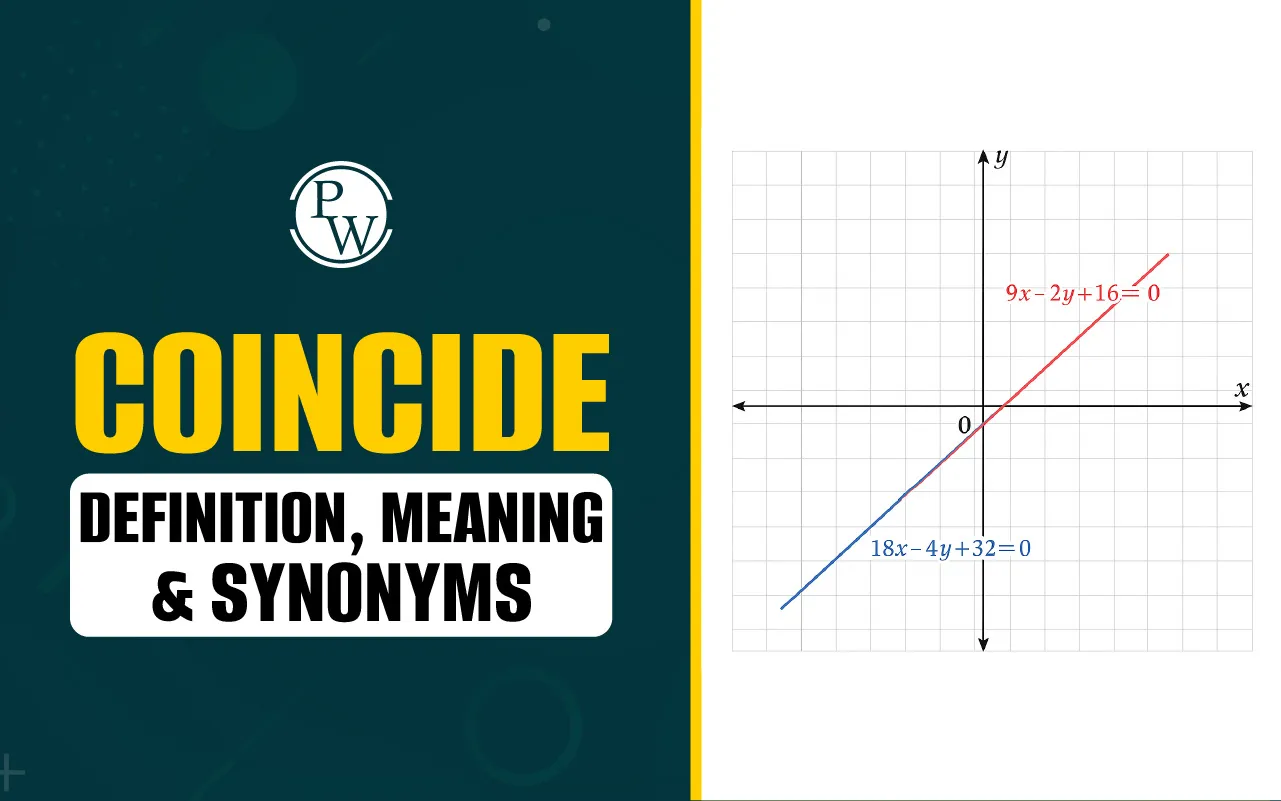
The Coincident meaning in maths describes two or more geometric figures that occupy the same position or have identical coordinates on a plane.

Coincident Lines: Meaning, Properties, Formula & Examples
Coincident lines are two or more lines that lie exactly on top of each other, sharing all points and appearing as one. Their equations are scalar multiples, with equal slopes and y-intercepts. Unlike parallel lines, coincident lines intersect at every point and have infinite solutions. Learn Coincident Lines definition, meaning in maths, properties, formula, and solved examples to identify and verify coincident lines easily.
 Swati Kumar19 Jan, 2026
Coincident Lines
Coincident lines are two or more lines lying precisely on top of one another and sharing all their points, basically creating the same line. In contrast to parallel lines that never meet, coincident lines overlap entirely, and their equations are multiples of or equal to each other. In geometry, the coincident lines meaning refers to lines that lie exactly on top of each other, sharing every point in common.
For instance, the lines given by Coincident lines equation x+y=4x+y=4 and 2x+2y=82x+2y=8 are coincident since they both lie on the same line. The concept of coincident lines is beneficial in solving systems of equations and studying geometric configurations.
Read more: Cartesian Plane
What Are Coincident Lines?
Coincident Lines meaning - Coincident lines are two or more lines perfectly on top of one another, sharing each point. This indicates they share the same slope and the same y-intercept. Even if they may seem like different lines in equation form, they actually are the same line in the coordinate plane.
To understand what are coincident lines, remember that they have the same slope and intercept, which makes them overlap completely on a graph.
For example, the Coincident lines equation y=2x+1 and 2y=4x+2 are coincident lines. If you reduce the second equation, it becomes the same as the first.
Read More: 30-60-90 Triangle
Coincident Lines Equation
The standard coincident lines equation is y = mx + b,
Where
-
m is the slope
-
b is the y-intercept of the line
Coincident lines are two or more linear equations that are scalar multiples of one another. That is, they have the same slope and the same y-intercept.
Example 1: Basic Equations
Look at the following two equations:
y=2x+1
2y=4x+2
If you divide each of the terms of the second equation by 2, you get y=2x+1. This indicates that both equations express the same line and are therefore coincident.
Example 2: More Complicated Equations
The following two equations are also coincident:
3x+6y=12
x+2y=4
To see if they are coincident, you can solve each of them to determine their slope and y-intercept.
For the first equation:
6y=−3x+12
y=−63x+612
y=−21x+2
For the second equation:
2y=−x+4
y=−21x+2
Because both of these equations reduce to the same form (y=−21x+2), they are coincident lines.
Coincident Lines Graph
Coincident lines graph as a single, solid line on a graph because they take up the same region of space in the coordinate plane. While they are equated by two or more different equations, all of the equations reduce to the same form, which gives them the same slope and y-intercept.
For instance
Look at the following two equations that are coincident lines:
y=2x+1
2y=4x+2
If you reduce the second equation by dividing all terms by 2, then you have y=2x+1, which is the same as the first equation. This is why they're coincident and become one line on the graph below.
Read More: Before Number Concept
Coincident Lines Solutions
Coincident lines have infinitely many solutions since they are, in essence, the same line. Because each point on one line is a point on the other, they intersect at every point from start to finish along their length.
Example 1: Basic Equations
Suppose we have two equations:
y=3x+2
2y=6x+4
To check that they are on the same line, you can plug in some points.
If x=1, the first equation produces y=3(1) + 2 = 5.
For the second equation, 2y=6(1)+4, which simplifies to 2y=10, so y=5.
The two equations have the point (1, 5) in common. This is a point for any point you pick, validating an infinite number of solutions.
Example 2: Non-Simplified Form
Consider these two equations:
4x−2y=8
2x−y=4
If you multiply the second equation by 2, it becomes 2(2x−y)=2(4), which is 4x−2y=8.
As the two equations become the same after this operation, they are coincident lines, and each point that satisfies one equation also satisfies the other.
Coincident Lines Formula
The coincident lines formula assists us in verifying whether the given pair of lines is a pair of coincident lines or not.
Take, for instance, two linear equations:
a1x+b1y+c1=0
a2x+b2y+c2=0
These lines are coincident if the ratios of the corresponding coefficients are equal:
a1/a2=b1/b2=c1/c2
For example, the line
3x+3y=9
9x+9y=27
These are coincident since the second is a scalar multiple of the first. This implies that the two lines are perfectly on top of one another and share infinitely many points.
Another Coincident lines example:
The lines 9x−2y+16=0 and 18x−4y+32=0 are coincident since
9/18=−2/−4=16/32
All ratios are equal, affirming coincidence.
Read More: Mean, Median, Mode
Coincident Lines Examples
Coincident lines are two or more linear equations that represent the same line. They have identical slopes and y-intercepts, and one equation is a scalar multiple of the other. Below are some coincident lines examples.
Example 1: Simple Multiplication
Line 1: y=2x+3
Line 2: 2y=4x+6
Explanation: Dividing the second equation by 2 gives y=2x+3, which is identical to the first. They are coincident.
Example 2: Standard Form
Line 1: 3x−5y=15
Line 2: 6x−10y=30
Explanation: The second equation is just the first one multiplied by 2. We can check this using the ratio of coefficients:
6/3=−10/−5=30/15=2/1.
All ratios are equal, so the lines are coincident.
Example 3: Rearranging Terms
Line 1: y=−x+2
Line 2: 3y+3x=6
Explanation: If we divide the second equation by 3, we obtain y+x=2. Rearranging to solve for y, we get y=−x+2, which is identical to the first equation.
Example 4: Negative Multipliers
Line 1: y=−2x+4
Line 2: −4y=8x−16
Explanation: If you divide the second equation by -4, you obtain y=(−8/4x)−16/-4), or y=−2x+4. This is the same as the first equation.
Example 5: Fractional Coefficients
Line 1: y=1x/2+1
Line 2: 4y=2x+4
Explanation: The second equation divided by 4 is y=2x/4+4/4, or y=1x/2+1. Both equations graph the same line.
Read More: Construction in Maths
Difference Between Coincident and Parallel Lines
Coincident lines are lines that exactly sit on top of one another and have all their points in common, constituting basically the same line. Parallel lines, on the other hand, are always equidistant from one another and never cut each other. Below are the main differences between coincident and parallel lines:
|
Difference Between Coincident and Parallel Lines |
||
|
Aspect |
Coincident Lines |
Parallel Lines |
|
Definition |
Two or more lines that lie exactly on top of each other, sharing all points. |
Two lines that are always equidistant and never intersect. |
|
Equation Condition |
Coefficients satisfy a1/a2=b1/b2=c1/c2 |
Coefficients satisfy a1/a2=b1/b2≠c1/c2 |
|
Intersection Points |
Infinite points (since they coincide fully). |
No points of intersection. |
|
Graph Representation |
Appear as a single line since they overlap completely. |
Two distinct lines with a constant distance apart. |
|
Slope |
Same slope for both lines. |
Same slope for both lines. |
|
Distance Between Lines |
Zero (lines overlap). |
Constant and non-zero distance. |
How CuriousJr Makes Learning Mathematics Simple for Your Child?
CuriousJr online Mental Maths classes makes math learning easy by turning it into an engaging, gamified journey. With fun challenges, quizzes, and interactive classes, the online coaching transforms complex concepts into simpler ones. There are also personalized learning paths, ensuring that every child can build a strong mathematical foundation at their own pace. Book a demo class today to know more about our classes.

🔥 Trending Blogs


Talk to a counsellorHave doubts? Our support team will be happy to assist you!


Coincident Lines FAQs
What are coincident lines?
Two or more lines that coincide exactly one upon another, having all points in common and a common appearance as a single line.
How to check if two lines are coincident?
If the ratios of the coefficients of the linear equations meet the condition a1/a2=b1/b2=c1/c2, the lines are coincident.
How many solutions do coincident lines have?
They have an infinite number of solutions because any point on one line is on the other.
Are coincident lines the same as parallel lines?
No, coincident lines are on top of each other, whereas parallel lines have a constant distance and never meet.
Can coincident lines be perpendicular?
No, coincident lines cannot be perpendicular because they travel in the same direction.