Construction in Maths: Methods and Examples
 Amit Lingwal19 Jan, 2026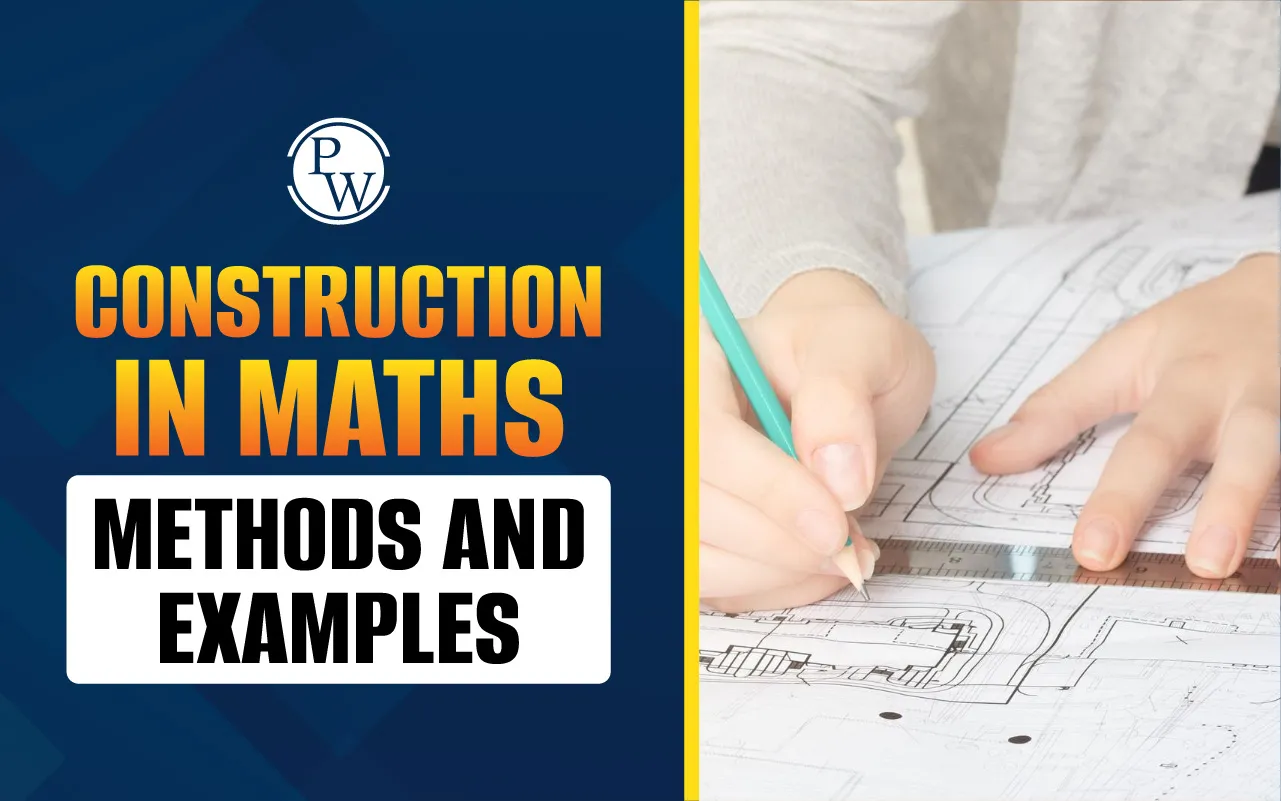
Construction in Maths means drawing shapes step by step using a ruler and a compass. Students can use these tools to make straight lines, triangles, circles, and angles. It is like following simple instructions to get the shape right.
Construction is not just drawing. It helps students become more focused and accurate. For example, if the compass is not set properly, the circle will look uneven.
By practising constructions, students learn how shapes fit together, such as two triangles making a square. In this article, we will explain easy methods that help students draw shapes with confidence. Here, we will discuss the different methods used to construct various geometric shapes.
What is Construction in Maths?
Construction in maths is a special way of drawing shapes like lines, angles, and triangles by using only two basic tools:
-
A compass, which is used to draw circles and arcs
-
A straightedge, which is a ruler without any numbers or markings
This approach focuses on creating exact figures through logical steps rather than measurements. Constructions are based on geometric principles and are used to demonstrate the properties and relationships of shapes.
Some common constructions include:
-
Drawing a straight line through two points
-
Constructing a perpendicular or bisector
-
Creating angles of specific sizes (like 60° or 90°)
-
Dividing a line segment into equal parts
-
Drawing a triangle with given side lengths
These methods are not only useful for learning geometry but also help build logical thinking and precision. Each construction begins with known values or figures and builds new ones using rules that apply to all similar shapes.
Read More: Perimeter of Square
Geometrical Construction Definition
A geometrical construction is defined as a method of drawing shapes, angles, or other geometric figures using only a compass, a straightedge, and a pencil. This process follows strict rules based on mathematical theorems and properties rather than relying on trial-and-error or measurement.
Why Learning Geometrical Construction is Important?
Here’s why learning geometrical constructions matters for students:
-
Learning constructions helps students think in an organised way by following steps and solving problems logically.
-
Drawing with a compass and straightedge teaches how to make accurate shapes, lines, and angles without guessing.
-
These skills are helpful in real-life fields such as architecture, engineering, map-making, and graphic design.
-
Creating shapes by hand helps students understand geometry better, making it easier to follow lessons and answer exam questions.
-
It also builds focus, patience, and attention to detail, which are useful in many subjects and activities.
Geometrical construction is more than just drawing. It helps students improve in maths and prepares them for practical uses beyond the classroom.
Read more: Counting Numbers
Basic Geometric Constructions Methods
These are some of the most common methods used in geometry. All constructions are done using only a compass and a straightedge (a ruler without numbers). When a specific length is given, you may use a ruler only to set the compass, not to draw or measure the line directly.
1. Draw a Line Segment of 6 cm
Follow these steps to draw a line segment of 6 cm:
-
Open your compass to 6 cm.
-
Mark a point on the paper and call it A.
-
Put the compass on A and draw an arc.
-
Label the other end of the arc as B.
-
Draw a straight line connecting A and B using a ruler.
The line segment AB is now 6 cm long.
2. Construction of a Perpendicular Bisector
To divide a line segment into two equal parts and make a right angle:
-
Draw a line segment and name the ends A and B.
-
Open the compass to more than half the length of AB.
-
Place the compass on point A. Draw one arc above the line and one below.
-
Without changing the compass, place it on point B. Draw another arc above and below the line.
-
The arcs will cross at two points. Mark these points clearly.
-
Draw a straight line connecting the two crossing points.
This line divides AB into two equal halves and makes a 90-degree angle with it.
3. Construction of an Angle Bisector
To divide an angle into two equal parts:
-
Take the angle ∠PQR, where Q is the vertex.
-
Place the compass on Q and draw an arc that touches both sides of the angle.
-
Label the points where the arc meets the sides as A (on QP) and B (on QR).
-
From points A and B, draw arcs that cross inside the angle.
-
Mark the crossing point as C.
-
Draw a line from Q to C.
The line QC divides ∠PQR into two equal angles.
Read more: Brackets in Maths
4. Construction of Parallel Line
To draw a line parallel to a given line through a point not on it:
-
Draw a straight line and mark a point P above or below it.
-
Draw a slanted line from P that crosses the original line. This is the transversal.
-
Put the compass at the intersection of the transversal and the original line. Draw an arc across both lines.
-
Without changing the compass, draw the same arc from P.
-
Measure the distance between the arc crossings on the original line.
-
Copy this distance onto the arc from P and mark the point.
-
Draw a line through P and the marked point using a ruler.
This line stays the same distance from the original line. It is parallel.
5. Construction of Triangle
You can draw different types of triangles depending on what information is given. Some common types are:
-
SSS (Side-Side-Side): Draw a triangle when all three sides are known. Measure and draw each side carefully.
-
SAS (Side-Angle-Side): Draw two sides and the angle between them. Start with the angle, then draw the sides from it.
-
ASA (Angle-Side-Angle): Draw two angles and the side between them. Draw the side first, then complete the triangle using the angles.
-
AAS (Angle-Angle-Side): Draw two angles and a side that is not between them. Use the side as a base and construct the angles from its ends.
-
RHS (Right angle-Hypotenuse-Side): Draw right-angled triangles when the hypotenuse and one side are known. Use the right angle as a starting point.
Construction of Common Angles Without Protractor
You can make many common angles using only a compass and a straightedge. You do not need a protractor. These steps use simple constructions based on equal arcs and angle bisectors.
1. 60° Angle
To make a 60-degree angle:
-
Draw a straight line and mark a point O.
-
Place the compass on O, draw an arc to cut the line. Mark the point where the arc cuts the line as A.
-
Without changing the compass, place it on A and draw another arc.
-
Mark where the arcs cross as B, then draw a line from O to B.
-
∠AOB is 60 degrees.
2. 90° Angle
To make a 90-degree angle:
-
First, make a 60° angle as above.
-
Then, from the same point, construct a second 60° angle on the other side.
-
Now bisect the angle between the two 60° arms.
-
The new angle is 90 degrees.
You can also make 90° by drawing a perpendicular bisector to a line.
3. 45° Angle
To make a 45-degree angle:
-
Start with a 90° angle.
-
Use your compass to divide it in half.
-
The new angle is 45 degrees.
4. 30° Angle
To make a 30-degree angle:
-
Start by making a 60° angle.
-
Then bisect it using your compass.
-
The result is a 30° angle.
5. 120° Angle
To make a 120-degree angle:
-
Draw a 60° angle first.
-
Without changing the compass, continue the arc to create another 60° from the same point.
-
The full angle is 120 degrees.
These angles are often used in triangle construction, polygons, and other geometric drawings. You can make each one accurately using only your compass and straightedge.
Read more: Straight angle
Applications of Geometrical Construction
Learning how to draw shapes with a compass and straightedge is useful in many areas of life and work. Here are some examples:
-
In Architecture: Used to draw floor plans, measure corners, and design curved walls or windows.
-
In Engineering: Helps with drawing machine parts and building structures correctly.
-
In Art and Design: Useful for making patterns, logos, and designs that are even and balanced.
-
In Navigation and Mapping: Helps in drawing maps, setting directions, and measuring distance between places.
Also Read: What is a Polyhedron
Tips for Accurate Construction in Maths
To draw correctly in geometry, it is important to follow some simple tips. These help keep your work neat and accurate:
-
Keep the compass width the same when copying or transferring lengths. Do not adjust it unless needed.
-
Draw light and clean arcs using a sharp pencil. This makes your construction easy to see and fix if needed.
-
Always mark intersection points clearly before drawing lines through them.
-
Use the straightedge only to draw lines, not to measure. You should not use a ruler with numbers for construction.
Construction in Maths Practice Problems
Try these problems to check your understanding and improve your skills:
-
Draw a triangle with base 6 cm, one base angle of 45 degrees, and the sum of the other two sides equal to 9 cm.
-
Bisect a 120-degree angle using only a compass and a straightedge.
-
Draw a line parallel to a given line, passing through a point that is not on the line.
These tasks help you practice different types of constructions.
Make Mental Math Easy and Fun for Your Child with CuriousJr
Every child learns differently. Some understand numbers quickly, while others may need a little more time and care. That does not mean they are behind. It simply means they learn in their own way.
At CuriousJr, our Mental Maths Classes are designed to make learning simple, and enjoyable. We use fun activities, easy methods, and visual learning to help children feel more confident with numbers. Our goal is to make math less stressful and more interesting.
Each class has two mentors who guide the children step by step. This gives every child the attention they need and helps them feel supported throughout the lesson. Parents also receive regular updates so you always know how your child is doing.
As children attend classes, they begin to solve problems faster, enjoy math more, and build a strong foundation for school and everyday life. Book a demo class with CuriousJr today and see the difference it can make.