Perimeter of Semicircle - Formula, Definition, Examples
 Shivam Singh19 Jan, 2026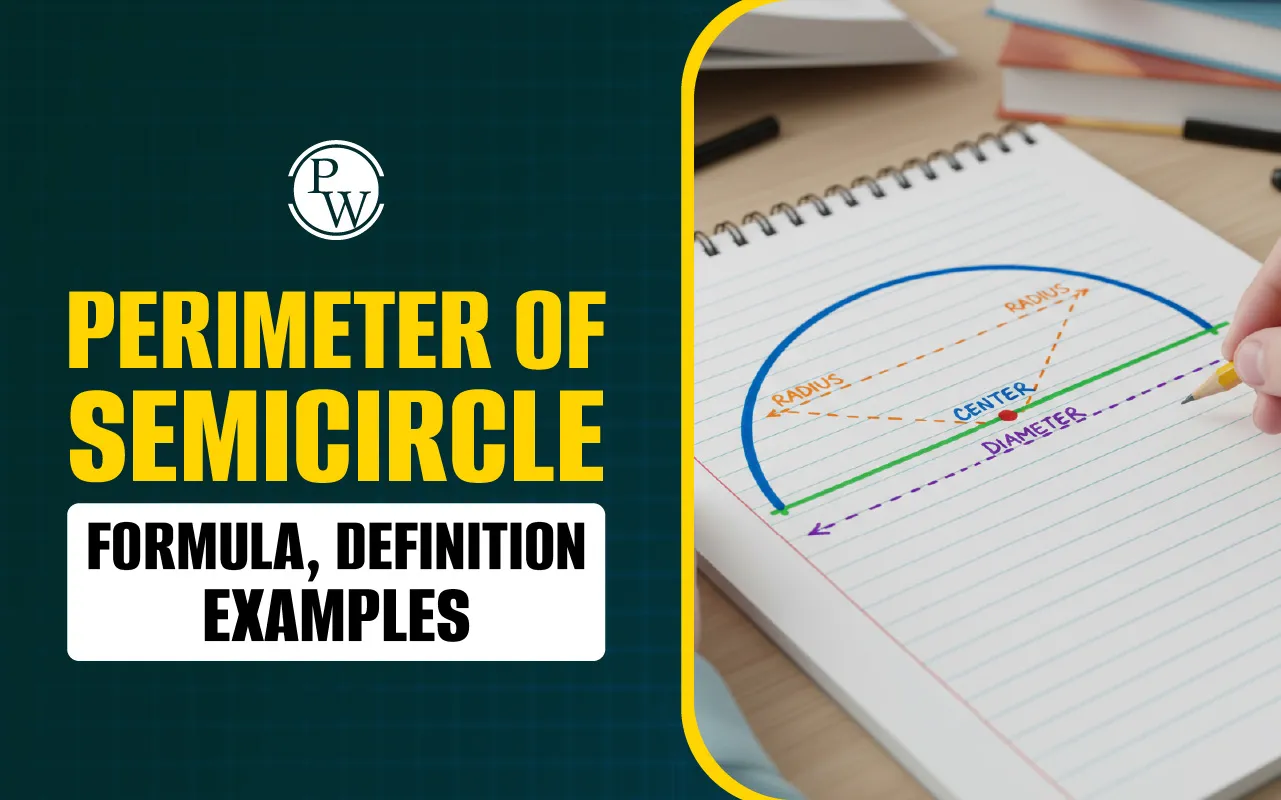
What is the Perimeter of a Semicircle?
The perimeter of a semicircle is the total length around its edge. A semicircle has two parts:
-
A curved part (this is half of the circle’s edge)
-
A straight part (this is the flat line across the bottom, called the diameter)
To find the perimeter of a semicircle, we must add both parts together.
Many students think the perimeter is just half of the circle’s perimeter, but that is not correct. We must also include the straight bottom part (the diameter), because it is part of the boundary. So the perimeter of a semicircle is half the circle’s curve plus the diameter.
Read More: Diameter of a circle
What is a Semicircle?
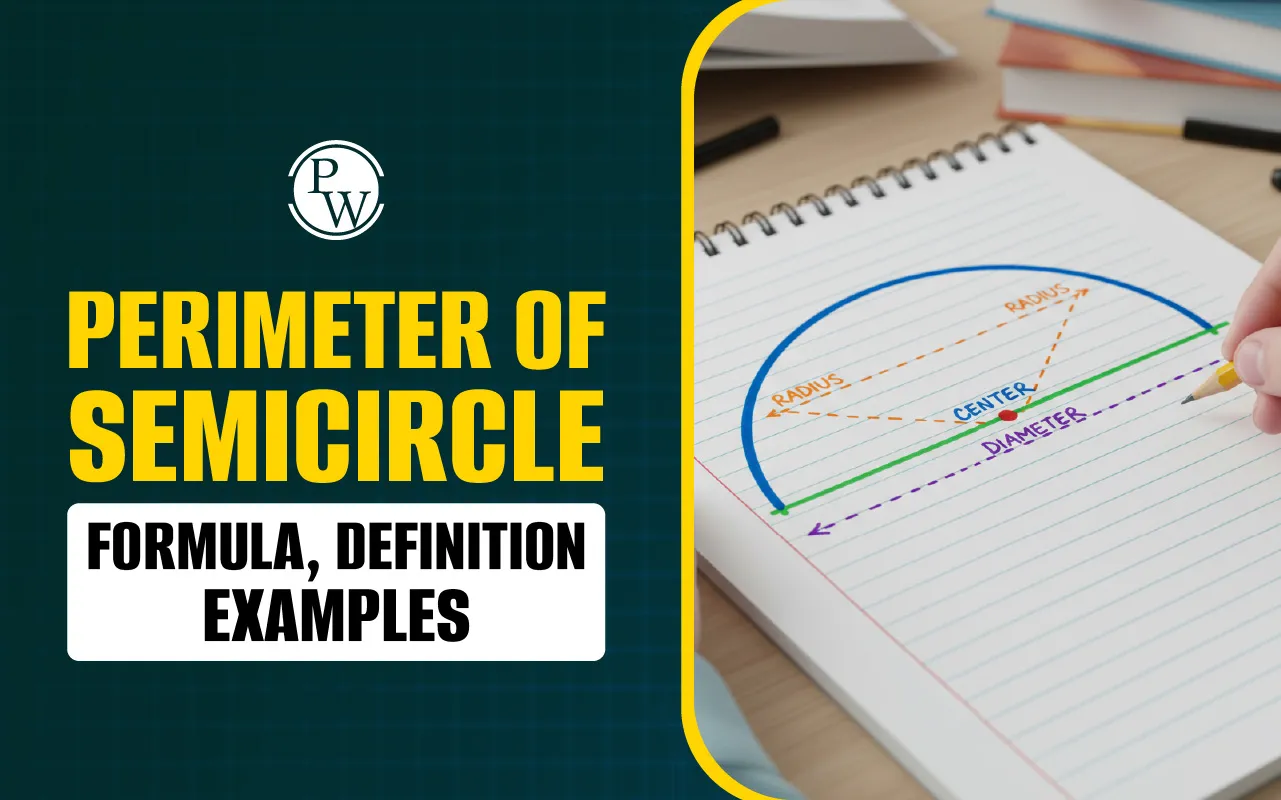
A semicircle is exactly half of a circle. Imagine cutting a round cookie into two equal parts. Each part is a semicircle. A semicircle has:
-
A diameter, which is the straight edge
-
A curved edge, which is half the circle’s edge
-
A center, which is the middle point
-
A radius, which is the distance from the center to the edge
The radius is always half of the diameter. So, if the diameter is 10 cm, the radius is 5 cm.
Circumference of a Semicircle
The word circumference means the distance around a full circle. The formula for the circumference of a full circle is:
Circumference = 2 × π × radius
We write π as 3.14 or sometimes 22/7.
Now, since a semicircle is half a circle, the curved part of a semicircle is:
Curved part = π × radius
But remember, this is not the full perimeter. We must also add the diameter (straight part) to get the complete perimeter of the semicircle.
Read More: Perimeter of a Sector
Perimeter of Semicircle Formula
Now that we understand the parts of a semicircle, we can look at the formula. There are two ways to write the perimeter of a semicircle formula. One is using the radius and the other is using the diameter.
-
Using the radius:
Perimeter of semicircle = πr + 2r
This can also be written as:
Perimeter of semicircle = r(π + 2)
-
Using the diameter:
Since diameter (d) = 2r, we can also write the formula as:
Perimeter of semicircle = πd/2 + d
Both formulas give the same result. You can choose the one that matches the information given in your problem. If you are given the radius, use the first formula. If you are given the diameter, use the second.
Read More: Perimeter of a Circle
How to Find the Perimeter of a Semicircle?
To find the perimeter of semicircle, follow these steps:
Step 1: Identify whether the problem gives you the radius or the diameter.
Step 2: Choose the correct formula:
-
If you have the radius, use r(π + 2)
-
If you have the diameter, use πd/2 + d
Step 3: Use 3.14 or 22/7 for the value of π unless told otherwise.
Step 4: Substitute the given values into the formula.
Step 5: Calculate the answer and write the unit (such as cm, m, inches, etc.)
Area and Perimeter of Semicircle
Just like the perimeter tells us the distance around the shape, area tells us how much space is inside it. For a semicircle, the area is half the area of a full circle.
The area formula for a circle is πr2. So, the area of a semicircle is:
Area = (1/2) × π × r2
This formula only uses the radius. It is useful to understand both the area and perimeter of a semicircle because many problems in geometry and real life involve both.
For example, if you are designing a garden that is shaped like a semicircle, you may need to know the area to plant flowers and the perimeter to build a fence.
Read More: Perimeter of Square
Perimeter of Semicircle Example
Let us look at a few solved examples to understand the concept better.
Example 1: Find the perimeter of a semicircle with a radius of 7 cm. Use π = 3.14.
Using the formula: perimeter = r(π + 2)
Substitute r = 7
= 7 × (3.14 + 2)
= 7 × 5.14
= 35.98
So, the perimeter of the semicircle is 35.98 cm
Example 2: Find the perimeter of a semicircle with a diameter of 10 meters. Use π = 3.14.
Using the formula: perimeter = πd/2 + d
Substitute d = 10
= (3.14 × 10)/2 + 10
= 31.4/2 + 10
= 15.7 + 10
= 25.7
So, the perimeter of the semicircle is 25.7 meters
Example 3: If the perimeter of a semicircle is 72.8 units, find the radius. Use π = 3.14.
Use formula: P = r(π + 2)
72.8 = r(3.14 + 2)
72.8 = r × 5.14
r = 72.8 ÷ 5.14
r = 14.16
So, the radius is approximately 14.16 units
These perimeter of semicircle examples show how the formula works in different situations.
Also read: Perimeter of Rhombus
Say Goodbye to Maths Struggles with CuriousJr’s Online Tuition
Is your child struggling with maths or avoiding homework because it feels too hard? You’re not alone. Many children lose confidence when they can’t understand math lessons, and this can make learning stressful.
CuriousJr’s after-school online tuition classes are designed to change that. These classes make maths simple, fun, and engaging, helping your child build strong foundational skills and become confident problem-solvers.
Here’s what your child gets with CuriousJr’s online maths classes:
-
Fun and interactive lessons that make learning exciting
-
Personal teacher support to clear doubts and assist with homework
-
Engaging activities that explain even tricky maths topics clearly
-
Daily progress reports so you can track your child’s improvement
Book a demo class today and give your child the support they need to enjoy and succeed in maths.