Perimeter of Rhombus - Formula, Properties, and Examples
 Nikita Aggarwal19 Jan, 2026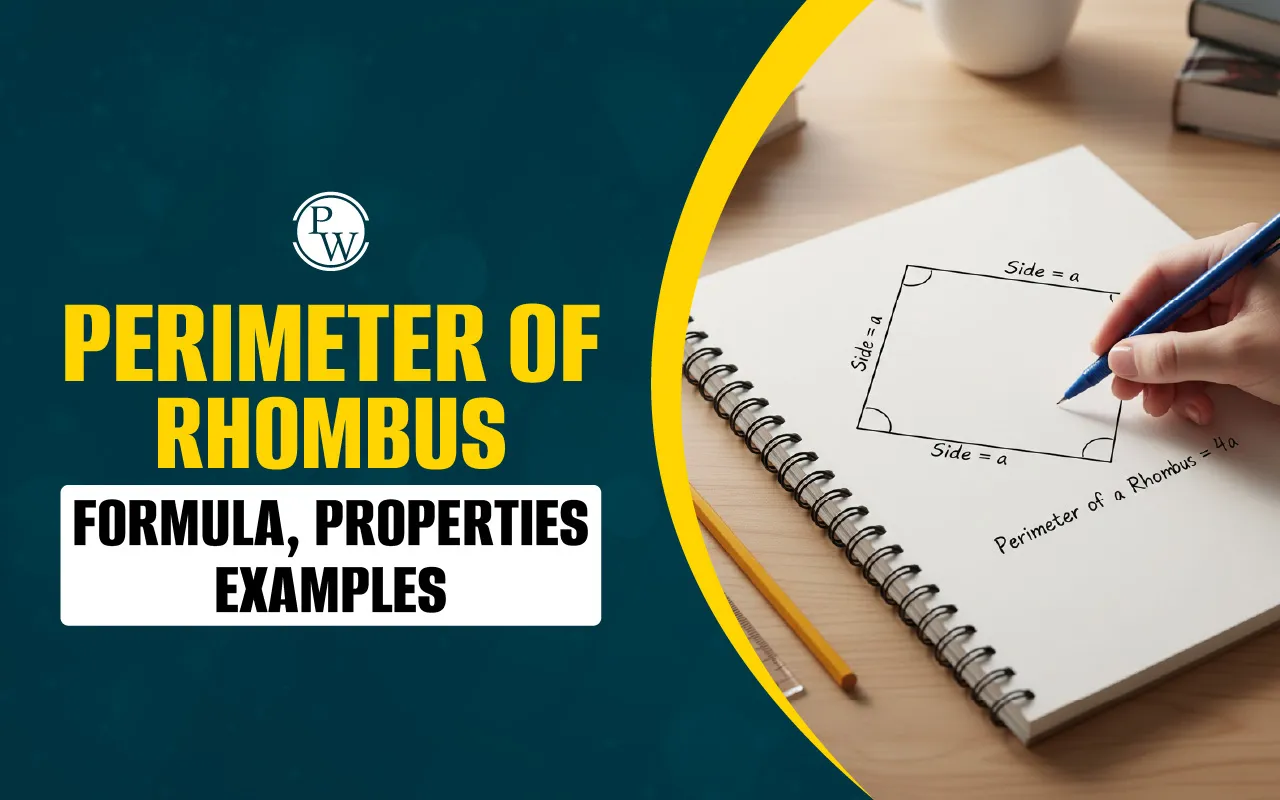
Perimeter of a Rhombus
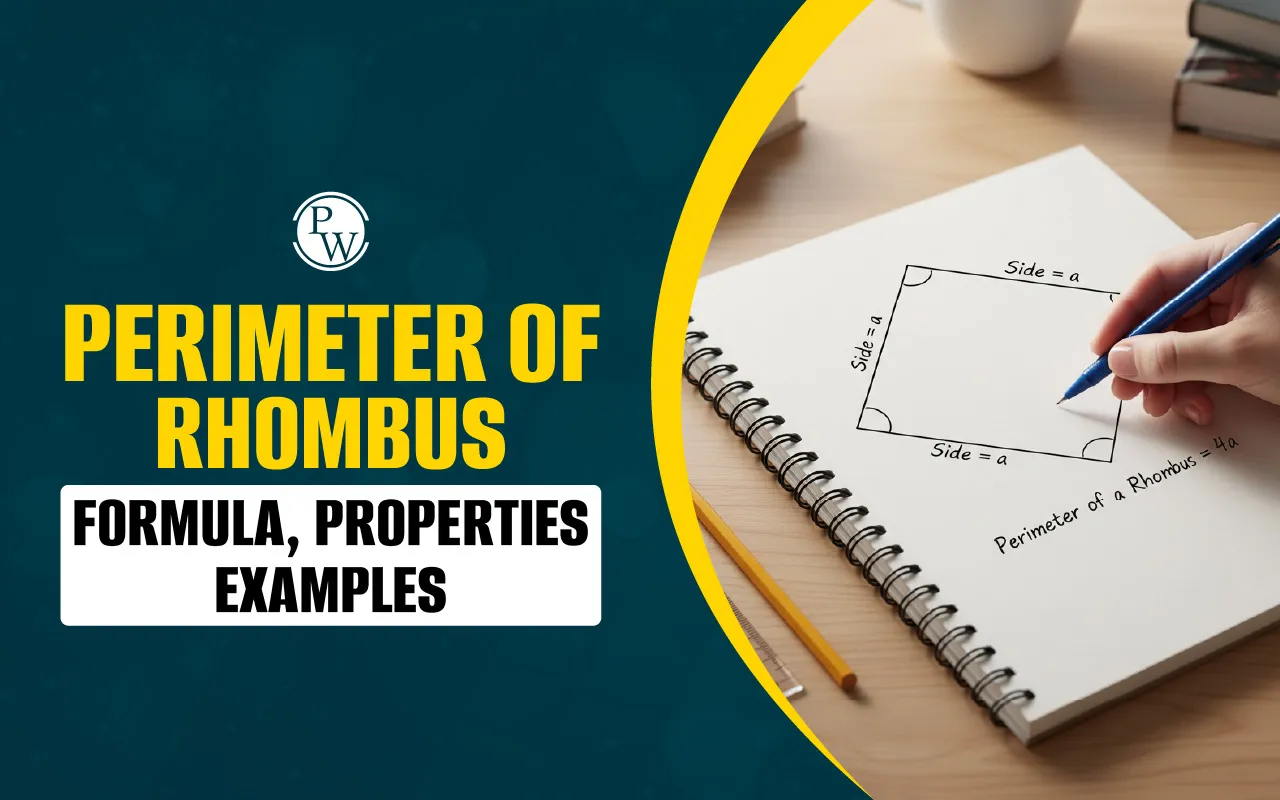
The perimeter of the rhombus refers to the distance around its outer boundary. It can be obtained by calculating the total length of all its four sides. Since all four sides are equal, finding the perimeter is quite straightforward if we know the dimension of any one side of a rhombus.
If the length of one side of a rhombus is ‘a,’ then:
The perimeter of a rhombus is a + a + a + a = 4a units.
What is a Rhombus?
A rhombus is a type of quadrilateral where all four sides are of equal length, but the inside angles are not necessarily 90°. It looks like a diamond or a slanted square. The opposite sides of a rhombus are parallel, and the opposite angles are equal. So, we can say a rhombus is a parallelogram with four equal sides.
Also read: Perimeter of Square - Formula, Definition, Examples
Properties of a Rhombus
The rhombus has some special properties that make it unique among other quadrilaterals. These properties also help us find out the perimeter of a rhombus. Let’s look at the main properties of a rhombus as follows:
All sides are equal
Each of the four sides of a rhombus is of equal length. If one side measures ‘a’ unit, all sides measure ‘a’ unit.
Opposite angles are equal
The opposite angles of a rhombus are always equal. Typically, two of them are less than 90 degrees, and the other two are more than 90 degrees.
Diagonals intersect each other at right angles
The two diagonals of a rhombus intersect each other at 90 degrees. It means four right angles are formed at the point of intersection of diagonals.
Diagonals bisect each other
The diagonals of a rhombus bisect each other at the point of intersection. It means the diagonals are divided into two halves at the point of intersection.
Diagonals bisect opposite angles
Each diagonal of a rhombus divides the opposite angles into two equal parts.
Also read: Perimeter of a Sector- Definition, Types, Examples
Perimeter of Rhombus Formula
The perimeter of a rhombus formula can be expressed in different ways depending on the information available. Let’s discuss the main methods of finding the perimeter of a rhombus as follows:
Perimeter of Rhombus Using Side Length
If each side of the rhombus has a length of ‘a,’ then the formula of the perimeter is given by:
P = 4 x a
Perimeter of Rhombus with Diagonals
In case the side length of the rhombus is not given directly, but the diagonals are known, we can calculate the perimeter of the rhombus.
Let’s consider the lengths of the diagonals of a rhombus to be ‘p’ and ‘q’. We can find the dimension of the side of the rhombus from the diagonals using Pythagoras’s theorem since the diagonals bisect each other at right angles. Therefore, we can calculate the side of the rhombus (a) using the following formula:
a = √(p/2)2 + (q/2)2
Now, by substituting this value of ‘a’ into the perimeter formula, we get the perimeter of rhombus formula with diagonals, which is given by:
Perimeter (P) = 4 x √(p/2)2 + (q/2)2
Or, P = 2 x √(p)2 + (q)2
Also read:Perimeter of a Circle - Definition, Formula with Examples
Area and Perimeter of Rhombus
The area and perimeter are the two important measurements for the rhombus. The area of a rhombus refers to the inside space enclosed by the shape while the perimeter of the rhombus defines the outer boundary.
The area of a rhombus can be calculated using its diagonals. If ‘p’ and ‘q’ are the diagonals, then:
Area of rhombus (A) = ½ x p x q
So, if we know the dimension of diagonals of a rhombus, we can find out both the area and perimeter of the rhombus.
Also read: Area of Rhombus: Meaning, Formula, and Solved Examples
Perimeter of Rhombus Examples
After understanding what is the perimeter of the rhombus and the properties of rhombus, students must learn how to apply this perimeter of rhombus formulas to solve various mathematical problems. Let’s go through some examples of perimeter of rhombus problems to strengthen the understanding.
Example 1: Find the perimeter of a rhombus with each side measuring 8 cm.
Solution:
Perimeter of rhombus = 4 x side
Here, side = 8 cm.
So, the perimeter P = 4 x 8 = 32 cm.
The perimeter of the rhombus is 32 cm.
Example 2: The diagonals of a rhombus are 12 cm and 16 cm. Find its perimeter.
Solution:
Let's consider the side of the rhombus is ‘a’.
Then, using the formula of side of rhombus with diagonals, we get:
a = √ (12/2)2 + (16/2)2
= √ (6)2 + (8)2
= √ (36+ 64)
= √ (100)
= 10
So, the perimeter P = 4 x 10 = 40 cm.
The perimeter of the rhombus is 40 cm.
Example 3: If a rhombus has diagonals of 3 cm and 4 cm, find its area and perimeter.
Solution:
The area of rhombus is:
A = ½ x 3 x 4 = 6 cm2.
The perimeter of rhombus is:
P = 2 x √ (3)2 + (4)2
= 2 x √ (9 + 16)
= 2 x √ 25
= 2 x 5
= 10
The area of the rhombus is 6 cm² and the perimeter is 10 cm.
Read More - Volume of Sphere: Formula, Derivation, Examples
Example 4: A rhombus has a side of 12 m. Find its perimeter and area if one of the diagonals is 16 m.
Solution:
The perimeter of the rhombus is,
P = 4 x 12 = 48 cm.
Now, to find the area, we need the other diagonal. Let ‘d’ be the diagonal.
Using the formula for finding the side of rhombus using diagonals, we get:
12 = √ (16/2)2 + (d/2)2
Or, 12 = √ (8)2 + (d/2)2
Or, 144 = 64 + (d/2)2
Or, (d/2)2 =144 – 64
Or, (d/2)2 = 80
Or, d/2 =√ (80
Or, d = 2 x √ (80 = 2 x 8.94 = 17.89 (approx.)
Therefore, area of rhombus is:
A = ½ x 16 x 17.89 = 143.12 cm².
The perimeter of the rhombus is 48 m and the area is 143.12 m².
The perimeter of a rhombus is a very important concept in geometry, which measures the total distance around this two-dimensional shape, which is a parallelogram with equal sides. The perimeter of a rhombus has wide applications in solving many mathematical and real-world problems.
Turn Your Child's Maths Fear into Fun Learning with CuriousJr
Does your child feel bored or lose interest while doing maths? Many kids find maths confusing and rely on fingers or calculators for simple sums, affecting their speed and confidence.
CuriousJr’s Mental Maths Online Classes make learning fun and engaging for Classes 1 to 8 through:
-
Live interactive sessions
-
Games, animations and rewards
-
Dual Teacher Mentorship
-
Daily practice and progress tracking
Book a demo class today.