Personification Figure of Speech: Definition, Uses, Examples
 Nikita Aggarwal15 Apr, 2026
Personification Figure of Speech Definition
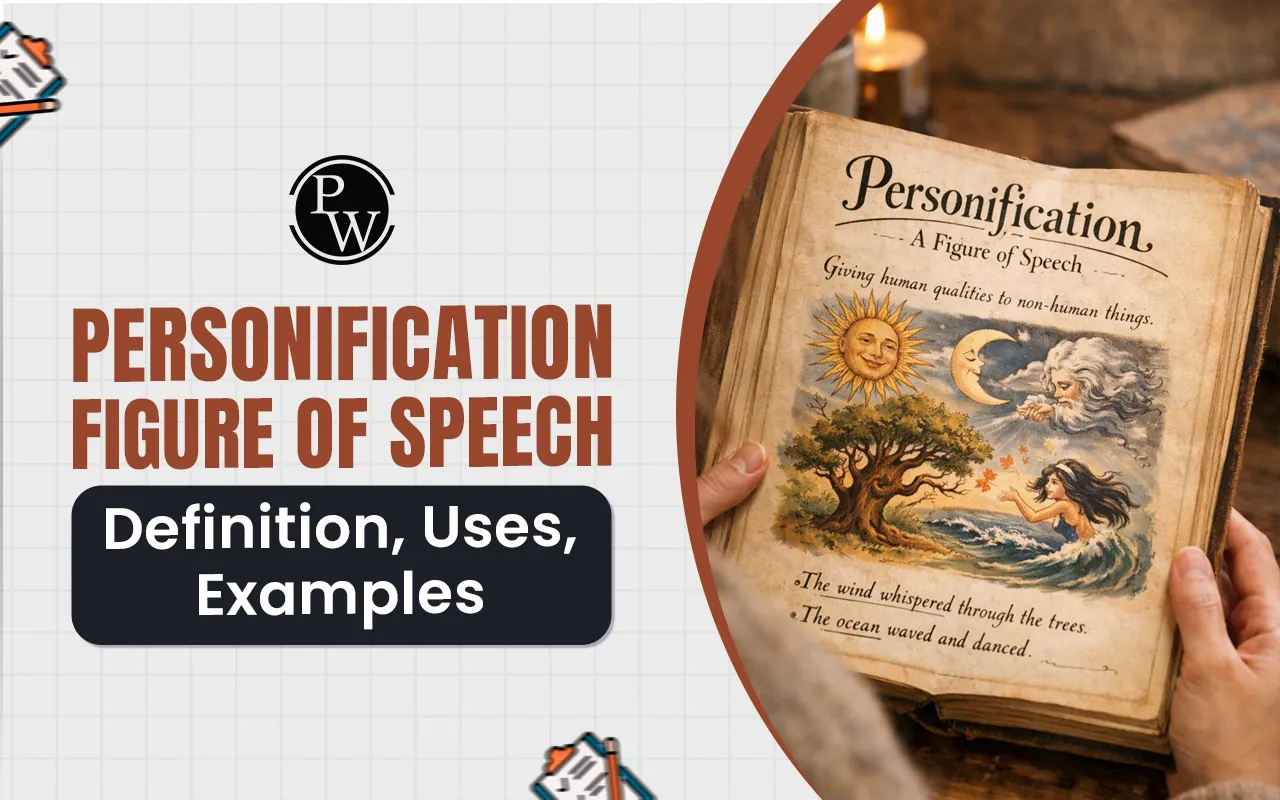
To get started, we need a clear definition. In simple terms, personification is a literary device where human qualities, emotions, or intentions are given to inanimate objects, animals, or abstract ideas.
When you use this technique, you treat a non-human entity as if it has a personality or the ability to act of its own volition. It is a sub-type of metaphor that bridges the gap between the human experience and the world around us. Instead of just stating a fact, you provide a "character" to an object.
According to literary standards, personification occurs when a writer attributes "human-like" characteristics to something that is clearly not human. These characteristics can include:
-
Physical Actions: Running, jumping, whistling, or dancing.
-
Emotional States: Being angry, happy, lonely, or stubborn.
-
Mental Capabilities: Thinking, deciding, or remembering.
For example, consider the sentence: "The camera loves her." A camera is a piece of plastic and glass; it cannot feel love. However, by using personification, the writer suggests that the person looks exceptionally good in photographs.
Why Writers Use Personification?
The personification figure of speech uses are varied, but they all serve the goal of better communication. Writers use it to:
-
Create Mental Images: It is easier to visualising a "dancing flame" than a "flickering fire."
-
Evoke Emotion: Giving an object feelings helps the reader empathise with the scene.
-
Simplify Complex Ideas: Abstract concepts like "justice" or "time" become easier to understand when they act like people.
-
Enhance Atmosphere: A "moaning wind" creates a spooky mood far better than a "loud wind" does.
Rules of Personification Figure of Speech
To use personification effectively, it is important to follow a few simple rules:
-
The subject must be non-human (object, animal, or abstract idea)
-
The action or quality assigned must be human-like
-
The sentence should not be taken literally
-
The personification should enhance imagery or emotion, not confuse the reader
Following these rules ensures that your writing remains clear and impactful.
Personification vs. Anthropomorphism
It is common to confuse personification with anthropomorphism. While they are similar, there is a slight difference. Anthropomorphism is when a non-human thing (like a cartoon animal) actually acts and talks like a human throughout a story. Personification is usually a descriptive phrase used to create imagery within a sentence.
Personification Figure of Speech Examples
The best way to learn is through looking at how this device functions in everyday language and literature. Below are several examples categorized by how they appear in our daily lives.
Nature and Weather
Nature is perhaps the most common subject for this figure of speech because its movements often mimic human behaviour.
-
The flowers bowed their heads in the heavy rain.
-
The lightning danced across the dark purple sky.
-
The wind howled in the night, searching for a way inside.
-
The snow wrapped the garden in a white blanket.
Everyday Objects
We often talk to or about our belongings as if they have their own minds, especially when they aren't working correctly!
-
The car groaned as it struggled to climb the steep hill.
-
The last piece of cake was calling my name from the fridge.
-
The alarm clock yelled at me to wake up at 6:00 AM.
-
The old floorboards complained under the weight of the heavy footsteps.
Abstract Concepts
Abstract ideas like time, love, or opportunity are often personified to make them feel more tangible.
-
Time flies when you are having fun.
-
Opportunity knocked at his door, but he was too afraid to answer.
-
Justice is blind, seeing only the facts of the case.
Read More - Apostrophe Figure of Speech - Definition, Uses, Examples
How To Identify Personification?
A simple way to identify personification is to ask the following:
Can this object behave like a human in real life?
If the answer is no, but the sentence gives it a human action, it is likely personification.
Example:
"The stars winked at us." → Stars cannot wink → Personification
Personification Short Summary
To help you distinguish between a literal sentence and one using personification, look at the comparison table below.
|
Literal Description |
Personified Description |
Human Quality Added |
|
The sun came out. |
The sun smiled down on the hikers. |
Happiness / Smiling |
|
The leaves moved in the wind. |
The leaves danced in the breeze. |
Dancing |
|
The city was loud at night. |
The city never sleeps. |
Sleeping / Consciousness |
|
The engine stopped working. |
The engine gave up its final breath. |
Dying / Breathing |
|
The stars were bright. |
The stars winked at us from above. |
Winking |
How to Use Personification Figure of Speech in Writing
If you want to use the personification in your own school essays or creative stories, follow these simple steps:
-
Identify your Subject: Pick an object or an idea (e.g., a pen, the ocean, or fear).
-
Pick a Human Action: Think of something a person does (e.g., crying, running, whispering).
-
Combine Them: Match the object with the action. If the ocean is rough, you might say "the ocean lashed out in anger."
-
Check for Flow: Ensure the personification matches the mood of your story. You wouldn't want a "happy, giggling brook" in the middle of a scary ghost story!
Read More - Root Words: Definition, Lists, and Examples
Common Mistakes to Avoid in Personification
While using the personification, avoid these common mistakes:
-
Overusing personification, which can make writing feel exaggerated
-
Mixing it with metaphor in a confusing way
-
Using unclear or forced human traits
-
Writing sentences that sound too literal or unnatural
Being mindful of these helps maintain clarity and creativity.
Personification Figure of Speech Practice Questions
Test your understanding with these simple exercises:
-
Identify the personification:
"The sun smiled down on the children." -
Rewrite using personification:
"The wind was strong." -
Find the human trait:
"The old house groaned in the storm."
These exercises help reinforce your understanding for exams.