Perimeter - Definition, Unit, Formula and Examples
 Nikita Aggarwal20 Jan, 2026
Perimeter
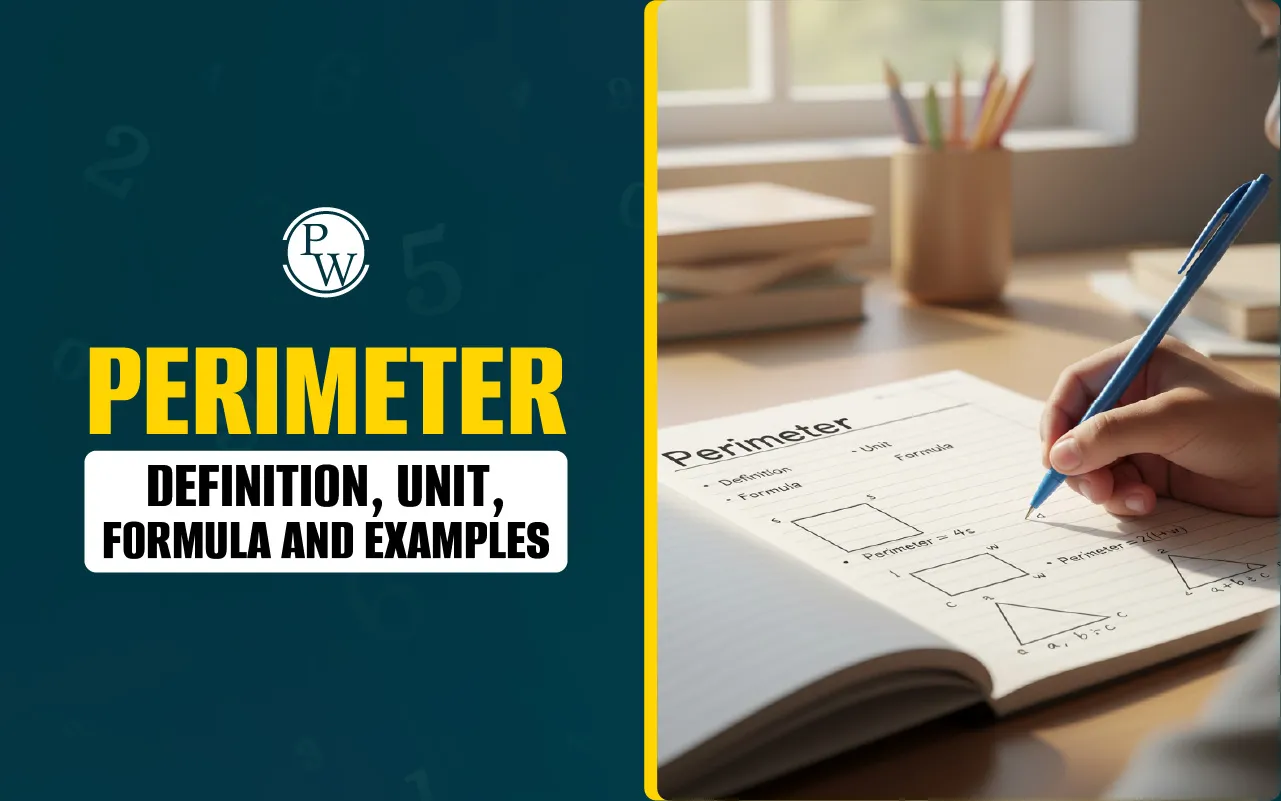
Perimeter is one of the most fundamental concepts in geometry. It represents the total length around the boundary of a two-dimensional shape. Understanding perimeter is essential in daily life, from measuring the edges of a garden to designing frames or calculating fencing requirements. It helps us determine how much material is needed to enclose or outline a particular space.
In mathematical terms, perimeter is measured in linear units such as centimeters, meters, or feet. It applies to both regular shapes, where all sides are equal, and irregular shapes, where sides have different lengths.Students will learn more about perimeter, how to find it for different shapes, its units, common formulas, real-world examples, and the difference between perimeter and area and more below.
What is Perimeter?
The definition of perimeter in geometry is:
Perimeter is the total distance around the boundary of a two-dimensional shape.
In simple terms, if you walk all the way around the edges of a shape, the total distance you cover is its perimeter.
It is found by adding the lengths of all sides of the figure. The perimeter helps determine the boundary length required for enclosing or outlining any flat shape, such as squares, rectangles, triangles, or circles (where the perimeter is called the circumference).
Key Points:
-
The perimeter is a linear measurement, meaning it measures length only.
-
It helps in finding the total boundary of any shape.
-
It applies to both regular shapes (equal sides) and irregular shapes (unequal sides).
Read More - Discounts: Definition, Formula, Rate
How to Find Perimeter of Shapes?
To find the perimeter of any two-dimensional shape, the total length of its outer boundary must be measured. The perimeter depends on the shape’s structure and the number of its sides. Each shape has its own formula to calculate the perimeter accurately. Below are the main perimeter formulas for common geometric shapes.
Perimeter of a Square
A square has four equal sides.
The perimeter of a square is calculated by multiplying one side by four.
Formula: Perimeter = 4 × side
This formula works for all squares, as each side has the same length.
Perimeter of a Rectangle
A rectangle has opposite sides that are equal in length.
The perimeter of a rectangle is found by adding the lengths of all sides or by using the formula below.
Formula: Perimeter = 2 × (Length + Breadth)
This gives the total distance around the rectangle.
Perimeter of a Triangle
A Preimeter of triangle has three sides, and its perimeter is the total of all three side lengths.
Formula: Perimeter = a + b + c
This formula applies to all types of triangles, whether scalene, isosceles, or equilateral.
Perimeter of a Circle (Circumference)
In perimeter of a circle, the boundary length is called the circumference, which acts as the perimeter of the shape.
Formula: Perimeter (Circumference) = 2πr
Here, r represents the radius, and π (pi) is approximately 3.1416.
Perimeter of a Regular Polygon
A regular polygon has equal sides and equal angles. The perimeter of a regular polygon is calculated by multiplying the number of sides by the length of one side.
Formula: Perimeter = Number of sides × Side length
This formula applies to regular shapes like pentagons, hexagons, and octagons.
Perimeter of an Irregular Polygon
An irregular polygon has sides of different lengths. To find its perimeter, measure each side separately and add all the side lengths together.
Formula: Perimeter = Sum of all sides
This method applies to shapes without equal sides or symmetry.
Perimeter of a Parallelogram
A parallelogram has opposite sides equal and parallel. The perimeter is calculated by adding twice the length and twice the breadth.
Formula: Perimeter = 2 × (Length + Breadth)
This formula also applies to special types of parallelograms such as rectangles and rhombuses.
Read More - Area of Isosceles Triangle - Formula, Definition, Examples
Perimeter of a Rhombus
Perimeter of a rhombus has four sides of equal length. Therefore, its perimeter can be calculated by multiplying one side by four.
Formula: Perimeter = 4 × side
Although similar to the formula for a square, a rhombus does not require equal angles.
Perimeter of a Trapezium (Trapezoid)
A trapezium has four sides, with one pair of sides parallel to each other. The perimeter is obtained by adding the lengths of all four sides.
Formula: Perimeter = a + b + c + d
This gives the total boundary length of the trapezium.
Perimeter of an Ellipse
An ellipse is an oval-shaped figure, and its perimeter is slightly more complex to calculate. The approximate formula to find the perimeter of an ellipse is:
Formula (Approximate): Perimeter = 2π √((a² + b²)/2)
Here, a and b represent the semi-major and semi-minor axes of the ellipse.
Read More - Integers: Types, Rules, Properties, and Examples
Perimeter Units
Perimeter units are always linear because the perimeter measures length, not area or volume. The units depend on the measuring system used (metric or imperial).
Common Units:
-
Millimeters (mm)
-
Centimeters (cm)
-
Meters (m)
-
Kilometers (km)
-
Inches (in)
-
Feet (ft)
-
Yards (yd)
Conversion Examples:
-
1 m = 100 cm
-
1 ft = 12 in
-
1 km = 1000 m
-
1 yd = 3 ft
Perimeter Formula
The perimeter formula varies depending on the shape. Below are the most common formulas used in geometry.
|
Shape |
Perimeter Formula |
|
Square |
4 × side |
|
Rectangle |
2 × (Length + Breadth) |
|
Triangle |
a + b + c |
|
Circle (Circumference) |
2πr |
|
Regular Polygon |
Number of sides × Side length |
Examples of Perimeter
Let’s look at some perimeter examples to understand the concept clearly.
Example 1: Square
-
Side = 6 cm
-
Perimeter = 4 × 6 = 24 cm
Example 2: Rectangle
-
Length = 8 cm, Breadth = 3 cm
-
Perimeter = 2 × (8 + 3) = 22 cm
Example 3: Triangle
-
Sides = 5 cm, 6 cm, 7 cm
-
Perimeter = 5 + 6 + 7 = 18 cm
Example 4: Circle
-
Radius = 7 cm
-
Perimeter (Circumference) = 2πr = 2 × 3.1416 × 7 ≈ 43.98 cm
Example 5: Regular Pentagon
-
Each side = 4 cm
-
Perimeter = 5 × 4 = 20 cm
Read More - Parallelogram: Definition, Formulas, and Examples
Difference Between Perimeter and Area
Understanding the difference between perimeter and area is very important in geometry. Though both terms are used in measuring shapes, they describe different aspects.
|
Difference Between Area and Perimeter |
||
|
Feature |
Perimeter |
Area |
|
Definition |
Total length around a shape |
Total surface covered by the shape |
|
Measurement Type |
Linear (one-dimensional) |
Square (two-dimensional) |
|
Units |
cm, m, ft, etc. |
cm², m², ft², etc. |
|
Purpose |
Measures boundary length |
Measures surface coverage |
|
Example |
Length of a fence around a garden |
Total grass-covered surface inside the garden |
Help Students Improve Math Confidence and Speed with CuriousJr
PW CuriousJr offers a Mental Maths Course designed to help students solve math problems faster and more accurately. The course follows an easy, step-by-step approach that covers key math topics, helping learners build strong skills gradually.
Students are encouraged to solve problems in their minds, which boosts their confidence and comfort with numbers. The lessons are short, clear, and engaging, making regular practice simple and fun.
This course focuses on improving basic math skills like addition, subtraction, multiplication, and division while increasing calculation speed. With practical activities and steady learning, students strengthen their understanding of math without pressure.
The PW CuriousJr Mental Maths Course is perfect for school students who want to improve their math performance in an enjoyable and effective way.