Perimeter of a Sector – Formula, Definition, Types & Examples
 Nikita Aggarwal20 Jan, 2026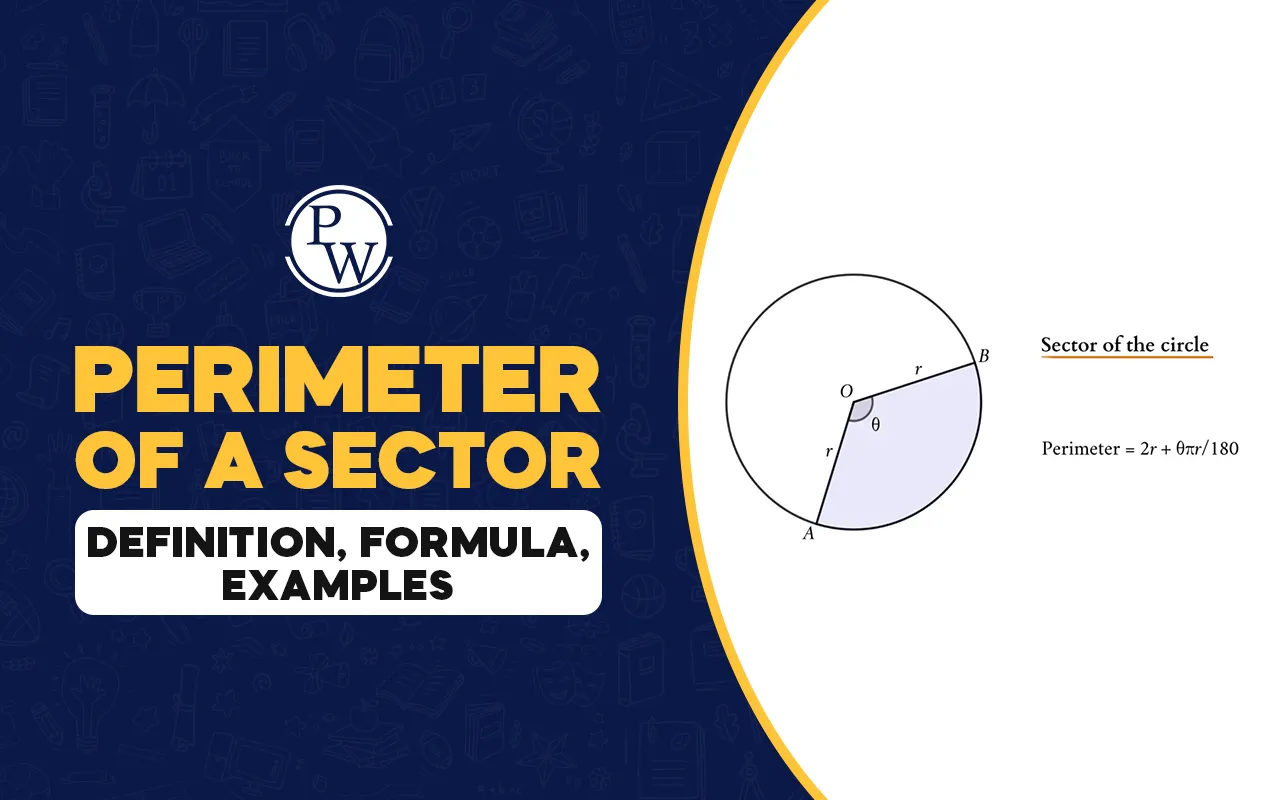
Perimeter of a Sector
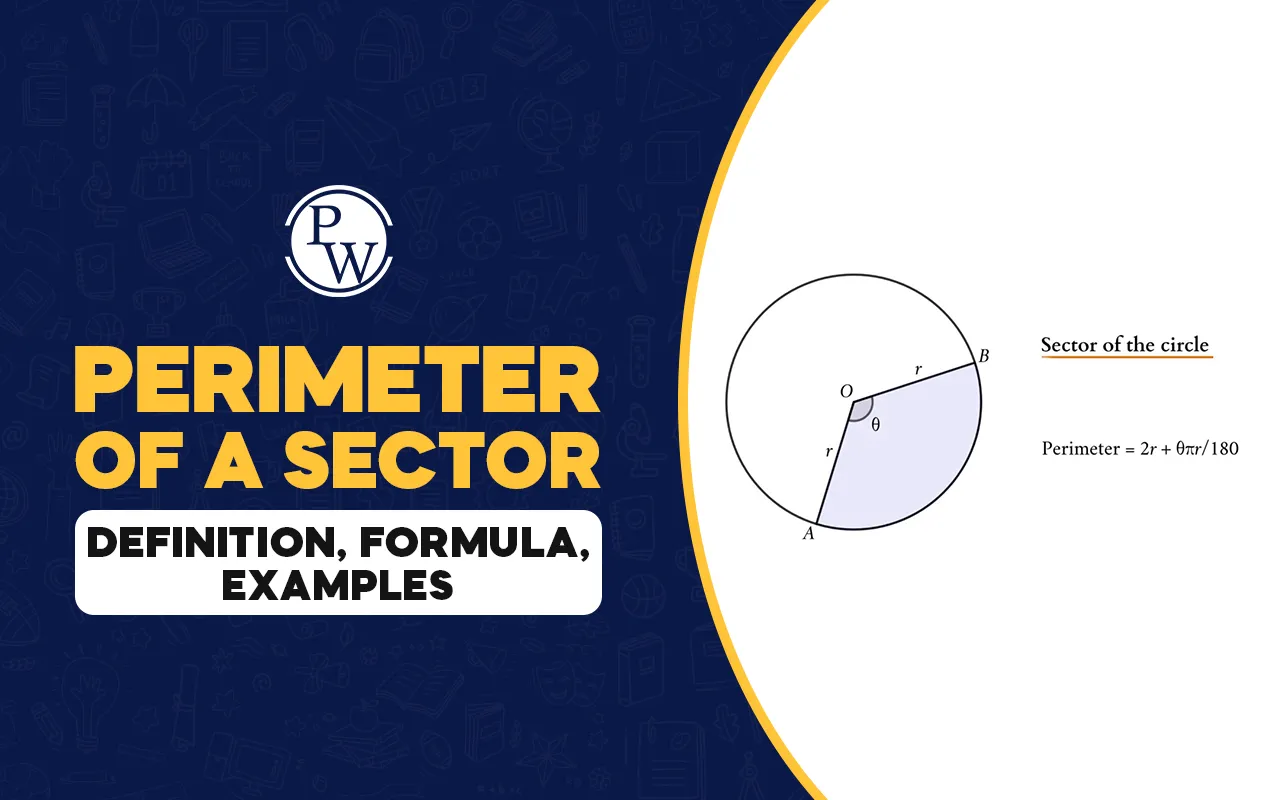
In geometry, a sector is a portion of a circle that resembles a slice of pizza or pie. It is made up of two radii (radius' plural) and the curved part of the circle connecting them, which is called an arc. The perimeter of the sector is the total distance around this slice, consisting of the two straight sides (radii) and the curved side (arc).
Understanding the perimeter of a sector helps us in real-life situations such as finding the length of curved fences, creating circular gardens, or designing round paths. It is also an important topic in geometry because it helps students understand how parts of a circle work.
Students should learn what is the perimeter of a sector, its types, the formula, how to find it, examples with step-by-step solutions and more below.
What is a Perimeter of a Sector?
The perimeter of a sector of a circle is the length of the boundary of a sector. A sector shares a two-radius, one-arc subtended arc and a perimeter that consists of:
-
The arc length (curved length)
-
The two radii (straights) in length.
In short,
Perimeter of a sector = Arc length + 2 Radius.
The concept is helpful where we want to know the amount of material required to cover a curved area or fence a curved area.
As an example, consider a slice of pizza. The radii are the two straight cuts made in the center and the arc is the curved crust. The perimeter of the sector is the sum of the total boundary around this slice of the crust and the two cuts.
Read More - Perimeter of Square - Formula, Definition, Examples
Types of Perimeter of a Sector
The type of sector depends on the size of the central angle (θ) at the center of the circle. Based on this angle, the perimeter of a sector can be of three main types:
1. Minor Sector
-
The central angle is less than 180°.
-
It represents a smaller portion of the circle.
-
The arc length is less than half of the circle’s circumference.
Example: A 60° or 90° slice of a circle is a minor sector.
2. Major Sector
-
The central angle is greater than 180°.
-
It represents a larger portion of the circle.
-
The arc length is more than half of the circle’s circumference.
Example: A 270° sector forms a major sector.
3. Semicircular Sector
-
The central angle is exactly 180°.
-
It forms half of a circle (a semicircle).
-
The arc length is half the circumference, and the perimeter includes the arc and the diameter (sum of two radii).
Read More - 30-60-90 Triangle - Sides, Formula, Examples
Perimeter of a Sector Formula
The formula for finding the perimeter of a sector depends on whether the central angle (θ) is given in degrees or radians.
1. When the angle is in degrees:
Perimeter = 2r + (θ/360) × 2πr
Where:
r = radius of the circle
θ = central angle in degrees
(θ/360) × 2πr = arc length of the sector
2. When the angle is in radians:
Perimeter = 2r + rθ
Where:
rθ = arc length when angle is in radians
Explanation: The formula combines:
-
2r: the two radii, and
-
The arc length, which depends on the angle.
Thus, the perimeter measures the total boundary of the curved slice of a circle.
How to Find the Perimeter of a Sector?
Follow these easy steps to learn how to find the perimeter of a sector of a circle.
Step 1: Identify Given Values
Find the values of:
-
Radius (r)
-
Central angle (θ) check if it’s in degrees or radians.
Step 2: Calculate Arc Length
-
If angle is in degrees: Arc Length = (θ/360) × 2πr
-
If angle is in radians: Arc Length = rθ
Step 3: Add Two Radii
A sector has two straight sides (radii), so we add 2r.
Step 4: Apply the Formula
-
For degrees: Perimeter = 2r + (θ/360) × 2πr
-
For radians: Perimeter = 2r + rθ
Step 5: Simplify the Expression
Calculate and simplify the values to find the final perimeter.
Read More - Pentagon Definition, Properties and Example
Perimeter of a Sector Examples
Let’s solve a few examples to understand this better.
Example 1: Find the perimeter of a sector of a circle with a radius of 7 cm and a central angle of 90°.
Solution:
Given: r = 7 cm, θ = 90°
Step 1: Find arc length
Arc Length = (θ/360) × 2πr
= (90/360) × 2 × 3.14 × 7
= (1/4) × 43.96 = 10.99 cm
Step 2: Find perimeter
Perimeter = 2r + Arc Length
= 2 × 7 + 10.99 = 14 + 10.99 = 24.99 cm
Final Answer: The perimeter of the sector is approximately 25 cm.
Example 2: Find the perimeter of a sector of a circle with a radius of 5 m and a central angle of 2 radians.
Solution:
Given: r = 5 m, θ = 2 radians
Step 1: Find arc length
Arc Length = rθ = 5 × 2 = 10 m
Step 2: Find perimeter
Perimeter = 2r + rθ = 2 × 5 + 10 = 10 + 10 = 20 m
Final Answer: The perimeter of the sector is 20 meters.
Example 3: Find the perimeter of a semicircular sector with a radius of 10 cm.
Solution:
Given: r = 10 cm, θ = 180°
Step 1: Find arc length
Arc Length = (θ/360) × 2πr
= (180/360) × 2 × 3.14 × 10
= 1 × 3.14 × 10 = 31.4 cm
Step 2: Find perimeter
Perimeter = 2r + Arc Length
= 20 + 31.4 = 51.4 cm
Final Answer: The perimeter of the semicircular sector is 51.4 cm.
Read More - Parallelogram: Definition, Formulas, and Examples
Boost Your Math Speed and Confidence with PW CuriousJr’s Mental Maths Course
PW CuriousJr offers a structured Mental Maths Course designed to help students improve their speed, accuracy, and confidence in mathematics.
The course is designed in a progressive learning style, which is easy to learn and apply to every idea. Regular lessons teach students to solve problems in their mind, which will create comfort and confidence with numbers.
The lessons are easy to follow as they are simple and engaging and learners do not need to stress or to feel overwhelmed.
Key Features of the Course
-
Focus on basic math concepts like addition, subtraction, multiplication, and division
-
Speed and accuracy training to solve problems quickly and efficiently
-
Hands-on activities and regular practice to strengthen mental math skills
-
A stress-free and student-friendly approach to make learning enjoyable
This course is a perfect choice for school students who want to sharpen their everyday math skills and become more confident with numbers in a fun and supportive environment.
Perimeter of a Sector FAQs
What is the perimeter of a sector?
What is the perimeter of a sector formula in degrees?
What is the perimeter of a sector formula in radians?
How to find the perimeter of a sector if only arc length is given?
Can the perimeter of a sector be greater than the circumference of the circle?