Linear Polynomials: Definition, Meaning, and Solved Examples
 Nikita Aggarwal15 Apr, 2026
What is a Linear Polynomial?
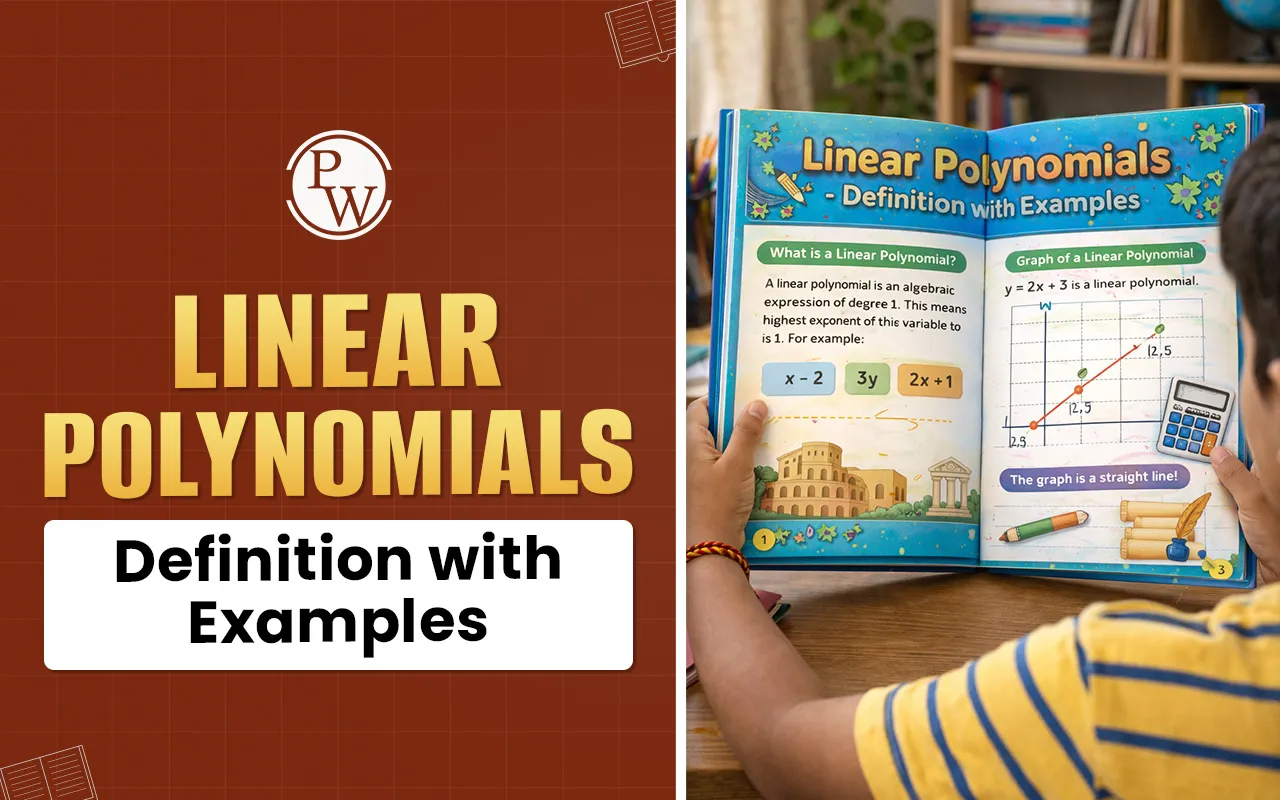
In algebra, a polynomial is an expression consisting of variables and coefficients. The word "linear" gives us a massive clue about its nature, it relates to a straight line. By the standard linear polynomial definition, It is a polynomial expression in which the highest power of the variable is 1. It is written in the form ax + b, where a and b are constants and a ≠ 0. It represents a straight-line relationship between variables when graphed.
For example, in the expression 3x + 5, the variable x has an invisible exponent of 1. Because there are no higher powers like x^2 or x^3, this is a linear polynomial in maths. If you were to draw this on a coordinate plane, the result would be a perfectly straight line, never curving or looping.
The General Form of a Linear Polynomial
To identify a linear polynomial for students, we look for a specific structure. The standard mathematical form is:
P(x) = ax + b
In this formula:
-
x is the variable.
-
a is the coefficient of x (and a cannot be zero).
-
b is the constant term.
If a were zero, the variable x would disappear, leaving only a constant number. That would no longer be a linear polynomial, but a "constant polynomial".
Key Characteristics of Linear Polynomials
How can you be certain you are looking at a linear polynomial example? Look for these three defining traits:
-
The Degree is One: The highest power of the variable must be 1.
-
One Zero: A linear polynomial has exactly one "root" or "zero"—the value of x that makes the whole expression equal to zero.
-
Straight Line Graph: When graphed, it always produces a straight line. The value of a determines the slope (steepness), and b determines where it crosses the vertical axis.
Solving a Linear Polynomial
One of the most frequent tasks for students is finding the "zero" of a polynomial. This means finding the value of the variable that makes the expression equal 0.
Problem: Find the zero of P(x) = 2x - 8.
Step-by-Step Solution:
-
Set the expression to zero: 2x - 8 = 0.
-
Move the constant to the other side: 2x = 8.
-
Divide by the coefficient: x = 8 / 2.
-
Result: x = 4.
When x is 4, the polynomial becomes 2(4) - 8, which equals 0. Therefore, 4 is the zero of this linear polynomial.
Read More - Zeros of Polynomials - A Complete Guide
Linear Polynomial Examples
Let’s look at some common versions of these expressions to see what is linear polynomial logic in practice.
1. Basic Examples
-
x + 2: The simplest form where a = 1 and b = 2.
-
5y - 10: Here, the variable is y, but it is still linear because the power is 1.
-
-3z: This is still linear even though there is no constant "b" shown (in this case, b=0).
Solving Linear Polynomial Questions:
Example 1: Identifying the Coefficients
Problem: Given the linear polynomial P(x) = -4x + 12, identify the coefficient of x and the constant term.
Solution:
-
Compare the given expression to the standard linear polynomial definition form: ax + b.
-
The value multiplied by the variable is a; here, a = -4.
-
The standalone number is the constant b. Here, b = 12.
-
Result: The coefficient is -4 and the constant is 12.
Example 2: Finding the Zero with Fractions
Problem: Find the zero of the linear polynomial P(x) = 3x + 5.
Solution:
-
To find the zero, set the polynomial to zero: 3x + 5 = 0.
-
Subtract 5 from both sides: 3x = -5.
-
Divide both sides by the coefficient (3): x = -5/3.
-
Result: The zero of the polynomial is -1.67 (or -5/3).
Example 3: Verifying a Linear Polynomial
Problem: Which of the following is a linear polynomial example?
A) x^2 - 4
B) 7(x - 1) + 2
C) 3/x + 5
Solution:
-
Check A: The power of x is 2. This is quadratic, not linear.
-
Check B: Simplify the expression: 7x - 7 + 2, which becomes 7x - 5. The highest power of x is 1. This is a linear polynomial.
-
Check C: The variable is in the denominator (x^{-1}). This is a rational expression, not a polynomial.
-
Result: B is the correct linear polynomial.
Read More - Factoring Polynomials – Methods, Examples & Steps
Example 4: Creating a Polynomial from a Word Problem
Problem: A taxi driver charges a flat fee of £5 plus £2 for every mile travelled. Write this as a linear polynomial in maths and find the cost for a 10-mile journey.
Solution:
-
Let x represent the number of miles.
-
The cost per mile is the coefficient (a = 2).
-
The flat fee is the constant (b = 5).
-
The polynomial is P(x) = 2x + 5.
-
To find the cost for 10 miles, substitute x = 10: 2(10) + 5 = 20 + 5.
-
Result: The total cost is £25.
Example 5: Solving for x when P(x) is given
Problem: If the value of the linear polynomial P(x) = 5x - 10 is 20, what is the value of x?
Solution:
-
Set the expression equal to the given value: 5x - 10 = 20.
-
Add 10 to both sides: 5x = 30.
-
Divide by 5: x = 30 / 5.
-
Result: x = 6.
Comparison Between a Linear Polynomial vs. Quadratic Polynomial
|
Feature |
Linear Polynomial |
Quadratic Polynomial |
|
Highest Power (Degree) |
1 |
2 |
|
Standard Form |
ax + b |
ax^2 + bx + c |
|
Graph Shape |
Straight Line |
Parabola (U-shape) |
|
Number of Zeros |
Exactly 1 |
Up to 2 |
Importance of Linear Polynomials in Maths
Why do we spend so much time on linear polynomial for students?
-
Foundation for Calculus: You cannot understand slopes and rates of change without mastering linear equations first.
-
Predictive Modeling: Business analysts use linear relationships to forecast sales and growth trends.
-
Simple Logic: They provide the most direct way to represent cause and effect. If you double the input, the output changes by a consistent, predictable amount.
Make Maths Easy and Fun with CuriousJr
CuriousJr helps children build a strong maths foundation by removing fear and boosting confidence. Our Mental Maths online classes for students from Classes 1 to 8 are designed to improve speed, accuracy, and logical thinking using simple techniques and interactive learning methods.
With our dual-mentor approach, students attend engaging live sessions and receive dedicated support for doubt clarification after every class. Animated lessons, fun activities, and exciting challenges make maths learning easy and enjoyable.
Parents also receive regular progress reports along with review sessions, ensuring full transparency in their child’s learning journey.
Book a demo class today and see how CuriousJr makes maths simple, engaging, and confidence-building for your child.