Perimeter of a Circle – Definition, Formula, πd & 2πr with Examples
 Shivam Singh19 Jan, 2026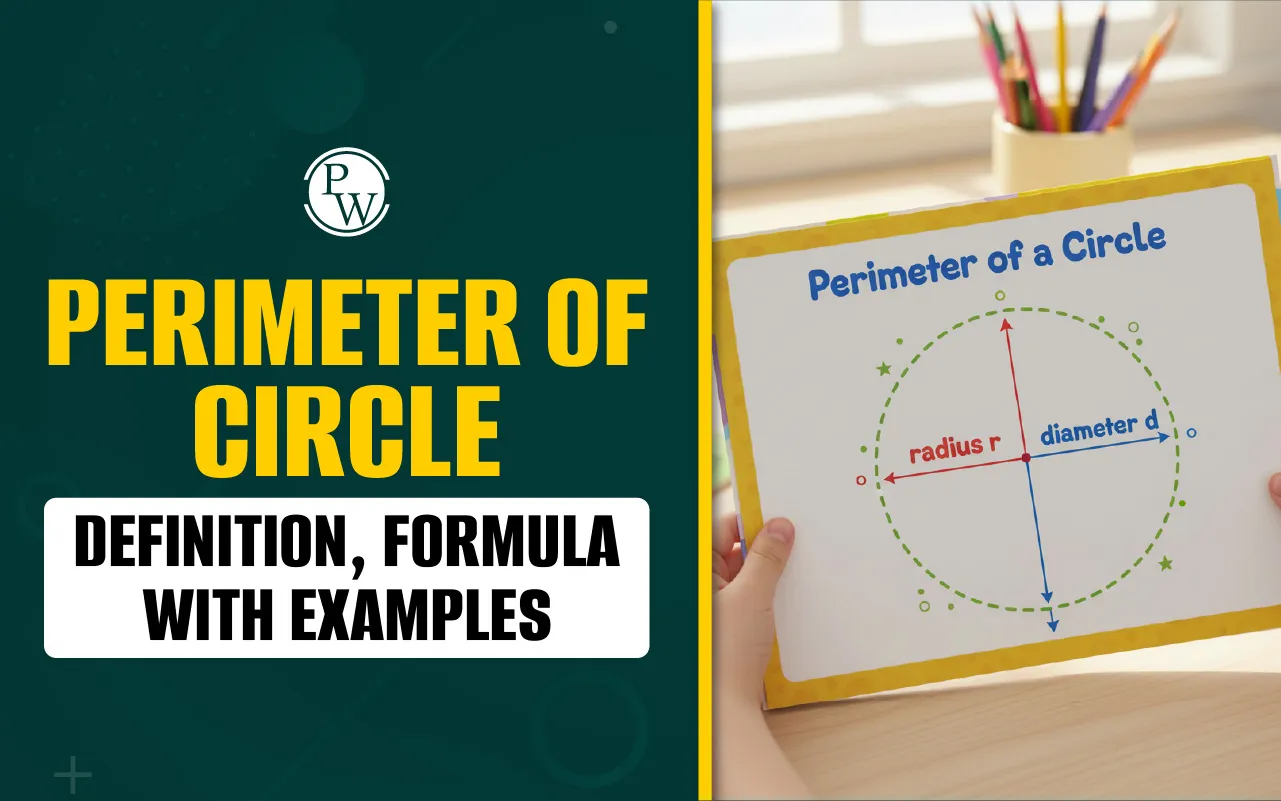
Perimeter of a Circle
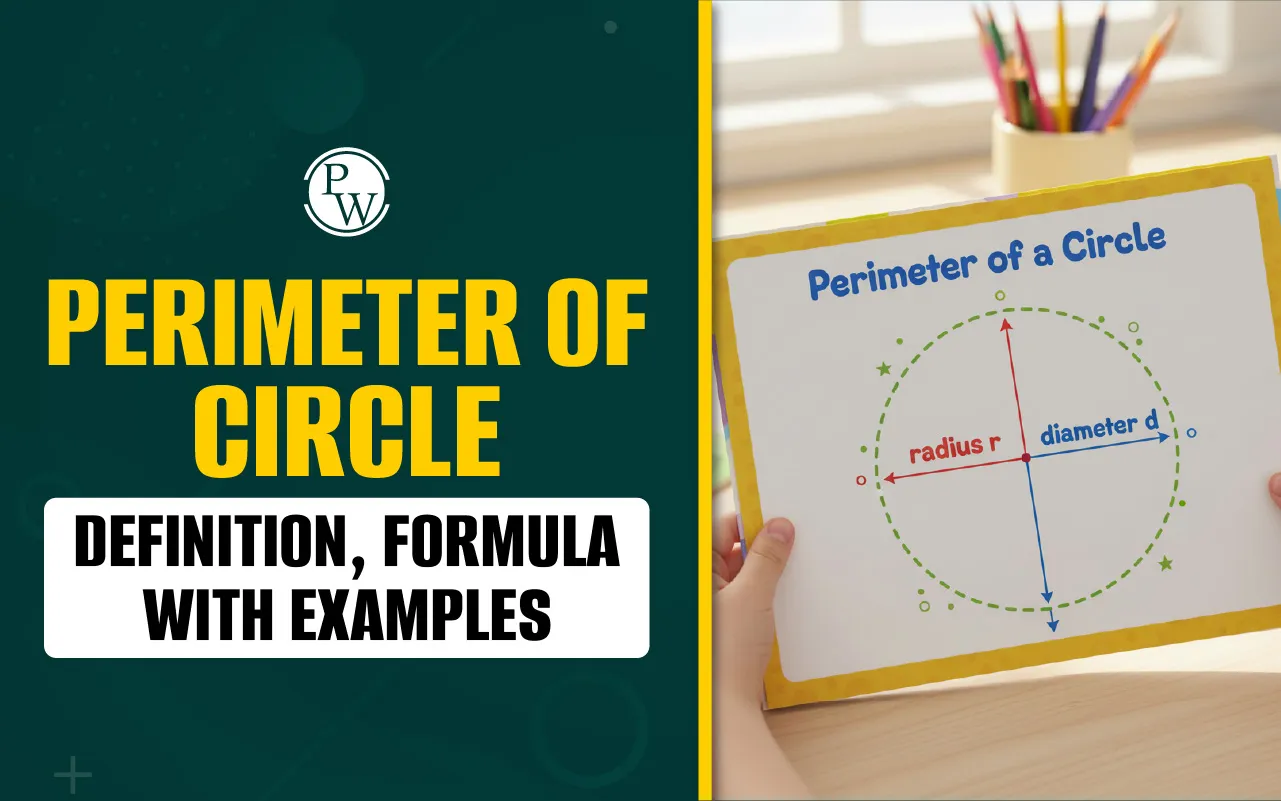
Perimeter of a circle means the total distance around the circle. It is also called the circumference. To find the perimeter of a circle, we use the formula C = 2πr or C = πd, where C stands for circumference, r is the radius, d is the diameter, and π (pi) is a constant with a value of about 3.14.
Just like the perimeter of a square or rectangle shows the length of its boundary, the circumference tells us how long the boundary of a circle is. In geometry, this concept is very important to find the boundary of round objects like coins, wheels, and plates. So, keep reading to learn more about the perimeter of a circle formula along with examples.
What is the Perimeter of a Circle Formula?
As we learnt, the perimeter of a circle, or the circumference, is the distance that goes all the way around the circle. We use the perimeter of a circle formula to know how long the circle’s outer edge is.
The perimeter of a circle formula is:
Perimeter (Circumference) = 2 × π × r
Here,
-
r means the radius of the circle (distance from the centre to the edge).
-
D means the diameter of the circle (distance across the circle passing through the centre).
-
π (pi) is a fixed number that always has a value close to 3.14.
So, the circle perimeter formula can also be written as C = 2πr or C = πD, depending on the values given in the question. You can use either of them to find how long the outer boundary of the circle is.
Read More: Area of Semicircle
Area and Perimeter of Circle Formula
The area and perimeter of a circle formula help us understand two important things about a circle:
-
How much space does it cover inside, and
-
How long is its boundary?
The perimeter of a circle is the total distance around it, while the area of a circle tells us how much space is inside the boundary.
The circle perimeter formula and area formulas are:
-
Perimeter of a circle = 2πr or πD
-
Area of a Circle = πr²
Here, r is the radius and D is the diameter of the circle. Both formulas are connected because they use the same value of radius or diameter. So, if you know the radius of a circle, you can easily calculate both using the area and perimeter of circle formulas.
Read More: Cone: Formula, Properties, Types, Examples
Real-Life Applications of the Perimeter of a Circle
The perimeter of a circle is useful not only in solving maths questions but also in many real-life scenarios. Knowing the area and perimeter of circle formula can help in daily tasks, making things, and solving real problems. Here are some key applications:
-
To find how much rope or tape is needed to go around a round garden or field.
-
To measure the border needed for round tables or circular decorations.
-
To calculate how far a wheel moves in one complete turn, useful in vehicles and machines.
-
To help builders measure materials for making circular structures like pools, columns, or roundabouts.
-
To understand the sizes of planets and other round objects in science and astronomy.
Read More: What is a Polyhedron
Solved Perimeter of a Circle Examples
Let’s learn how to use the perimeter of a circle formula with some easy-to-understand word problems.
Example 1: A round garden has a diameter of 8 cm. We want to put a small rope around it. What will be the length of the rope?
Solution: Diameter = 8 cm
Perimeter = π × D
= 3.14 × 8
= 25.12 cm
So, the rope should be 25.12 cm long.
Example 2: A circular table has a radius of 5 cm. We want to add a ribbon around it. How long will the ribbon be?
Solution: Radius = 5 cm
Perimeter = 2 × π × r
= 2 × 3.14 × 5
= 31.4 cm
The ribbon will be 31.4 cm long.
Example 3: A round plate has a diameter of 20 cm. We want to measure its edge length. What is it?
Solution: Diameter = 20 cm
Perimeter = π × D
= 3.14 × 20
= 62.8 cm
The edge length of the plate is 62.8 cm.
Example 4: A circular pond has a radius of 12 cm. A small fence will be built around it. How long will the fence be?
Solution: Radius = 12 cm
Perimeter = 2 × π × r
= 2 × 3.14 × 12
= 75.36 cm
The fence needs to be 75.36 cm long.
Also Read: Euler's Formula
Help Your Child Enjoy and Learn Maths Better With CuriousJr
Many parents worry when their child avoids maths homework because lessons feel too hard to understand. This can lower confidence and make learning stressful.
CuriousJr's Online Tuition Classes after school make maths simple and enjoyable for your child. It helps them understand the basic concepts deeply and gives them confidence to solve maths problems on their own. Here is what these online tuition classes by CuriousJr offer:
-
Interactive online lessons that make learning fun and effective
-
Personal teacher support to solve doubts and help with homework
-
Engaging activities to make tough maths concepts easy to understand
-
Daily progress tracking so parents can see improvement
Book a demo class today and help your child enjoy learning maths with ease.