
NCERT Solutions for Class 6 Science Chapter 5 Separation of Substances
 Shivam Singh15 Sept, 2026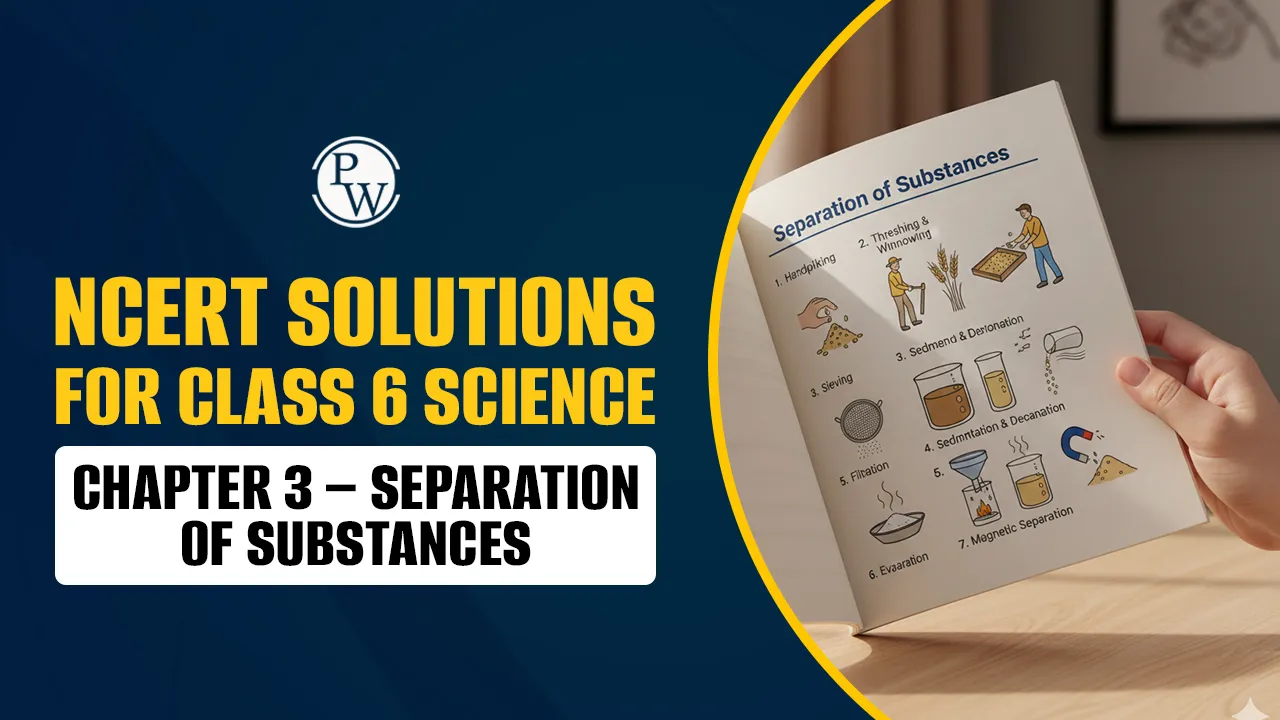
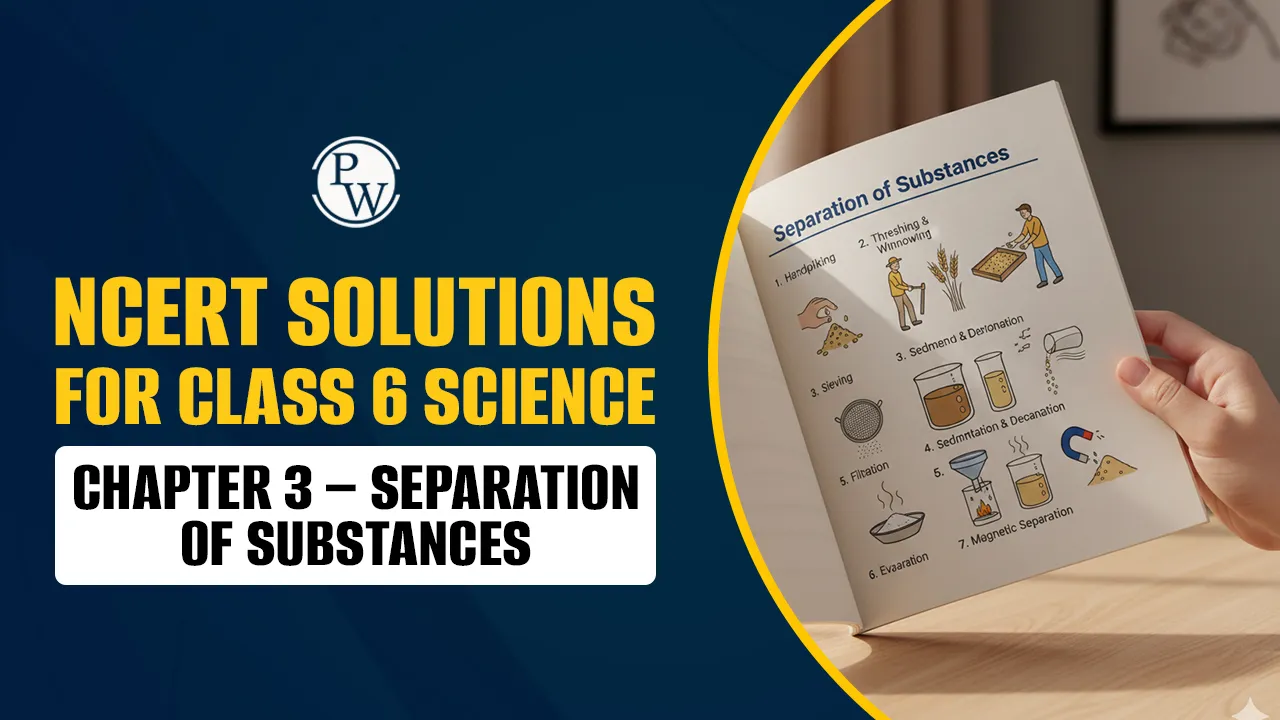
Separation of Substances is an important topic in Class 6 Science Chapter 5 that helps students understand how different materials can be separated based on their properties. In our daily life, we often need to separate useful substances from unwanted ones, such as removing stones from rice or separating tea leaves from tea. This chapter explains these ideas in a simple and practical way.
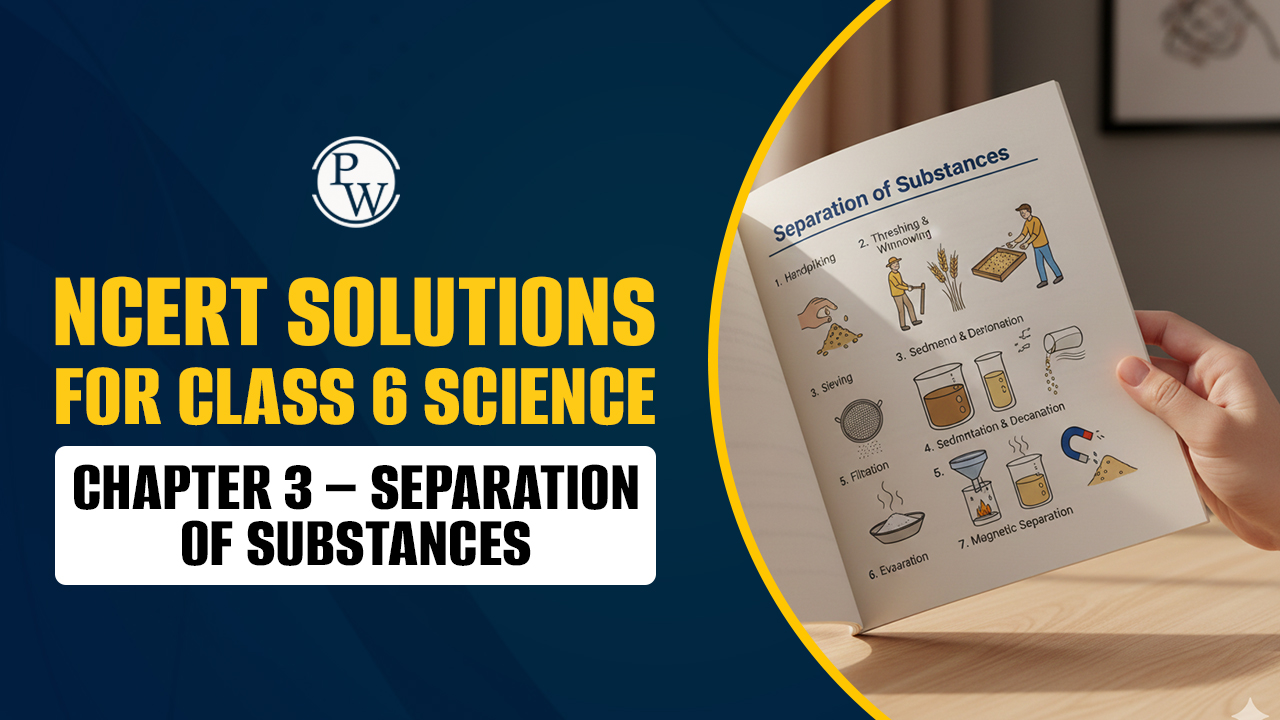
The chapter covers common methods like handpicking, threshing, winnowing, sieving, sedimentation, decantation, filtration, evaporation, and condensation. Each method is explained with easy examples so that students can relate them to real-life situations. Understanding these methods builds a strong foundation for higher science concepts.
Students looking for separation of substances class 6 questions and answers can rely on these separation of substances class 6 NCERT solutions for clear and accurate explanations. The NCERT Solutions for Class 6 Science Chapter 5 follow the latest syllabus and help students answer textbook questions correctly. These solutions are useful for homework, exams, and quick revision.
Overall, Class 6 separation of substances is a scoring chapter if studied well. Practicing Class 6 Science Chapter 5 questions and answers regularly will improve concept clarity and boost confidence in science.
Separation of Substances Class 6 Questions and Answers
NCERT Solutions for Class 6 Science Chapter 5 Separation of Substances are provided here with simple step-by-step explanations.
Exercise
Questions 1. Why do we need to separate different components of a mixture? Give two examples.
Solution: When two or more substances are mixed together, they form a mixture. Components of a mixture should be separated because some components may not be useful or may spoil the useful component of the mixture. Examples: Tea leaves are separated from the liquid with a strainer while preparing tea. Removal of stone pieces from wheat, rice or pulses by hand.
2. What is winnowing? Where is it used?
Solution: The method of separating the components from a mixture is known as winnowing. In this method, heavier and lighter components of a mixture are separated by wind or by blowing air. This method is used by farmers to separate lighter husk particles from heavier seeds of grain.
3. How will you separate husk or dirt particles from a given sample of pulses before cooking?
Solution: Husk and dirt particles are separated from pulses by winnowing.
4. What is sieving? Where is it used?
Solution: Sieving is a method in which fine particles are sieved through holes in the sieve while the bigger impurities remain on the sieve. Sieving is used in a flour mill to separate impurities like husk and stones from wheat before grinding it. It is also used at construction sites to separate pebbles and stones from sand.
5. How will you separate sand and water from their mixture?
Solution: Sand and water are separated from their mixture by the following steps: a) The mixture is allowed to stand without any disturbances. b) Now, sand settles down. c) Slowly pour the water into another container to obtain sand in the bottom.
6. Is it possible to separate sugar mixed with wheat flour? If yes, how will you do it?
Solution: Yes, it is possible to separate sugar mixed with wheat flour by the following method: a) Mix sugar and wheat flour in water. b ) Stir the solution to allow the sugar to dissolve. c) Now, filter the mixture. d ) Filtrate contains the sugar solution, and the residue will be wheat flour.
7. How would you obtain clear water from a sample of muddy water?
Solution: The following process should be carried out to obtain clear water from muddy water: i) Allow muddy water to stand. ii) Mud gets settled down in the water. iii) Slowly pour water into another container.
8. Fill in the blanks. (a) The method of separating the seeds of paddy from its stalks is called ___________. (b) When milk, cooled after boiling, is poured onto a piece of cloth, the cream (malai) is left behind on it. This process of separating cream from milk is an example of ___________. (c) Salt is obtained from seawater by the process of ___________. (d) Impurities settled at the bottom when muddy water was kept overnight in a bucket. The clear water was then poured off from the top. The process of separation used in this example is called ___________.
Solution:
(a) The method of separating the seeds of paddy from its stalks is called threshing. (b) When milk cooled after boiling is poured onto a piece of cloth, the cream (malai) is left behind on it. This process of separating cream from milk is an example of filtration. (c) Salt is obtained from seawater by the process of evaporation. (d) Impurities settled at the bottom when muddy water was kept overnight in a bucket. The clear water was then poured off from the top. The process of separation used in this example is called decantation.
9. True or false. (a) A mixture of milk and water can be separated by filtration. (b) A mixture of powdered salt and sugar can be separated by the process of winnowing (c) Separation of sugar from tea can be done with filtration. (d) Grain and husk can be separated with the process of decantation.
Solution:
a) False b) False c) False d) False
10. Lemonade is prepared by mixing lemon juice and sugar in water. You wish to add ice to cool it. Should you add ice to the lemonade before or after dissolving sugar? In which case would it be possible to dissolve more sugar?
Solution: Ice should be added to lemonade after dissolving sugar. It is possible to add more sugar before adding ice.
Read More: Chemical Mixtures
Essential Separation of Substances Class 6 Questions and Answers Guide
Students who hunt for a separation of substances class 6 questions and answers frequently want to know why we need to separate substances in the first place. The NCERT curriculum says that we separate parts of a combination for three major reasons: to get rid of hazardous or useless parts, to get rid of impurities, and to get rid of parts that are beneficial but different.
We churn milk to make butter, for example. In this scenario, both milk and butter are useful. But when we use a sieve to separate tea leaves from tea, we are taking out something that isn't useful. We also take out little stones or bugs from grains or beans before cooking because they are bad for you. Students can review these ideas offline and get ready for their tests better with separation of substances class 6 questions and answers.
In many cases, students might encounter a separation of substances class 6 questions and answers section in their tests. A lot of the time, these multiple-choice questions are about the meanings of different ways to separate things. The first step to learning the separation of substances class 6 questions and answers part element of the science syllabus is to understand the "why" and "how" of these processes.
Methods of Separating Substances and Their Practical Applications
In this chapter, you will learn about some physical ways to segregate things depending on their size, weight, and state of matter. Each approach is unique to the kind of mixture being worked with.
Picking by hand
Handpicking is a way to separate wheat, rice, or legumes that have small particles of dirt, stone, or husk in them. This strategy works best when there aren't too many of these kinds of contaminants and they can be easily seen with the naked eye.
Separating grains from stalks
The process of threshing separates grain from stalks. The stalks are dried in the sun after they are picked. There are a lot of grain seeds on each stalk. Because the seeds are too little to be picked like mangoes or guavas, threshing is used. To get the grain seeds out, the stalks are hit. For big amounts of grain, threshing is sometimes done with the help of bullocks or machinery.
Winnowing
Winnowing is a way to separate the heavier and lighter parts of a mixture using wind or blowing air. Farmers often use this approach to separate lighter husk particles from heavier seeds of grain. The combination is dropped from a height. The wind carries away the lighter husk, making a separate pile, while the heavier grain seeds fall straight down, making a pile near the platform.
Sifting
When the parts of a combination of various sizes, sieving is used. The sieve lets the little particles past, while the bigger pollutants stay on top of it. Before grinding wheat, a flour mill removes dirt and stones by sifting it. Sieving is also used at building sites to separate sand from pebbles and stones.
Sedimentation, Decantation, and Filtration
These are the ways to separate solids that don't dissolve in liquids:
-
Sedimentation: It is the process by which the heavier part of a mixture settles after water is introduced.
-
Decantation: It is the process of removing the water and particles by tilting the container.
-
Filtration: This method uses a filter, such as a strainer or filter paper, to get rid of smaller pollutants that decantation can't get rid of. For instance, filtering tea leaves out of tea is better than decanting them.
Read More: Metals and Non-metals
Complex Separation Processes: Sand, Salt, and Water
A common challenge in the separation of substances class 6 questions and answers is explaining how to separate a mixture of sand and salt. Since both are solids and salt is considerably finer, you can't pick them up by hand or use a sieve. Instead, you need to follow a series of steps:
To combine with water, add water to the mixture and stir. The sand stays solid while the salt dissolves in the water.
Let the mixture sit so that sedimentation and decantation can happen. The sand settles to the bottom (sedimentation). Then, the salty water can be emptied into a different container (decantation).
-
Filtration: A filter can be used to make sure that no little sand particles are left in the liquid.
-
Evaporation: The kettle heats up the salt water. The water evaporates, leaving the salt in the kettle.
-
Condensation: To get the water back, the steam from the kettle is cooled by touching a metal plate with ice on it. The steam turns back into water (condensation) and is put into a different beaker.
Can Water Dissolve Any Amount of a Substance?
Water can dissolve a lot of things, but not everything. If a solution can't dissolve any more of a chemical at a certain temperature, it is said to be "saturated." If you keep adding salt to a specific amount of water, the salt will ultimately stop dissolving and sink to the bottom. You can, however, dissolve extra salt in the water by heating it. This is an important idea that you will often see separation of substances class 6 questions and answers.
|
Method |
Property Used for Separation |
Example |
|
Handpicking |
Difference in size/color of large particles |
Removing stones from pulses |
|
Winnowing |
Difference in weight (Heavier vs Lighter) |
Separating husk from grain |
|
Sieving |
Difference in size of fine particles |
Separating pebbles from sand |
|
Filtration |
Insoluble solid in a liquid |
Separating tea leaves from tea |
|
Evaporation |
Soluble solid in a liquid |
Obtaining salt from seawater |
Read More:
| NCERT Solutions for Class 6 Science Chapter 1 | NCERT Solutions for Class 6 Science Chapter 2 |
How CuriousJr Makes Online Learning Easy and Enjoyable
Every child learns better with the right support, patience, and guidance. CuriousJr transforms online learning at home into a happy and stress-free experience for both children and parents.
Parents choose CuriousJr’s online tuition classes because they keep children engaged, confident, and eager to learn. We create a friendly and supportive learning space where students feel relaxed, understood, and encouraged—never overwhelmed or confused.
Our online classes focus on building strong concept clarity while nurturing curiosity and creativity. With interactive lessons, fun activities, and regular practice, children stay involved and develop a genuine interest in learning.
Experienced and caring teachers provide individual attention, especially to students who need extra support. This helps children understand difficult topics at their own speed and grow in confidence. Parents receive regular progress updates and clear feedback, making it simple to track improvement and spot learning gaps.
Book a demo class today and see how CuriousJr makes online learning simple, engaging, and effective for your child.
|
Related Articles |





NCERT Solutions for Class 6 Science Chapter 5 FAQs
What can we do to separate sand and water?
Is it possible to separate sugar and wheat flour?
What does it mean to have a saturated solution?
How PW CuriousJr classes help Class 6 Science Students?





Get Free Counselling Today
and Clear up all your Doubts
 Live & recorded classes available at easeDashboard for progress trackingLakhs of practice questions

