Multiplication as Repeated Addition - Definition and Examples
 Shivam Singh19 Jan, 2026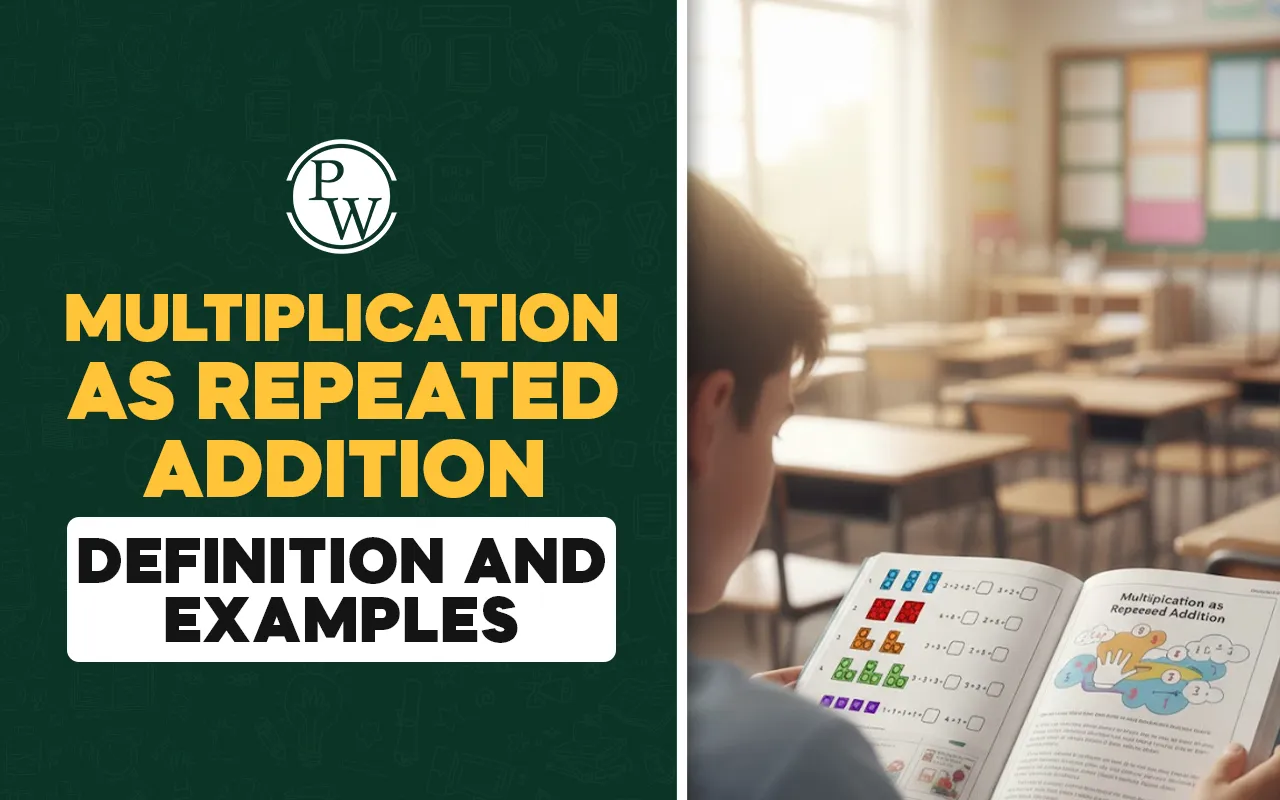
Multiplication as Repeated Addition
Multiplication as repeated addition means adding the same number again and again. When we have equal groups and we want to find the total, we can add them one by one or multiply them.
For example, if you have 3 groups of 4 chocolates, you can add 4 + 4 + 4. This is a repeated addition. The same can be written in multiplication form as 3 × 4.
Read More: Adding and Subtracting of Rational Numbers
What is Repeated Addition?
Repeated addition means adding the same number many times when there are equal groups. Each group must have the same number of items.
For example, imagine there are 6 groups, and each group has 4 marbles. To find the total number of marbles, we add the same number again and again:
4 + 4 + 4 + 4 + 4 + 4
This is a repeated addition because the number 4 is repeated six times.
So the total number of marbles can be written as 4 + 4 + 4 + 4 + 4 + 4 = 24
Why Do We Use Repeated Addition Before Multiplication?
Children understand addition much earlier than multiplication. So using repeated addition helps them move easily from adding numbers to multiplying numbers. It builds confidence and makes learning fun.
Here is why repeated addition is helpful.
-
It shows clearly how groups grow.
-
It helps children count totals without confusion.
-
It prepares their mind to understand multiplication in repeated addition form.
-
It helps them connect number patterns with multiplication tables.
-
It gives them clear steps before they learn how to multiply repeated addition in one step.
Once children understand repeated addition well, multiplication becomes very easy.
Read More: Counting Numbers
How Multiplication and Repeated Addition Are Connected?
Multiplication and repeated addition are connected because both help us find the total number of items in equal groups. The only difference is that repeated addition takes more time, while multiplication gives the answer faster.
If you can add equal numbers again and again, you already understand the idea of multiplication. Every time you add equal numbers, you are using multiplication as repeated addition without noticing it.
Here is the connection:
Repeated addition: 5 + 5 + 5
Multiplication: 3 × 5
This shows 3 groups of 5.
So whenever you multiply, you are adding equal groups in a quicker way. This is why teachers explain that multiplication and repeated addition are closely linked.
Read More: Vedic Maths Tricks For Faster Calculations
Steps to Change Repeated Addition Into Multiplication?
To change repeated addition into a multiplication sentence, we follow a few easy steps. This helps us see how adding equal numbers again and again turns into a single multiplication statement.
Step 1. Count how many times the number is repeated
Look at the repeated addition and find out how many groups there are. For example, if you see 6 + 6 + 6 + 6, the number 6 appears four times. This tells us there are four equal groups.
Step 2. Look at the number being added each time
Check the value that is repeated. In 6 + 6 + 6 + 6, the repeated number is 6.
This tells us each group has 6 items.
Step 3. Write a multiplication sentence to match the repeated addition
Now turn the repeated addition into multiplication by using the idea of equal groups. Since 6 appears four times, there are four groups of six. This gives the multiplication sentence 4 × 6, which shows the same total as 6 + 6 + 6 + 6.
Read More: Zero Divided by a Number
Solved Examples of Multiplication as Repeated Addition
To understand multiplication in repeated addition, here are a few examples of multiplication as repeated addition shown with solutions.
Example 1: How can we write 2 + 2 + 2 as a multiplication sentence?
Solution: The number 2 is repeated three times, so there are three groups of 2. The multiplication sentence is 3 × 2.
Example 2: How can we change 7 + 7 + 7 + 7 into multiplication?
Solution: The number 7 appears four times, which means there are four groups of 7. The multiplication sentence is 4 × 7.
Example 3: What is the multiplication form of 5 + 5 + 5 + 5 +
Solution: The number 5 is repeated five times, so there are five groups of 5. The multiplication sentence is 5 × 5.
Example 4: How do we write 9 + 9 using multiplication?
Solution: The number 9 is repeated two times, so there are two groups of 9. The multiplication sentence is 2 × 9.
Read More: Halves in Math
Multiplication As Repeated Addition Facts
Repeated additional facts help children understand multiplication without feeling scared of big numbers. They help kids break a multiplication question into small and easy steps. Some of the repeated addition facts you should know are:
-
When you add a number two times, you are doing × 2. Example: 4 + 4 = 2 × 4
-
When you add a number three times, you are doing × 3. Example: 3 + 3 + 3 = 3 × 3
-
When you add a number five times, you are doing × 5.Example: 6 + 6 + 6 + 6 + 6 = 5 × 6.
-
When the number of groups grows, the multiplication number on the left side grows.
-
When each group has more items, the number on the right side grows.
Multiplication As Repeated Addition Practice Questions
Try these questions to understand the idea better.
-
Write 4 + 4 + 4 as a multiplication sentence
-
Write 7 + 7 + 7 + 7 + 7 as multiplication.
-
What is the repeated addition form of 6 × 3
-
Draw 3 groups of 5 stars and write both the repeated addition and multiplication sentence.
-
Change the repeated addition 9 + 9 + 9 + 9 into multiplication.
Also read: Quick Calculation Techniques for School Students
Turn Your Childs’ Maths Fear into Fun Learning with CuriousJr Online Classes
Does your child lose focus or feel stuck while solving math problems? Many parents face this challenge. Maths can seem confusing or even scary for children, but with the right guidance, it can become their favourite subject.
CuriousJr’s Online Maths Tuition Classes make learning fun, simple, and aligned with your child’s school syllabus. Here’s what your child gains:
-
Live interactive classes that make every topic easy to understand
-
Daily practice and assignments to strengthen basic concepts
-
Homework help so your child never struggles alone
-
Regular feedback and progress reports to track improvement
-
Two-teacher model for concept teaching and personalised doubt-solving
Book a demo class with CuriousJr today and see how we make math learning fun for our child!
Multiplication as Repeated Addition FAQ
What is multiplication as repeated addition?
What is the rule of repeated addition?
Is multiplication the process of repeated addition true or false?
Give an example of repeated addition in a sentence
What is another name for repeated multiplication?