Halves in Math – Definition, Fractions, Uses, Examples
 Nikita Aggarwal19 Dec, 2025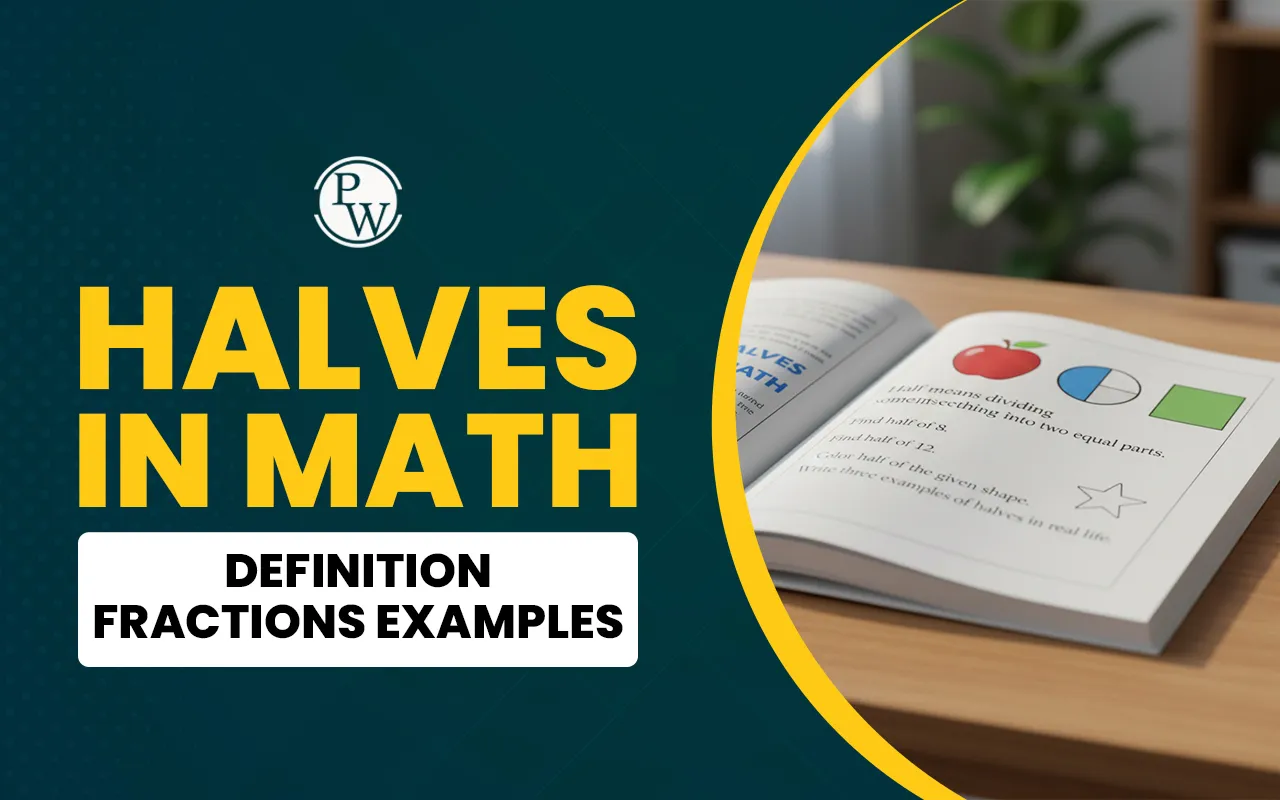
Halves in Math
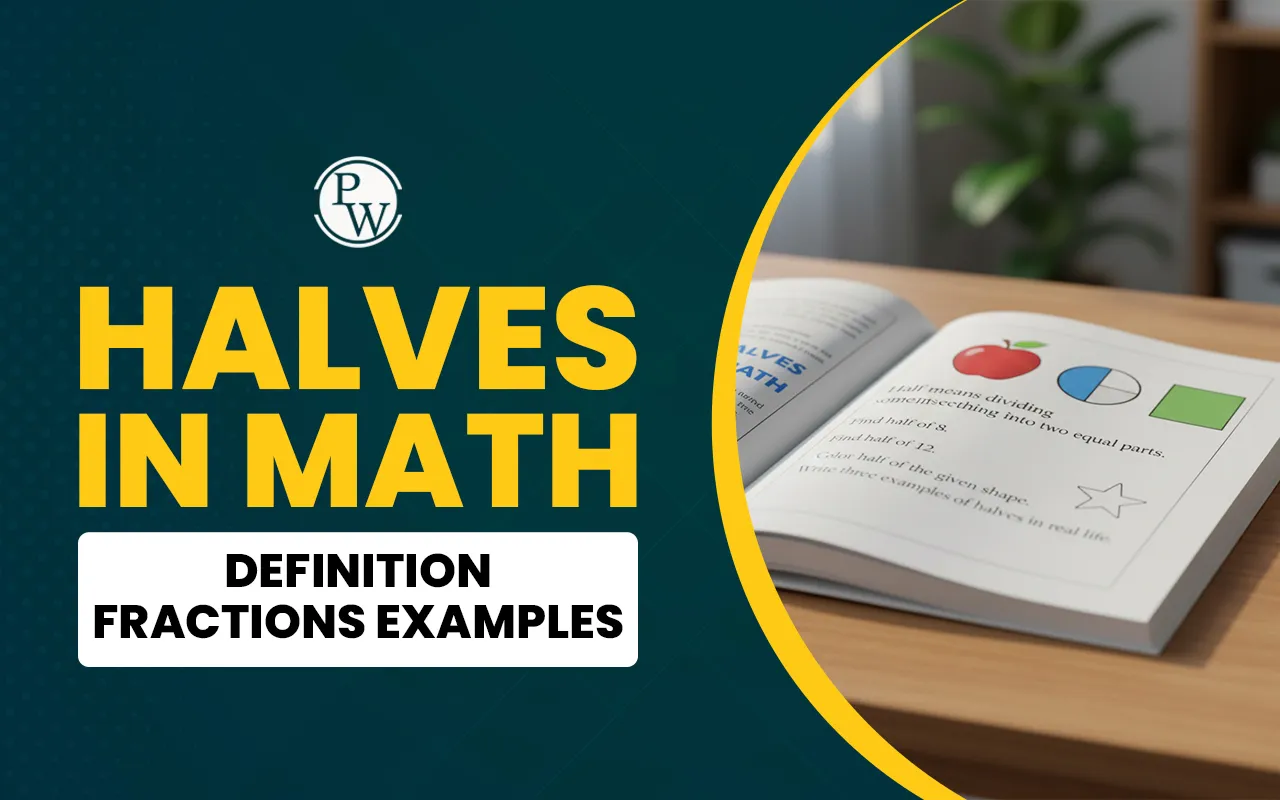
Halves in Math are one of the most basic and important ideas in early mathematics. They assist students to know how to split something in two parts and the parts are equal. An idea of halves is observable in the real world, e.g., cutting a cake into two parts, folding a piece of paper, or dividing fruit equally.
Learning about halves in mathematics is also the basis of further concepts such as fractions, division, ratios, and decimals. When students learn what halves mean and how to use them, they become more confident in solving everyday math problems.
Students can learn about halves in math, how to find half of a number, how to use halves in daily life, examples on halves and more below.
What are Halves in Math?
In simple terms, halves in math refer to dividing something into two equal parts. A half is defined as when a complete object, a complete number or a complete quantity is divided into two equal parts.
A half is represented as ½ and this translates to one half of the total. It is one of the first fractions students learn in school. Learning half in math makes students find it easy to proceed to learn other fractions like one-third and one-fourth.
Key Points About Halves in Math:
-
A half means one part of two equal parts.
-
It is written as ½, a unit fraction where 1 is the part taken, and 2 is the total number of equal parts.
-
Halves may refer to objects, shapes, numbers or quantities.
Read More - Abacus vs. Vedic Maths: Which One is Better?
Finding Half of a Number
Finding half of a number means dividing that number by 2. This is an easy and important operation that students use often in mathematics and in everyday life.
How to Find Half of a Number
-
Take the total number or value.
-
Divide it by 2.
-
The answer is the half of that number.
Examples of Finding Half
-
Half of 10 = 10 ÷ 2 = 5
-
Half of 36 = 36 ÷ 2 = 18
-
Half of 0.8 = 0.8 ÷ 2 = 0.4
For even numbers, dividing by 2 gives a whole number.
For odd numbers, the result can be a fraction or a decimal.
Mental Math Tip: To find half quickly, remember that dividing by 2 is the same as splitting equally between two groups. This skill helps in sharing money, measuring ingredients, or dividing time easily.
Read More - Brackets in Maths: Types, Rules & Examples
How to Identify and Use Halves in Everyday Problems
The concept of halves in math is not just for textbooks. It is something we use in daily life very often. Knowing how to identify and use halves helps students apply mathematics in practical situations.
How to Identify Halves
To check if something is divided into halves, look to see if it is split into two equal and identical parts. Each part should have the same size and shape or the same value.
Examples of Using Halves in Everyday Life
-
Shopping: If two friends share ₹100 equally, each gets ₹50, which is half.
-
Cooking: Using half a cup of milk or half a teaspoon of salt.
-
Time: Half an hour equals 30 minutes, which is half of 60 minutes.
-
Distance: Half of 12 kilometers is 6 kilometers.
Read More - Successor and Predecessor in Maths
How to Solve Problems Using Halves
-
Identify the total or whole quantity.
-
Check if it can be divided equally into two parts.
-
Divide the total by 2 to find the half.
Example:
-
Ravi has 20 chocolates. He wants to share them equally with his sister.
-
Half of 20 = 20 ÷ 2 = 10. So, each person gets 10 chocolates.
Halves in Math Examples
Examples on halves help learners understand this topic more clearly. Let’s look at some different types of examples in math.
Numerical Examples
-
Half of 100 = 50
-
Half of 20 = 10
-
Half of 1.6 = 0.8
-
Half of 3/4 = 3/4 ÷ 2 = 3/8
Geometric Examples
-
A square cut diagonally forms two equal triangles, which are halves.
-
A rectangle divided vertically gives two equal halves.
-
A circle divided through the center forms two equal semicircles, which are halves.
Word Problem Example
Rina has ₹60. She spends half of it on books. How much money did she spend?
-
Half of 60 = 60 ÷ 2 = ₹30.
-
Rina spent ₹30 and saved ₹30.
These examples of halves in math show how the concept can be used in numbers, shapes, and real-world applications.
Read More - Tips for Parents to Help Kids Practice Math at Home
Help Your Child Become Faster and More Confident in Maths with CuriousJr
Does your child find maths difficult or take extra time to solve problems? These challenges can affect confidence and performance in school. CuriousJr’s Online Mental Maths Classes make learning maths easier, faster, and more enjoyable for every student.
Here’s how CuriousJr helps your child grow in maths:
-
Step-by-step lessons designed according to your child’s learning level.
-
Simple and engaging topics that boost logical thinking and problem-solving.
-
50+ smart tricks to solve maths questions quickly and accurately.
-
Visual and practical methods that help children understand better.
-
Fun games, quizzes, and rewards to make maths interesting every day.
-
Live sessions with expert mentors to clear homework doubts easily.
-
Regular progress updates for parents to track improvement.
-
Helps students perform better in school exams with stronger basics.
With CuriousJr, your child can build confidence, improve speed, and start enjoying maths while developing a lifelong love for learning numbers.