Homographs in English: Meaning, Definition, List & Examples
 Shivam Singh20 Jan, 2026
Homographs in English
Homographs in English are words that have the same spelling but different meanings, and sometimes different pronunciations. These words often appear in everyday language, writing, and exams, and their meaning changes depending on the context in which they are used. For instance, the word tear can mean a drop of liquid from the eye or the action of ripping something.
Learning homographs helps improve reading and vocabulary skills, making it easier to understand and use English effectively. These words are different from homophones and homonyms, even though they may seem similar.
Recognizing homographs is important for clear communication and better comprehension in both written and spoken English. Read more about Homographs in English, examples, key differences, and tips to identify homographs and more below.
What are Homographs?
Homographs are words that have the same spelling but have different meanings. In some cases, they also have different pronunciations. These words are very common in English and their meanings can only be understood by looking at the context in which they are used.
Homographs are a part of homonyms, and are often confused with homophones (words with the same sound but different spelling and meaning). Homographs add variety and depth to English, especially in poetry, puns, and creative writing.
Understanding homographs helps improve reading skills, vocabulary, and the ability to understand complex sentences.
10 Homographs in English Examples
Homographs are words that have the same spelling but carry different meanings, and sometimes even different pronunciations. The following are 10 common examples of homograph in English:
1. Lead
-
Meaning 1: To guide or direct (verb, pronounced leed)
-
Meaning 2: A type of heavy metal (noun, pronounced led)
Example: She will lead the class. / The pipes are made of lead.
2. Tear
-
Meaning 1: To rip or break (verb, pronounced tair)
-
Meaning 2: A drop from the eye (noun, pronounced teer)
Example: Do not tear the book. / A tear rolled down her face.
3. Bass
-
Meaning 1: A kind of fish (noun, pronounced bass)
-
Meaning 2: A low musical sound (noun, pronounced base)
Example: He caught a bass in the river. / The bass sound was deep and clear.
4. Row
-
Meaning 1: A line or arrangement (noun, pronounced roh)
-
Meaning 2: A fight or argument (noun, pronounced rau)
Example: The chairs are in a row. / They had a loud row yesterday.
5. Wind
-
Meaning 1: To twist or turn (verb, pronounced wīnd)
-
Meaning 2: Air in motion (noun, pronounced wind)
Example: Wind the string carefully. / The wind blew all night.
6. Bow
-
Meaning 1: To bend forward (verb, pronounced bau)
-
Meaning 2: A tied ribbon or weapon (noun, pronounced boh)
Example: She made a bow after singing. / He used a bow and arrow.
7. Close
-
Meaning 1: To shut something (verb, pronounced klohz)
-
Meaning 2: Near in distance (adjective, pronounced klohs)
Example: Please close the window. / The school is close to my house.
8. Content
-
Meaning 1: Happy or satisfied (adjective, pronounced kun-tent)
-
Meaning 2: The subject or material inside something (noun, pronounced kon-tent)
Example: She was content with her results. / The content of the lesson is clear.
9. Minute
-
Meaning 1: A unit of time (noun, pronounced min-it)
-
Meaning 2: Very small or tiny (adjective, pronounced my-noot.
Example: Wait a minute before starting. / There was a minute spot on the wall.
10. Object
-
Meaning 1: A thing or item (noun, pronounced ob-jekt)
-
Meaning 2: To disagree or protest (verb, pronounced ub-jekt)
Example: That object is fragile. / Many students object to extra homework.
Read More: Compound Words
Tips to Identify Homographs in English
Homographs are words that are spelled the same but have different meanings. Some also have different pronunciations. These tips can help you identify them correctly:
-
Look at the Sentence: Check how the word is used in the sentence. The meaning often depends on whether the word is used as a noun, verb, or adjective.
-
Listen to How It’s Pronounced: In spoken English, some homographs sound different depending on the meaning. Focus on the stress and how the vowels are said.
-
Know the Part of Speech: Understanding if the word is a noun, verb, or adjective can help you know its meaning. Use grammar clues like nearby words.
-
Use a Dictionary: If you’re unsure, check a dictionary. It will show the different meanings and how the word is pronounced in each case.
-
Practice with Common Words: Practice using well-known homographs like lead, tear, bass, and object in different sentences to learn how they work.
-
Pay Attention While Reading: If a word seems unclear, read the full sentence or paragraph again. The meaning usually becomes clearer from the context.
Read More: Singular and Plural Words
Difference Between Homographs, Homonyms, and Homophones
Understanding the difference between homographs, homophones, and homonyms helps in using English correctly. These types of words can look or sound alike, but their meanings are different. The table below explains them in a simple way.
|
Word Type |
Definition |
Spelling |
Pronunciation |
Examples |
Usage Tip |
|
Homographs |
Words that are spelled the same but have different meanings. |
Same |
Same or different |
Lead (to guide) / Lead (a metal) |
Check the sentence and part of speech to understand the meaning. |
|
Homophones |
Words that sound the same but have different meanings and spellings. |
Different |
Same |
Flour (baking) / Flower (plant) |
Listen carefully and look at spelling when writing or reading. |
|
Homonyms |
Words that are spelled and pronounced the same but have different meanings. |
Same |
Same |
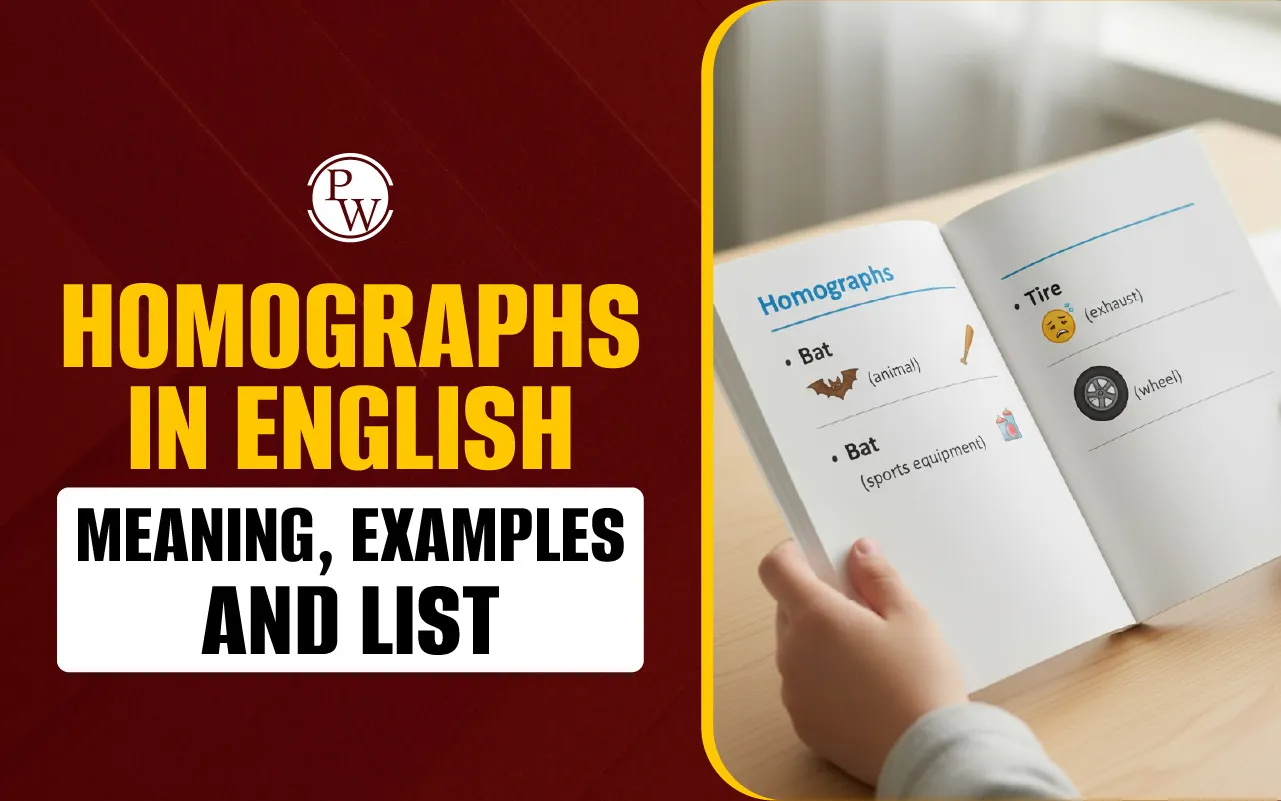
Bat (animal) / Bat (used in sports) |
Use the sentence to know which meaning is correct. |
Also Read: Describing Words
Help Your Child Grow English Skills with PW Curious Junior
PW CuriousJr’s Online English Classes provide a focused way for junior students to improve their English skills. Designed for small groups, these classes ensure each child gets the attention and support they need to succeed. The lessons are engaging and tailored to help young learners build confidence in reading, writing, speaking, and listening.
The courses follow internationally recognized standards like the Cambridge English Scale and CEFR. This ensures that students learn at a level that meets global benchmarks, helping them develop useful language skills that can be applied in real-life situations. Each course is designed to be completed in one day, making learning both effective and manageable.
In addition to live classes, PW CuriousJr offers video lessons that reinforce the skills taught online. These videos provide extra practice and allow students to learn at their own pace. Together, the online classes and video content create a comprehensive program that supports children’s growth in English language proficiency.