Factors and Multiples Worksheet for Students
 Nivedita Dar6 Feb, 2026
Mastering Concepts with Factors and Multiples Worksheet for Class 4
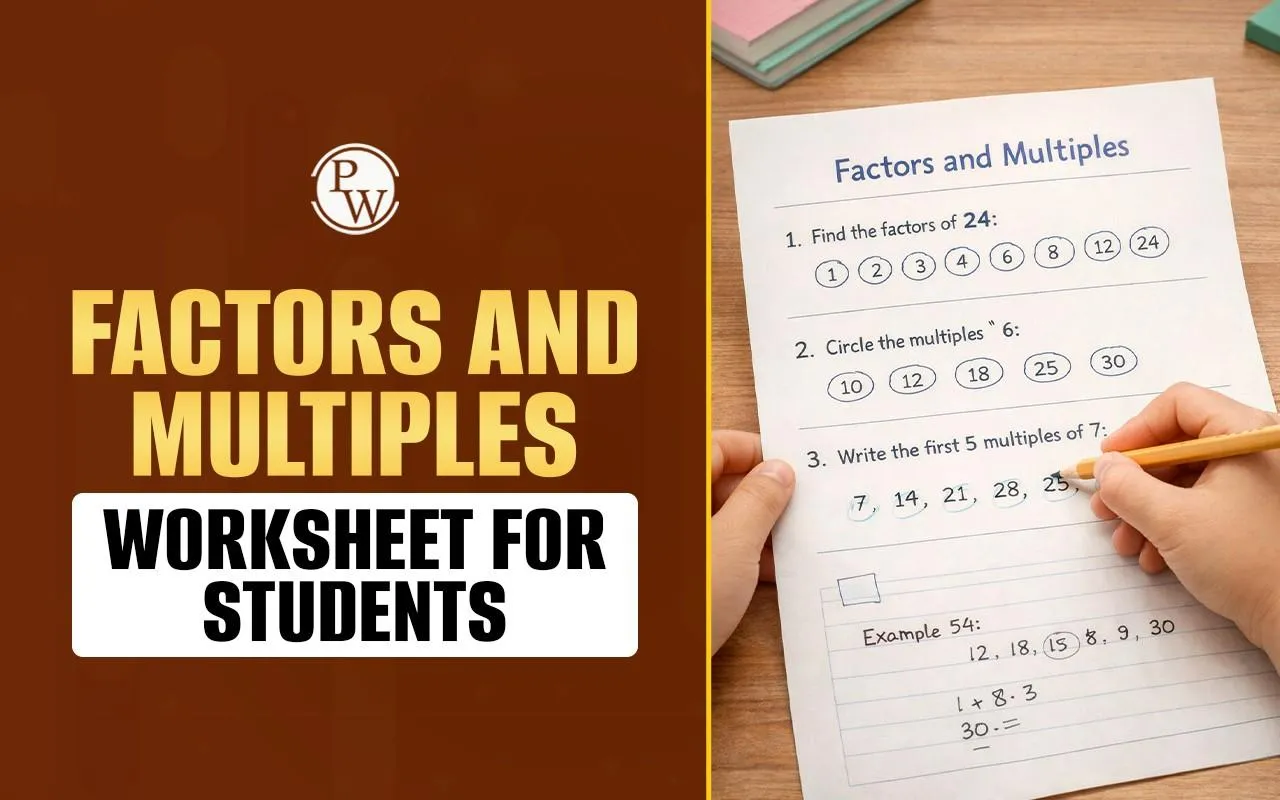
When students reach the middle of their primary education, using factors and multiples worksheet grade 4 becomes essential for building mathematical fluency. Whether you are looking for a factors and multiples worksheet 4th grade level or a comprehensive factors and multiples worksheet pdf to print for home study, these tools provide the repetition needed to master core concepts. A factors and multiples worksheet for class 4 typically focuses on visualizing how numbers break down and build up, which is a vital part of preparing for more advanced fraction and algebra work later on.
The Importance of Consistent Practice
-
Divisibility Mastery: Practicing factors helps students recognize which numbers divide evenly into others without leaving a remainder.
-
Multiplication Fluency: Working on multiples reinforces the times tables and the concept of infinite numerical growth.
-
Problem-Solving Speed: Regularly solving these worksheets improves a student's ability to calculate Greatest Common Factors (GCF) and Least Common Multiples (LCM) mentally.
-
Logical Reasoning: It teaches kids to categorize numbers as prime or composite based on their factor counts.
Read More: Construction in Maths
Detailed Sections: Understanding Factors and Multiples
To get the most out of a factors and multiples worksheet, students must first understand the fundamental definitions and the logical flow of how these two concepts interact.
Defining Factors and Multiples
A factor is a number that divides another number completely, leaving a remainder of zero. For example, the factors of 12 are 1, 2, 3, 4, 6, and 12 because 12 is divisible by each of these. Conversely, a multiple is the result of multiplying a number by an integer. The multiples of 12 would be 12, 24, 36, 48, and so on.
Key Content Found in Factors and Multiples Worksheets
Standard worksheets often break down the learning process into specific sections to ensure a student doesn't feel overwhelmed.
-
Finding Factors: Students are asked to list all possible factors of a given number. A common technique is finding factor pairs. For 20, the pairs would be (1, 20), (2, 10), and (4, 5).
-
Prime and Composite Numbers: Worksheets help students identify if a number is prime (having only two factors: 1 and itself) or composite (having more than two factors).
-
Generating Multiples: Exercises involve skip-counting or multiplying to find the first five or ten multiples of a number like 7 (7, 14, 21, 28, 35).
-
Common Factors and Multiples: This section introduces the idea of comparing two numbers, such as finding the common factors of 8 and 12, which are 1, 2, and 4.
Practical Study Advice for Students
When working through your factors and multiples worksheet, try to use visual aids like "factor trees" or "number lines." If you're stuck on finding factors for a large number, always start by checking the smallest prime numbers like 2, 3, and 5. Remember that every number is a factor of itself, and 1 is a factor of every number. For multiples, think of them as the results you find in a multiplication table.
Strengthen Your Child’s Maths Skills with CuriousJr’s Mental Maths Online Classes
Does your child take longer to solve maths questions or feel anxious around numbers? CuriousJr’s Mental Maths Online Classes are designed to turn these difficulties into confidence. The program, suitable for students from Class 1 to 8, focuses on building faster calculation skills, better accuracy, and clear logical thinking in an easy and supportive way.
Live classes are highly interactive and follow a two-teacher approach—one teacher explains concepts step by step, while the other clears doubts, so no child is left behind. Fun activities, games, and regular practice keep learning interesting and engaging.
Parents receive regular progress updates to clearly track their child’s improvement. With flexible after-school schedules and a positive learning environment, CuriousJr helps children enjoy maths, stay focused, and perform better in school. Book a demo class today and see the difference.