List of Singular and Plural Words
 Swati Kumar19 Jan, 2026
List of Singular and Plural Words
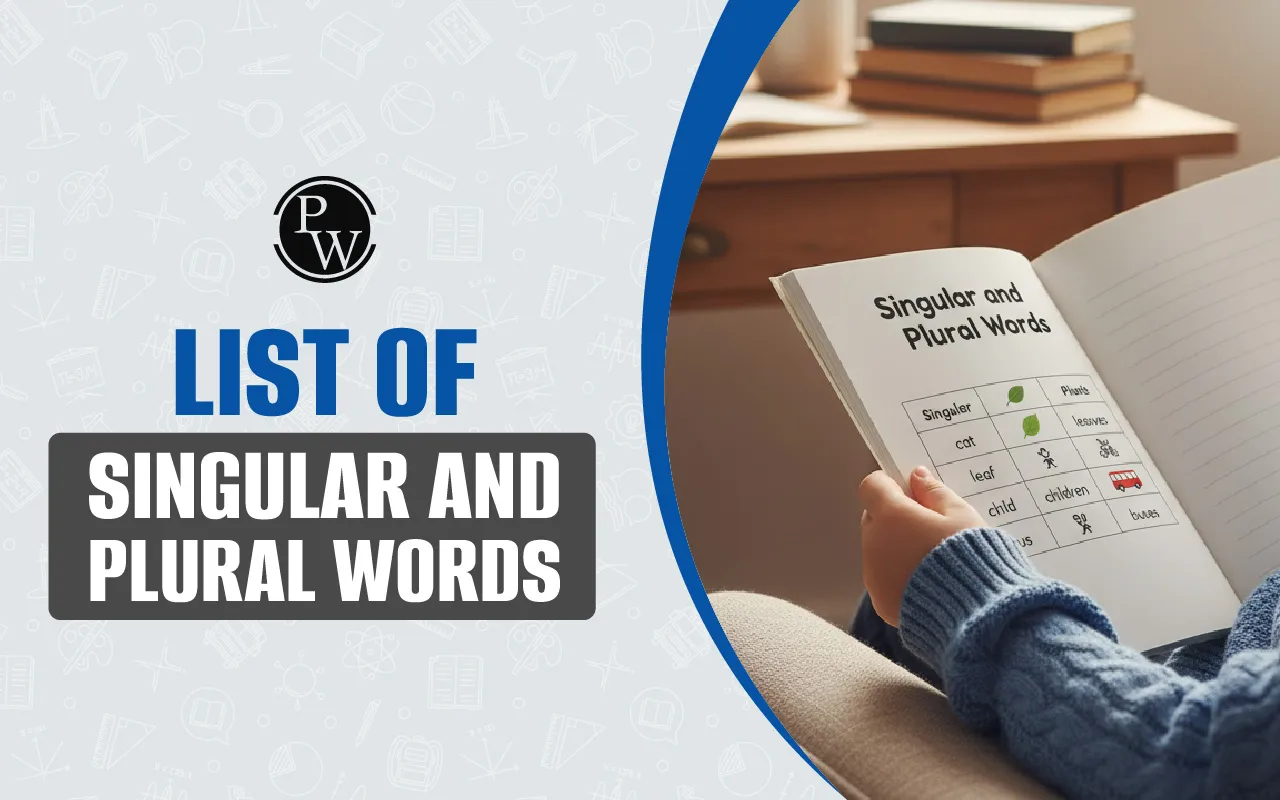
When we talk or write, we constantly need to show whether we are referring to one thing or more than one thing. This is the difference between singular and plural words. The singular form names just a single person, place, thing, or idea, like book or student. The plural form names two or more, like books or students. Most of the time, we just add an 's' to make a word plural, but sometimes words change in special ways, like child becoming children.
Read More: Phrases and Clauses
Singular and Plural Words
Nouns are words that name people, places, things, or ideas. They are important because they tell us who or what the sentence is about. Nouns can be divided into singular and plural forms. A singular noun names just one person, place, or thing, like "dog" or "city." A plural noun names more than one, like "dogs" or "cities."
To make many singular nouns plural, we often add “-s” or “-es.” Sometimes, plural forms change irregularly, like "child" becoming "children."
Read More: Compound Sentence
Irregular Singular and Plural Nouns
Irregular singular and plural nouns are special words that don't follow the normal rule of just adding an -s or -es to become plural. Instead, they change their spelling in unique ways, or sometimes they don't change at all! Think of them as the rebels of the English language.
Normally, if you have one → dog, you have two → dogs. That's regular. Irregular nouns, however, have their own sets of rules, often because they come from older forms of English or other languages. You simply have to learn these different spellings:
1. Vowel Change: Sometimes, the vowels inside the word change:
- One → man → Many → men
- One → foot → Many → feet
2. Totally Different Word: A few words completely change their form:
- One → person → Many → people
- One → child → Many → children
3. No Change: Some nouns are the same whether they are singular or plural:
- One → sheep → Many → sheep
- One → deer → Many → deer
4. Ending in -en: A very small group adds an -en ending (like the old form of English):
- One → ox → Many → oxen
You can't guess the plural of an irregular noun. You just need to practice and memorize these exceptions to make sure your grammar is correct!
10 Examples of Singular and Plural
Singular and plural words help us show whether we are talking about one item or many items. The singular form is used for just one, while the plural form is used for two or more. While most plurals just add an 's', some words are irregular and change their spelling completely. Here are 10 examples of singular and plural words.
| 10 Examples of Singular and Plural | |
| Singular | Plural |
| Cat | Cats |
| Book | Books |
| Child | Children |
| Man | Men |
| Woman | Women |
| Mouse | Mice |
| Tooth | Teeth |
| Leaf | Leaves |
| City | Cities |
| Baby | Babies |
Examples of Sentences with Singular Nouns
Here are some examples of sentences with singular nouns in each one bolded.
- The cat sat on the windowsill and watched a bird fly by.
- My little brother lost his favorite toy.
- The sun rose over the mountain this morning.
- She drank a large glass of water after her run.
- I bought a new book at the store yesterday.
- The city is preparing for a huge festival.
- His idea for the project was very creative.
- A single star shone brightly in the night sky.
- This song is my absolute favorite.
- The old tree has stood in the park for over a hundred years.
Read More: Gender in Grammar
Examples of Sentences with Plural Nouns
Given below are a few examples of sentences with plural nouns in bold letters for your reference.
- The students finished their homework before class.
- I need to buy new shoes for the wedding.
- The geese flew south for the winter.
- She carried three heavy boxes up the stairs.
- All the children played together in the park.
- The baker made dozens of fresh loaves of bread.
- We saw many colorful fish while snorkeling.
- The mice ran quickly across the floor.
- He repaired the old radios in his shop.
- The feet of the tables were uneven.
Also read: Direct and Indirect Speech
How CuriousJr Improves Your Child's Foundational English Skills
Many parents worry that their child struggles with grammar, which can make speaking and writing English correctly difficult. CuriousJr’s Online English Learning Classes make grammar simple and fun.