

If Clause: Types, Rules, Examples and Exercises
 Nivedita Dar27 Sept, 2026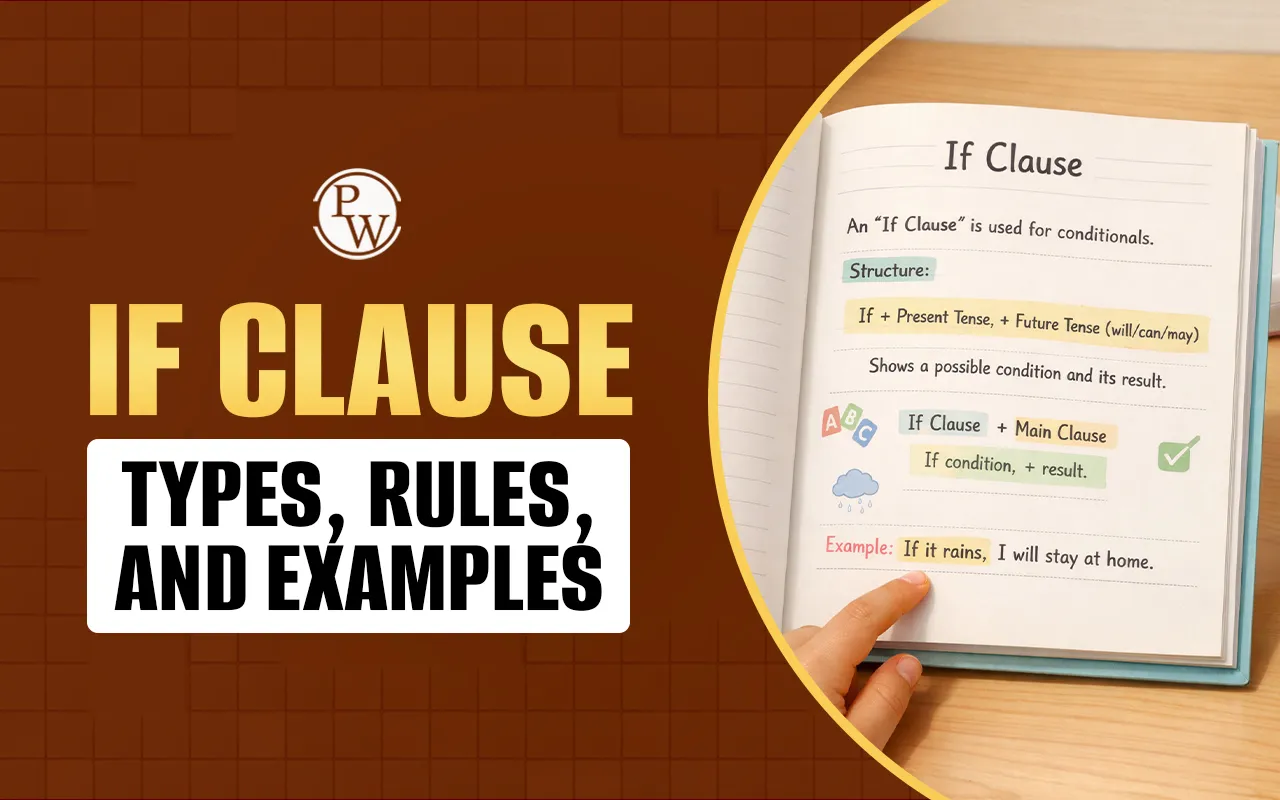
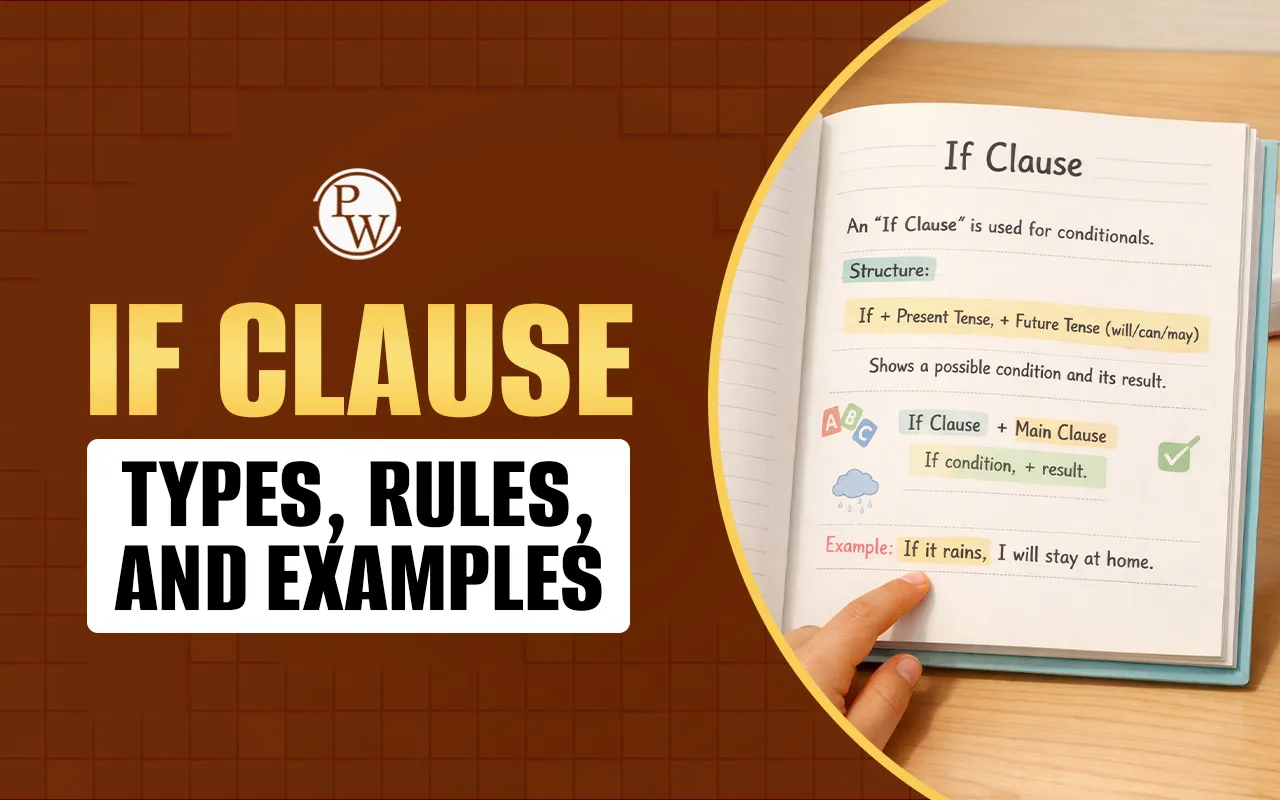
An if clause is used to talk about a condition and its possible result. It is also called a conditional clause. An if clause usually works with a main clause to show what happens when a particular condition is true, possible, imaginary, or related to the past.
For example:
If it rains, we will stay at home.
Here, “If it rains” is the if clause, and “we will stay at home” is the main clause.
If clauses are commonly used in English grammar to talk about facts, possible future situations, imaginary situations, and past situations that did not happen.
What Is an If Clause?
An if clause is a part of a sentence that gives a condition. The other part of the sentence gives the result of that condition.
Basic structure:
If + condition, result
Example:
If you study regularly, you will improve your marks.
- If you study regularly = if clause
- you will improve your marks = main clause
The order can also be changed:
You will improve your marks if you study regularly.
The meaning stays the same. Students can practise more English grammar concepts and explore age-appropriate learning resources on Curious Jr.
If Clause and Main Clause
A conditional sentence normally has two parts:
-
If clause: tells us the condition.
-
Main clause: tells us the result.
Example:
If you work hard, you will succeed.
|
Part |
Sentence |
|
If clause |
If you work hard |
|
Main clause |
you will succeed |
The if clause can come before or after the main clause.
If she comes early, we will start the meeting.
We will start the meeting if she comes early.
When the if clause comes first, use a comma between the two clauses. When the main clause comes first, a comma is normally not needed.
Also Check : Online Tuition For Class 5 Students
Four Types of If Clauses
There are four commonly taught types of conditional sentences:
-
Zero Conditional
-
First Conditional
-
Second Conditional
-
Third Conditional
Each type uses a different tense pattern and is used for a different kind of condition.
1. Zero Conditional
The Zero Conditional is used for facts, general truths, rules, and situations that normally have the same result.
Structure
If + Simple Present, Simple Present
Examples
-
If you heat ice, it melts.
-
If plants do not get water, they die.
-
If you mix blue and yellow, you get green.
-
If people eat too much, they may feel uncomfortable.
The result is presented as a general or usual fact.
Read More - Their vs There - Meaning, Rules, Examples
2. First Conditional
The First Conditional is used for a possible situation in the present or future and its likely result.
Structure
If + Simple Present, will + base verb
Examples
-
If I study hard, I will pass the exam.
-
If it rains, we will stay at home.
-
If she comes early, we will start the class.
-
If you practise daily, you will improve your English.
The condition is possible, and the result is connected to that possibility.
Read More - How to Learn English with CuriousJr English Class
First Conditional Example with Answer
Question: If it _____ (rain), we _____ (stay) at home.
Answer: If it rains, we will stay at home.
3. Second Conditional
The Second Conditional is used for imaginary, unlikely, or hypothetical situations in the present or future.
Structure
If + Simple Past, would + base verb
Examples
-
If I won the lottery, I would travel the world.
-
If I had more time, I would learn another language.
-
If she lived nearby, we would visit her often.
-
If I were you, I would tell the truth.
With I/he/she/it, were is commonly used in formal hypothetical expressions such as:
If I were you, I would apologise.
Second Conditional Example with Answer
Question: If I _____ (be) you, I _____ (tell) the truth.
Answer: If I were you, I would tell the truth.
4. Third Conditional
The Third Conditional is used to talk about an imaginary past situation and its possible past result. It is often used when discussing things that did not happen.
Structure
If + Past Perfect, would have + past participle
Examples
-
If she had studied, she would have passed the exam.
-
If they had arrived earlier, they would have caught the bus.
-
If I had known about the meeting, I would have attended it.
-
If we had left earlier, we would have reached on time.
Third Conditional Example with Answer
Question: If they _____ (arrive) earlier, they _____ (catch) the bus.
Answer: If they had arrived earlier, they would have caught the bus.
If Clause Rules with Examples
Understanding the rules makes it easier to choose the correct tense and structure.
Rule 1: Use the correct tense for the type of condition
Each conditional has its own common structure.
|
Type |
If Clause |
Main Clause |
Use |
|
Zero |
Simple Present |
Simple Present |
Facts and general truths |
|
First |
Simple Present |
will + base verb |
Possible future situations |
|
Second |
Simple Past |
would + base verb |
Imaginary or unlikely situations |
|
Third |
Past Perfect |
would have + past participle |
Imaginary past situations |
Rule 2: Do not normally use will in the if clause
For a standard First Conditional sentence, use the Simple Present after if, not will.
Incorrect: If it will rain, we will stay home.
Correct: If it rains, we will stay home.
Rule 3: Do not normally use would in the if clause
In a standard Second Conditional sentence, use the Simple Past after if.
Incorrect: If I would have more money, I would buy a car.
Correct: If I had more money, I would buy a car.
Rule 4: Use a comma when the if clause comes first
If you study hard, you will pass the exam.
When the main clause comes first, the comma is normally not needed.
You will pass the exam if you study hard.
Rule 5: Use “were” in common hypothetical expressions
For hypothetical situations, were is commonly used with I.
If I were you, I would revise this chapter.
If I were rich, I would travel more.
Rule 6: “Unless” can sometimes replace “if...not”
Unless means something similar to if...not in many conditional sentences.
If you do not hurry, you will miss the bus.
Unless you hurry, you will miss the bus.
The meaning is similar, but the sentence structure changes.
Rule 7: Other modal verbs can be used in the main clause
The main clause does not always have to use will or would.
Depending on the meaning, we can use words such as can, could, may, might, or should.
Examples:
-
If you finish your work, you can go outside.
-
If it rains, we might stay home.
-
If you need help, you should ask your teacher.
If Clause Examples with Answers
Here are common if clause questions with answers for grammar practice.
Question 1
If you heat water to a high temperature, it _____ (boil).
Answer: If you heat water to a high temperature, it boils.
Type: Zero Conditional
Question 2
If she studies hard, she _____ (pass) the examination.
Answer: If she studies hard, she will pass the examination.
Type: First Conditional
Question 3
If I _____ (have) more free time, I would learn French.
Answer: If I had more free time, I would learn French.
Type: Second Conditional
Question 4
If they had left earlier, they _____ (reach) the station on time.
Answer: If they had left earlier, they would have reached the station on time.
Type: Third Conditional
Question 5
If you do not water the plant, it _____ (die).
Answer: If you do not water the plant, it will die.
Type: First Conditional
Question 6
If I _____ (be) you, I would speak to the teacher.
Answer: If I were you, I would speak to the teacher.
Type: Second Conditional
Question 7
If she had called me, I _____ (help) her.
Answer: If she had called me, I would have helped her.
Type: Third Conditional
Question 8
If you mix red and blue, you _____ (get) purple.
Answer: If you mix red and blue, you get purple.
Type: Zero Conditional
If Clause Formula
The basic formulas can be remembered like this:
Zero Conditional
If + Simple Present, Simple Present
Example:
If you freeze water, it becomes ice.
First Conditional
If + Simple Present, will + base verb
Example:
If I study, I will pass.
Second Conditional
If + Simple Past, would + base verb
Example:
If I had money, I would travel.
Third Conditional
If + Past Perfect, would have + past participle
Example:
If I had studied, I would have passed.
If Clause Questions with Answers
1. If it rains, we _____ at home.
a) stayed
b) will stay
c) would stay
d) had stayed
Answer: b) will stay
2. If I were rich, I _____ a large house.
a) buy
b) will buy
c) would buy
d) bought
Answer: c) would buy
3. If she had studied harder, she _____ the test.
a) passes
b) will pass
c) would pass
d) would have passed
Answer: d) would have passed
4. If you heat ice, it _____.
a) melts
b) will melt
c) would melt
d) melted
Answer: a) melts
5. If you practise every day, you _____ better.
a) became
b) will become
c) would have become
d) had become
Answer: b) will become
If Clause Exercises
Complete the following sentences using the correct form of the verbs in brackets.
-
If you study regularly, you _____ (improve) your marks.
-
If I _____ (be) you, I would apologise.
-
If they had started earlier, they _____ (finish) the work.
-
If you heat ice, it _____ (melt).
-
If she comes tomorrow, we _____ (meet) her.
-
If I had known the answer, I _____ (tell) you.
-
If plants do not get enough water, they _____ (die).
-
If I had more time, I _____ (read) more books.
-
If he works hard, he _____ (succeed).
-
If they had invited me, I _____ (go) to the party.
Answers
-
will improve
-
were
-
would have finished
-
melts
-
will meet
-
would have told
-
die
-
would read
-
will succeed
-
would have gone
Common Mistakes in If Clauses
Mistake 1: Using “will” after if
Incorrect: If she will come, I will meet her.
Correct: If she comes, I will meet her.
Mistake 2: Confusing the Second and Third Conditional
The Second Conditional refers to an imaginary or unlikely present or future situation.
If I had a car, I would drive to school.
The Third Conditional refers to an imaginary past situation.
If I had bought a car, I would have driven to school.
Mistake 3: Forgetting the past participle in the Third Conditional
Incorrect: If he had studied, he would have pass.
Correct: If he had studied, he would have passed.
Mistake 4: Using the wrong punctuation
Correct: If you work hard, you will succeed.
Correct: You will succeed if you work hard.
How to Identify the Type of If Clause
Ask what kind of situation the sentence describes.
Is it a fact or general truth?
Use the Zero Conditional.
Is it a real or possible future situation?
Use the First Conditional.
Is it imaginary or unlikely in the present or future?
Use the Second Conditional.
Is it about an imaginary past result?
Use the Third Conditional.
A simple timeline can help:
Zero: fact or usual result
First: possible future
Second: imaginary present/future
Third: imaginary past
Quick Revision: If Clause Rules
-
An if clause gives a condition.
-
The other clause gives the result.
-
Zero Conditional uses Simple Present + Simple Present.
-
First Conditional uses Simple Present + will + base verb.
-
Second Conditional uses Simple Past + would + base verb.
-
Third Conditional uses Past Perfect + would have + past participle.
-
Use a comma when the if clause comes first.
-
Do not normally use will after if in a standard First Conditional.
-
Use were in common hypothetical expressions such as “If I were you.”
-
Unless can often be used instead of if...not.




If Clause FAQs
1. What is an if clause?
2. What are the four types of if clauses?
3. What are the rules of if clauses?
4. What is the difference between the Second and Third Conditional?






Get Free Counselling Today
and Clear up all your Doubts
 Live & recorded classes available at easeDashboard for progress trackingLakhs of practice questions

