
Kilometer to Mile Calculator: Easy & Accurate Distance Conversion
A kilometer to mile calculator instantly converts distances from kilometers to miles using the standard conversion factor (1 km = 0.621371 miles). It helps students, travelers, and exam aspirants avoid calculation errors, save time, and maintain unit accuracy in maths, physics, and real-life distance problems.
 Aditya Kumar6 Feb, 2026
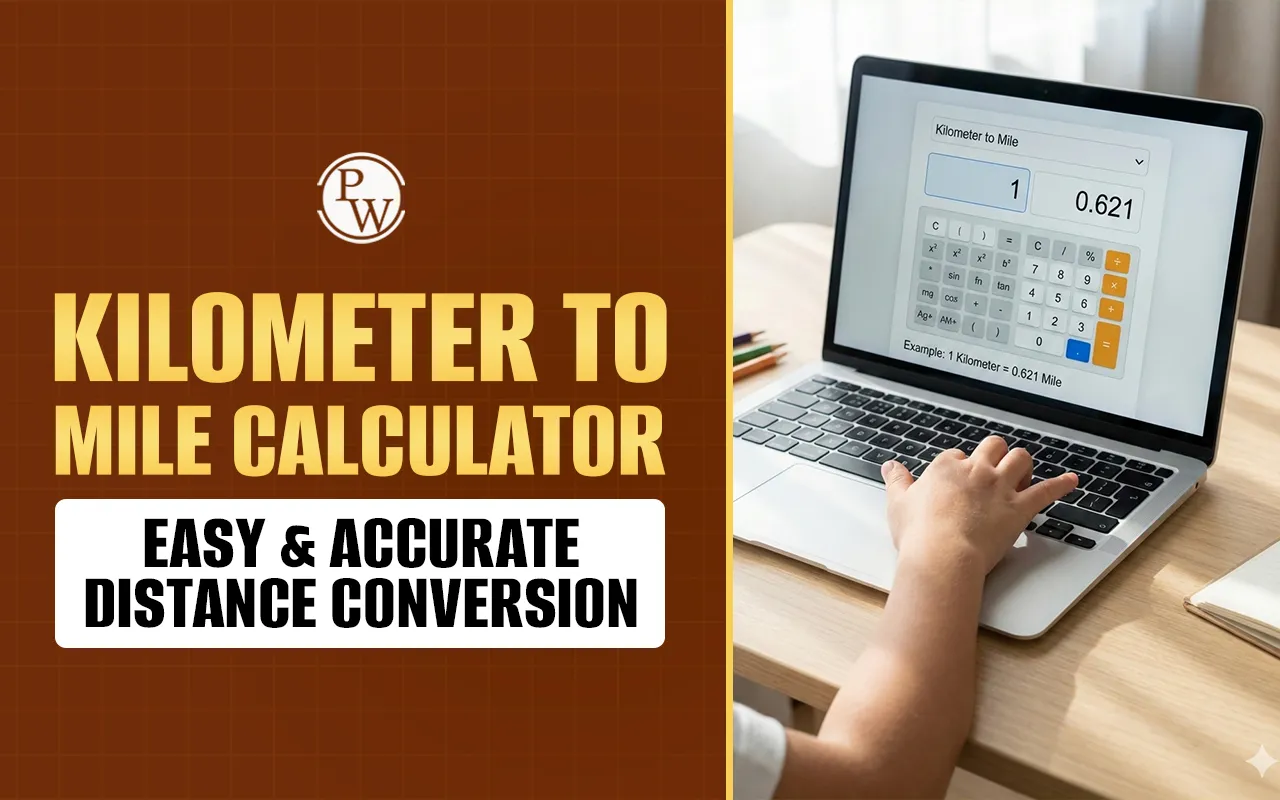
The kilometer to mile calculator is an efficient digital tool designed to help you convert units of distance between the metric and imperial systems instantly. By entering a value in kilometers, the tool applies the standard conversion factor to provide the equivalent distance in miles, ensuring accuracy for students, travelers, and competitive exam aspirants alike.
Use a kilometer-to-mile calculator to learn how to convert distances
To be good at mental maths, you need to know how to use several measurement systems. The metric system is used by most of the world, while the imperial system is still common in places like the US and the UK. If you're looking at a map or getting ready for a physics test, understanding how to calculate kilometer to mile will help you not have to guess. A kilometer to mile calculator makes this easier by getting rid of the chance of making mistakes when doing the math by hand. It is a good teacher for students who need to quickly flip between units while studying or doing difficult homework.
Understanding the Formula and Conversion Factor
To use a kilometer to mile calculator effectively, you should first understand the underlying logic that governs the tool. The relationship between these two units is fixed based on international standards of measurement. One kilometer is approximately equal to 0.621371 miles. Conversely, if you ever need to go the other way, one mile is roughly 1.60934 kilometers. When you enter a number into the tool, it multiplies your kilometer value by 0.621371 to yield the result.
Let’s look at why this specific number matters. The metric system is based on powers of ten, making it very logical for scientific work. However, miles have historical roots that don't align perfectly with decimal logic. Because of this, the conversion factor contains several decimal places. Using a digital calculator ensures that these decimals don't lead to "rounding drift," which can happen when you try to do the math in your head using a simplified 0.6 ratio.
Step-by-Step Guide: How to Calculate Kilometer to Mile
Even if you have a tool, it's good for your brain to learn how to calculate kilometer to mile by hand. To do the conversion yourself or to check what the calculator says, follow these easy steps:
-
Find the Value: You should begin with the entire number of kilometres you want to change.
-
Use the Factor: Then, multiply that number by the constant 0.62137.
-
The Result: To make it clearer, round the final value to two or three decimal places, depending on what you need.
To change 10 kilometres to miles, for example, you just multiply 10 by 0.62137. The answer is 6.2137 miles. It's a simple process. If you're in a hurry, just remember that a mile is longer than a kilometre. This means that the last number you get in miles should always be less than the first number you get in kilometres. You probably multiplied by the wrong number or used the mile-to-kilometer constant wrongly if your answer is bigger.
Why Distance Conversion is a Vital Part of Geometry
Unit consistency is very important in math, especially in geometry and coordinate physics. You can't just add kilometres to miles. You need to change one of the numbers so that they match before you can find the area of a triangle if the base is in kilometres and the height is in miles.
In these situations, a kilometre to mile calculator is a must-have. It lets you line up your data points so that your final computations are still correct. A lot of the time, students lose points not because they didn't know the geometric formula, but because they forgot to make sure their units were the same. A small unit discrepancy shouldn't mess you up on a huge test.
Practical Examples of Kilometer to Mile Conversion
To see the tool in action, let’s explore a few common scenarios you might encounter:
-
The 5K Run: A standard 5-kilometer race is a popular distance for beginners. When you plug "5" into the calculator, you'll find it equals roughly 3.1 miles.
-
Highway Speeds: If you see a sign saying a city is 100 kilometers away, the calculator tells you that you have about 62.1 miles left to travel.
-
Long Distance: A massive distance of 1,000 kilometers converts to approximately 621.37 miles.
Benefits of Using Online Calculation Tools
Why should you use an online kilometer to mile calculator are in a mile instead of just guessing? The main factor is accuracy. In competitive tests, even a few decimal points off can make you choose the wrong answer. When you use online tools from reliable educational sites, they use very precise constants to make sure you get the most accurate results possible.
These tools also save time. You don't want to pause in the middle of a complicated physics derivation to do long-form multiplication on the side of your page. You want to stay in the flow of the issue. You keep on by utilising a fast calculator. It's not just about working harder; it's also about working smarter. We always tell kids to understand the "why" behind the maths, but we also know that digital tools are useful in today's classrooms.
The History of the Units: Metric vs. Imperial
It’s interesting to note that the kilometer was defined during the French Revolution as one-ten-thousandth of the distance from the equator to the North Pole. It’s a "natural" unit. The mile, however, has roots in the Roman "mille passus," or a thousand paces. Because these units grew out of completely different cultures and eras, they don't fit together neatly.
This historical gap is exactly why the kilometer to mile calculator is so necessary today. It bridges two different ways of looking at the world. Whether you are studying for a standardized test or just curious about the distance of a famous international landmark, these tools make the world feel a little smaller and more understandable.

FAQs
What is the actual formula that the kilometre to mile calculator uses?
To get miles, you need to multiply kilometres by 0.621371. The calculator does this multiplication for you so you can see the answers right away.
Is a kilometre longer than a mile?
No, a kilometre is shorter than a mile. A mile is about 1.61 km, which is why the mile count is always lower.
How can I figure out how many kilometres are in a mile without a calculator?
You can quickly estimate by multiplying the kilometres by 0.6. It won't be 100% accurate, but it will get you close.
What is the reason we need to change kilometres to miles?
You need to convert when you work with international data, travel to different countries, or solve physics problems with different units.
Is it possible for this tool to change miles back to kilometres?
Most calculators can do maths in both directions. To change miles into kilometres, you would multiply the miles by 1.60934.