
Mental Maths for Kids: Learn Whole Numbers & Smallest Whole Number at Home
Mental maths at home helps children build strong number sense, confidence, and logical thinking. Understanding whole numbers—especially that zero is the smallest whole number—forms the foundation for fast calculations. With daily drills, simple games, and support from online or structured mental maths classes, children can develop speed, accuracy, and a lifelong comfort with mathematics.
 Aditya Kumar6 Feb, 2026
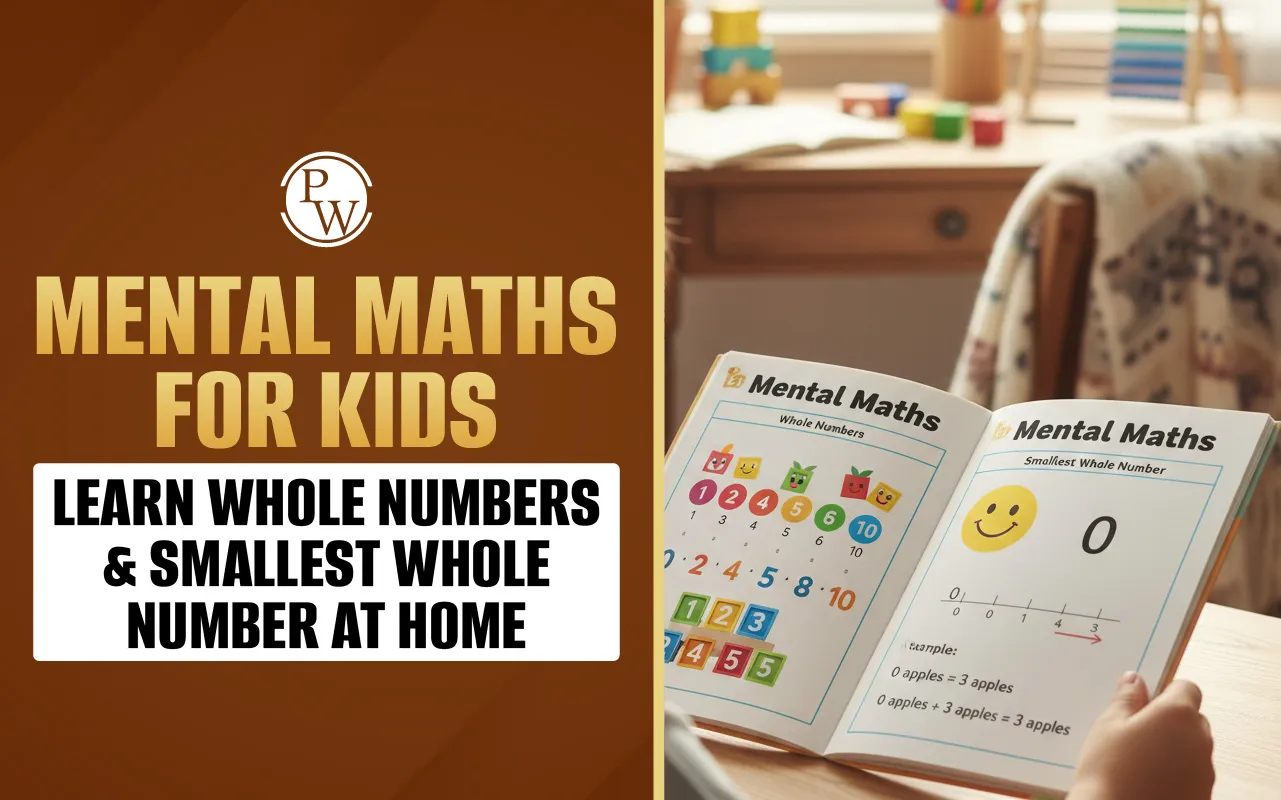
To help your child get better at mental maths at home, you should encourage them to figure out answers in their heads without needing any outside resources like calculators or paper. This practice makes their logical thinking and ability to use numbers much better. By including simple daily drills, you help kids learn basic ideas, such how to find the smallest whole number. This will give them confidence in maths for the rest of their lives.
Strengthening Number Sense and Mental Maths at Home
To help your child do well in maths, they need to understand how numbers work. Whole numbers are the set of natural numbers plus zero. It is a basic idea since it shows how to start counting. Zero is the smallest whole number and stands for a null value, but it is also the basis for all higher-level calculations. If a child doesn't know that whole numbers don't include fractions, decimals, or negative values, you can't expect them to be able to quickly add or subtract in their heads.
Teaching these basics doesn't require a classroom. You can use household items to show that you have "zero" apples before you buy some. This simple visualization is the first step in learning mental maths at home effectively. We want students to see numbers as tangible objects they can manipulate mentally. Once they realize that the set {0, 1, 2, 3...} goes on forever, their curiosity about patterns naturally grows.
Understanding the Smallest Whole Number and Its Role
When kids start out, they typically mix up whole numbers with natural numbers. The first natural number is one. But whole numbers contain zero, which means that zero is the smallest whole number in the collection. Why is this important for mental maths? It sets the starting point for the number line. A child can better picture how far apart numbers are if they know that zero is the starting point. We employ this way of thinking to make hard additions easier. For example, it can be easier to add nine if you think of it as adding ten and then going back to the smallest number you started with.
Exploring the Properties of Zero in Calculations
Zero isn't just a placeholder; it’s a powerful tool in mental arithmetic. In multiplication, any number multiplied by the smallest whole number becomes zero. In addition, adding zero doesn't change the value of the original figure. These are the "identities" that make quick thinking possible. We teach kids to recognize these patterns so they don't waste precious seconds calculating what they should already know instinctively.
Structured Learning through Mental Maths Classes
While home practice is vital, structured mental maths classes provide a systematic curriculum that builds upon what you teach in the living room. These sessions often introduce Vedic maths techniques or abacus-style visualization. Such methods transform how a student perceives a problem. Instead of seeing a scary string of digits, they see shapes or patterns. You'll find that children who attend these classes develop a "maths reflex" that allows them to answer questions before their peers can even pick up a pencil.
Benefits of Professional Guidance for Young Learners
Professional instructors know how to spot a "maths block" before it becomes a permanent hurdle. They use gamified versions of the number line to keep engagement high. We see a massive difference when students are taught to find the smallest whole number in a set of mixed digits versus just memorizing a definition. It’s about application. Classes offer a competitive yet friendly environment where speed and accuracy are celebrated equally.
Incorporating Daily Drills into Your Routine
Don't let the learning stop when the class ends. You should spend ten minutes every evening doing "flash calculations." Ask your child to add the digits on a license plate or calculate the change at a grocery store. This makes the subject feel alive. It's no longer a chore; it's a game. We've seen that kids who treat maths like a puzzle are much more likely to pursue STEM careers later in life.
The Shift to Online Mental Maths Classes
In today's digital age, online mental maths classes offer a level of flexibility that traditional tutoring can't match. You don't have to worry about the commute. Your child can learn from the best educators in the country right from your dining table. These platforms use interactive software that tracks progress in real-time. If your child struggles with the concept of whole numbers or keeps forgetting that zero is the smallest whole number, the system flags it immediately.
Choosing the Right Online Platform for Your Child
Look for platforms that prioritize "active" learning over "passive" watching. A good online session should involve plenty of "you-do" moments. We recommend checking if the curriculum aligns with school standards while offering advanced mental shortcuts. The goal is to supplement schoolwork, not replace it. You want a program that builds a bridge between conceptual understanding and lightning-fast execution.
Interactive Tools and Digital Number Lines
Many digital platforms use virtual number lines to help kids visualize the infinite nature of whole numbers. By starting at zero, the smallest whole number, and scrolling right, children gain a physical sense of magnitude. This visual "anchor" is incredibly helpful when they start doing mental multiplication of large sums. It's all about building a mental map that they can access whenever a problem arises.
Practical Study Advice for Parents
Consistency beats intensity every single time. It's better to do five minutes of mental maths every day than two hours once a week. We suggest creating a "maths-friendly" zone in the house. This doesn't need to be fancy. Just a place where numbers are discussed without stress or pressure. Remember, your attitude toward maths will shape theirs. If you act like maths is a scary monster, they'll believe you. Instead, treat it like a superpower that helps you navigate the world.
How to Learn Mental Maths at Home Without Stress
Keep it light. Use dice games or card games to practice addition and subtraction. If they get an answer wrong, don't just give them the right one. Ask them how they reached their conclusion. Often, the error is just a small slip in logic. By tracing their steps back to the smallest whole number or the nearest ten, they learn to self-correct. This self-correction is the hallmark of a true mathematician.
Encouraging Curiosity and Logical Thinking
When your child asks, "What is the smallest whole number?" don't just say "zero." Ask them why they think that. Compare it to the natural number set. Explain that whole numbers are "whole" because they don't have pieces like 0.5 or 1/2. This depth of understanding ensures they don't just memorize facts; they internalize the logic. At the end of the day, mental maths is about the beauty of logic and the speed of thought.
Join CuriousJr Online Mental Maths Classes Now!!
FAQs
What is the smallest whole number?
The smallest whole number is 0. The set of whole numbers starts at 0 and continues infinitely as 1, 2, 3, and so on.
Can I start mental maths at home with a preschooler?
Yes, you can. Start by counting physical objects and introducing the concept of "zero" when nothing is left to count.
Are online mental maths classes effective for young children?
They are highly effective because they use visual aids and interactive games that keep children engaged longer than traditional methods.
How do whole numbers differ from natural numbers?
Natural numbers start from 1, whereas whole numbers include 0. Therefore, 0 is the smallest whole number, but 1 is the smallest natural number.
How often should we practice mental maths?
We recommend daily practice for about 10-15 minutes to keep the skills sharp and build long-term retention.