Homonyms: Meaning and Definition
 Shivam Singh19 Jan, 2026
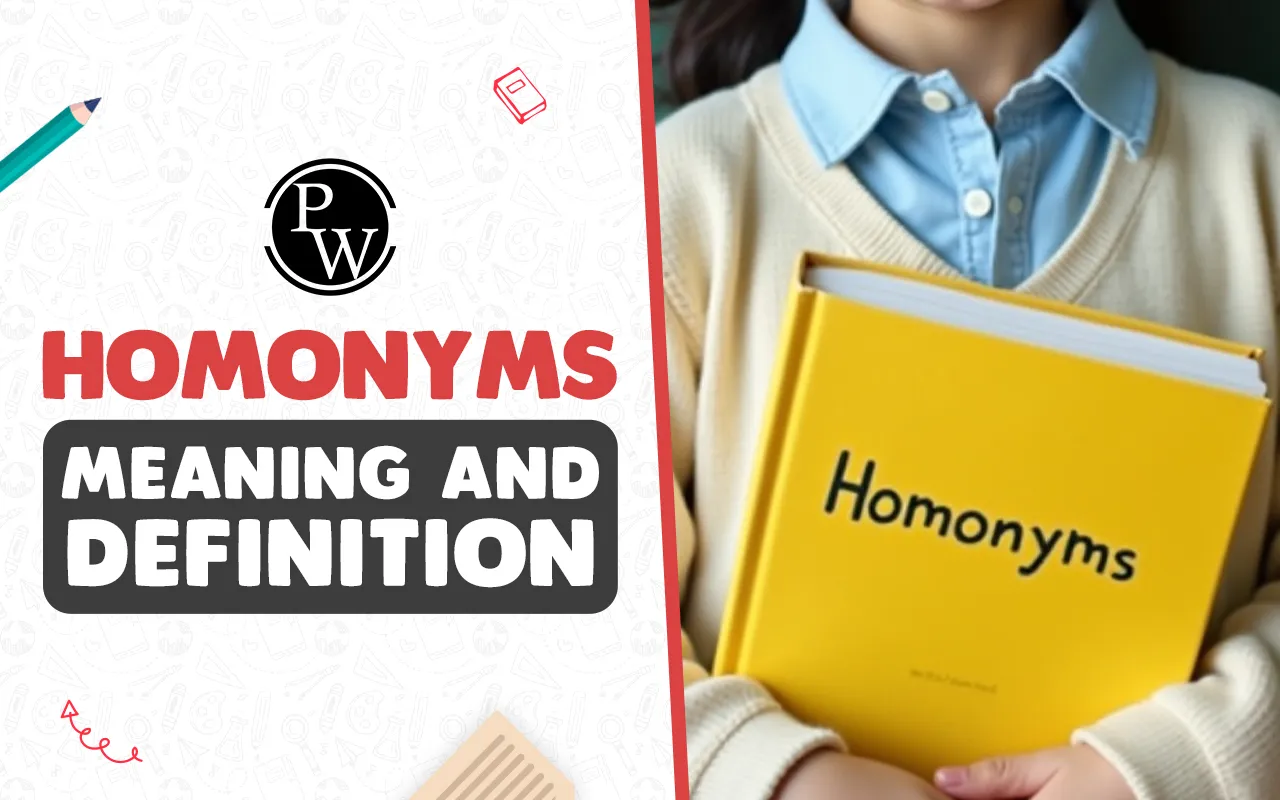
Homonyms are unique words that we often use in our daily conversations and writing. These special words sound the same and have similar spellings, but their meanings are entirely different.
Whether interacting casually or delivering a formal speech, understanding homonyms and their appropriate use can greatly enhance your communication.
In this blog, we help you learn about what is homonyms with examples and interesting quizzes so that you can use them correctly and confidently in any context.
Read More: Two Letter Words in English
What Are Homonyms?
Homonyms are words that are spelled the same or sound the same but have completely different meanings. Let’s understand the concept with an example.
Take the word bank. If someone says, “I am going to the bank,” they probably mean the place where people keep their money. It’s a building where you can deposit or withdraw cash.
But if another person says, “We had lunch on the bank of the river,” now the word bank means something completely different. It refers to the land beside a river, not a money-related place.
So even though the word is spelled the same and sounds exactly the same in both sentences, it means two totally different things. That’s what makes it a homonym.
You need to understand the meaning of the sentence. The word doesn’t change, but its use and meaning do. That’s the idea behind homonyms. One word, different meanings, depending on how it’s used.
Homonyms Definition
The word ‘homonym’ comes from the Greek word homonymos, meaning ‘same name.’
This means, homonyms in english are words that are spelled the same or sound the same but have different meanings. For homonyms examples sentences, the word “bat” can mean a flying animal, or it can mean a stick used to hit a ball in sports.
Types of Homonyms
Many students wonder, what are homonyms and how they are used in English. The homonyms meaning refers to words that are spelled or pronounced the same but have different meanings. Understanding what are homonyms helps in improving vocabulary and avoiding confusion in writing or conversation.
Homonyms are grouped into two main types: homophones and homographs.
Homonyms in english are words that sound the same but have different spellings and meanings. For example, the words “sea” and “see” sound the same when you say them, but “sea” is a large body of water, and “see” means to look.
Homographs are words that are spelled the same but have different meanings. Sometimes they sound the same, and sometimes they don’t. For example, the word “bat” can mean an animal that flies or a bat used in cricket. Another example is “lead” (to guide) and “lead” (a metal), which are spelled the same but sound different.
Both types are called homonyms because the words either look the same, sound the same, or both, but their meanings are always different.
Read More: Degree of Comparison
Homonyms Parts of Speech, Meaning, and Examples
Learning the homonyms meaning with real-life examples of homonyms makes language learning more interesting and fun. For instance, “bat” can mean a flying mammal or a piece of sports equipment, these are perfect examples of homonyms. Here's a table that shows examples of common homonyms, their parts of speech, meanings, and homonyms examples sentences:
|
Homonyms Parts of Speech, Meaning, and Examples |
|||
|
Homonyms |
Parts of Speech |
Meaning |
Example |
|
Bear |
Noun |
A large wild animal |
They saw a black bear in the forest. |
|
Verb |
To carry or endure something |
You will have to bear the pain bravely. |
|
|
Bat |
Noun |
A flying mammal |
A bat flew out of the cave. |
|
Noun |
Equipment used in sports |
He hit the ball with a bat. |
|
|
Tear |
Noun |
A drop of liquid from the eye |
A tear rolled down her cheek |
|
Verb |
To rip or pull apar |
Don’t tear the paper. |
|
|
Right |
Adjective |
Correct or true |
You gave the right answer. |
|
Noun |
Direction or side |
Turn to the right at the corner |
|
|
Watch |
Noun |
A device for telling time |
He wears a watch on his wrist |
|
Verb |
To look at something carefully |
Please watch the baby while I cook. |
|
|
Match |
A sports competition |
He lit the candle with a match. |
|
|
Well |
A stick used to make fire |
They drew water from the well |
|
|
A deep hole for water |
They drew water from the well |
||
|
In a good or healthy way |
I’m feeling well today |
||
|
Ring |
A circular piece of jewelry |
She wore a gold ring. |
|
|
To make a bell sound or call someone |
I will ring you later. |
||
|
Right |
Something that makes things visible |
The room was filled with light |
|
|
Not heavy |
This bag is very light to carry. |
||
Read More: List of Tricky Words in English
Quick Homonyms Quiz
Let’s test your knowledge. Fill in the blanks with the correct homonym.
-
I can’t wait to open the birthday _______. (present / present)
-
The _______ is blowing strongly today. (wind / wind)
-
We sat near the river _______. (bank / bank)
-
My pet dog has soft _______. (paws / pause)
-
Please write down your home _______. (address / address)
-
He had a bright idea to fix the broken _______. (light / lite)
-
She shed a _______ after watching the sad movie. (tear / tear)
-
The teacher asked us to _______ quietly while she spoke. (read / reed)
-
They saw a bat flying above the cricket _______. (bat / bat)
-
The knight rode his horse into the night under the moon’s _______. (knight / night)
Answers:
-
I can’t wait to open the birthday present.
-
The wind is blowing strongly today.
-
We sat near the river bank.
-
My pet dog has soft paws.
-
Please write down your home address.
-
He had a bright idea to fix the broken light
-
She shed a tear after watching the sad movie.
-
The teacher asked us to read quietly while she spoke.
-
They saw a bat flying above the cricket bat.
-
The knight rode his horse into the night under the moon’s light.
Also read: No vs. Not
Tips for Understanding Homonyms
Here are a few ways to get better at using homonyms:
Look at the sentence: The meaning of the word depends on how it is used. Try to understand the full sentence before guessing.
Read more books: Storybooks often use homonyms, especially funny ones. Reading will help you remember them.
Practice with friends or teachers: Try making your own sentences using homonyms examples.
Use a dictionary: If you are not sure what a word means, look it up. Many words have two or more meanings listed.
Help Your Child Excel in English with CuriousJr’s Online Classes
Is your child facing challenges in speaking fluently, understanding grammar, or completing writing assignments? CuriousJr’s Online Tuition Classes Program, designed for students in Classes 3 to 8, offers a practical and engaging way of learning to build confidence and competence in English communication.
What Makes CuriousJr’s English Classes Effective?
-
Our teaching is tailored to fit CBSE, ICSE, and State Board syllabi, ensuring academic relevance.
-
Live interactive classes are held daily to help students stay consistent, attentive, and involved in learning.
-
Experienced tutors provide individual attention and help clarify concepts and doubts whenever required.
-
Ongoing assessments and performance tracking with feedback keep students motivated.
-
We adapt a customised learning approach to match each child’s learning pace and style.
At CuriousJr, we make English learning interesting and enjoyable. Our interactive teaching methods help students effectively strengthen vocabulary, grammar, and speaking and writing skills. Book a demo today and watch how your child achieves proficiency in English.