Frequency Formula - Definition with Solved Examples
 Shivam Singh6 Feb, 2026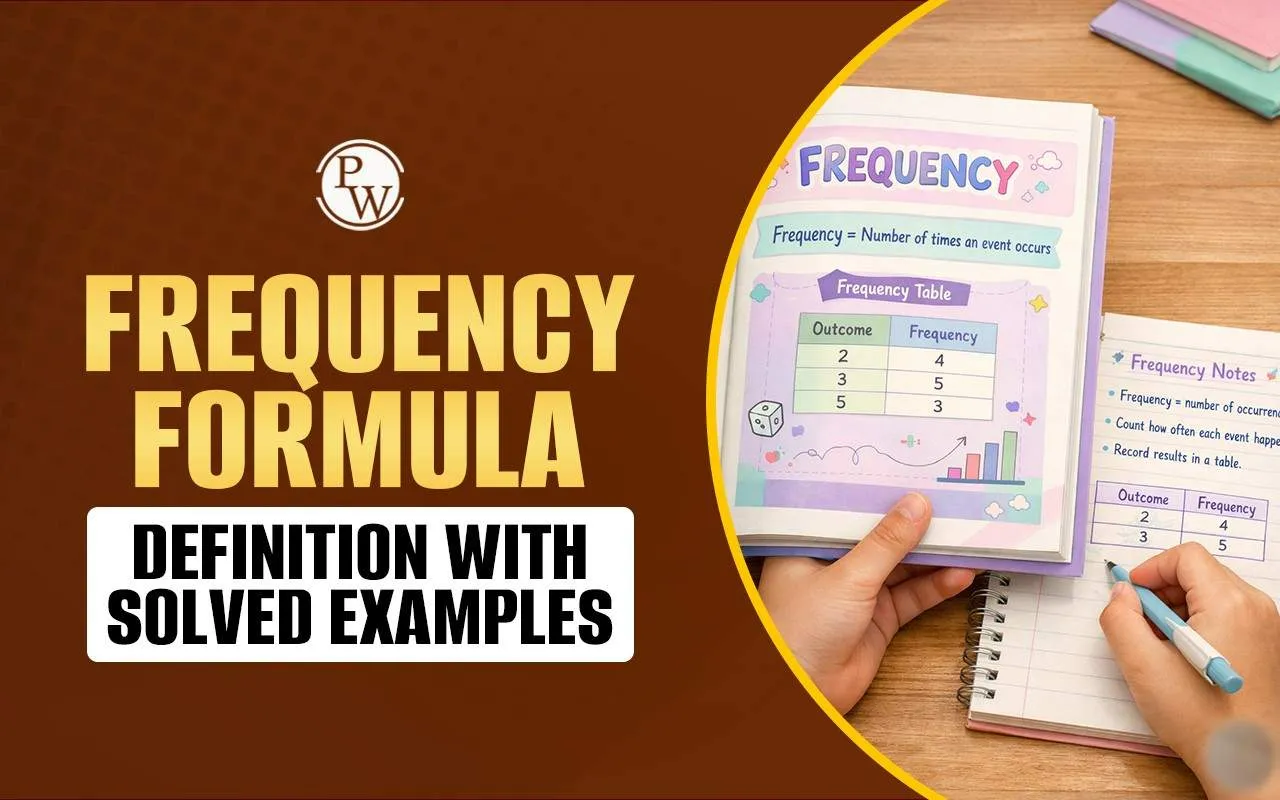
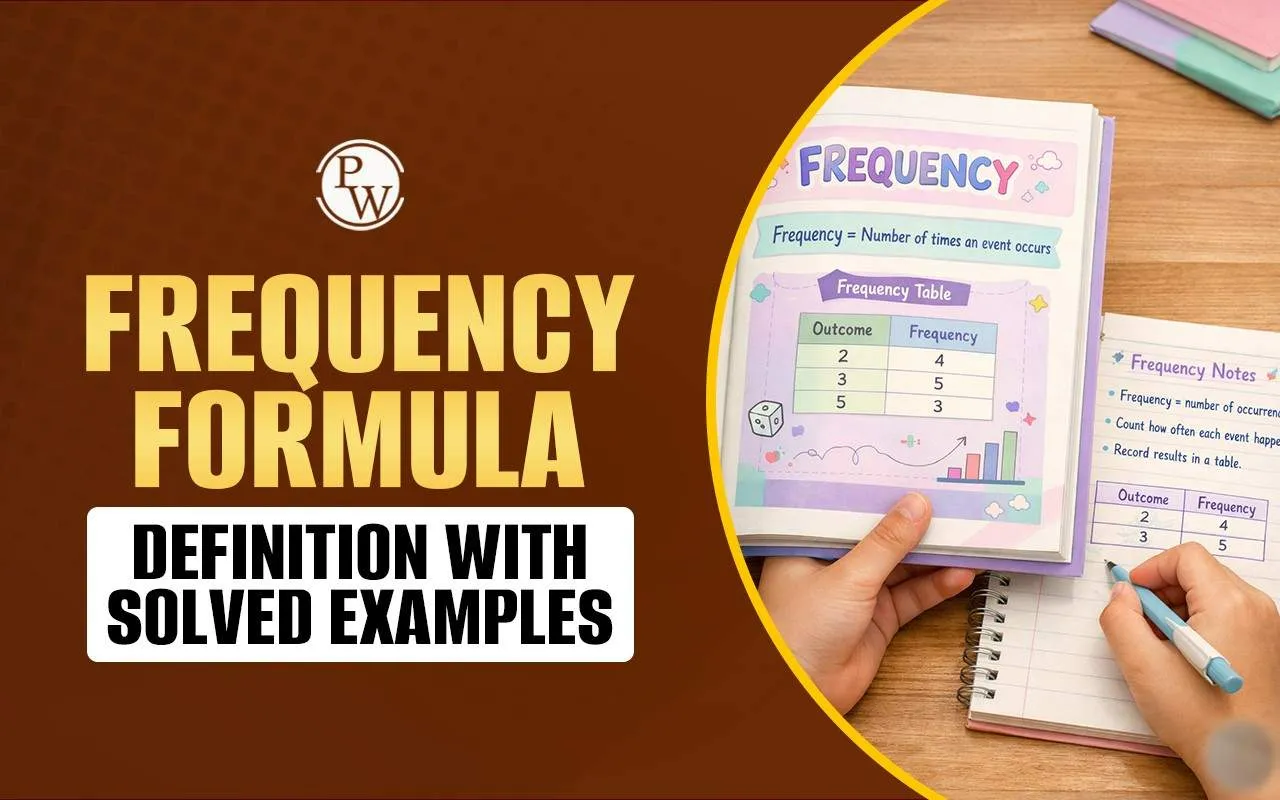
The frequency formula is a math formula that tells us how often an event that happens again and over again happens in a certain amount of time. It shows us how many full cycles, or "beats," an oscillation completes in one second, which is measured in Hertz (Hz). This makes it a very important tool for tuning an instrument and interpreting radio waves.
Understanding Frequency Formula Physics and Chemistry Applications
In science, frequency means the "rate" of a vibration. The frequency formula applies to both the quick shaking of a guitar string and the waves of electromagnetic radiation that you can't see. The laws of physics still hold: frequency is the opposite of time. It's easy to figure out how many cycles fit into one second if you know exactly how long it takes for one cycle to finish.
When it comes to frequency formula chemistry, the focus is usually on electrons and light. Chemists use these calculations to figure out what elements are present and how atoms act when they absorb energy because the energy of light is directly related to its frequency. The Hertz (Hz) is the standard unit of measurement. One Hz is equal to one cycle per second. You can also see it measured in revolutions per minute (RPM) or angular frequency.
How to Find Frequency: The Different Formulas You’ll Need
The data you start with will determine how you figure out the frequency. You could be timing a basic motion that happens over and over again, or you could be looking at a wave and need a frequency formula with wavelength.
1. The Basic Formula (When You Know the Time)
If you know the time period (T) — which is the time it takes to complete just one full cycle — use this formula:
f = 1 / T
-
f = Frequency (Hertz)
-
T = Time period (Seconds)
2. Frequency Formula with Wavelength (For Waves)
When you are studying sound, light, or water waves, you often need to convert frequency to wavelength formula units. Since the speed of a wave (v) is found by multiplying its frequency by its wavelength (λ), we can flip that around to find frequency:
f = v / λ
-
f = Frequency
-
v = Velocity (speed) of the wave
-
λ = Wavelength (the distance between two peaks)
For light traveling through a vacuum, the velocity (v) is always the speed of light, represented as c (roughly 3 × 10^8 m/s).
Read More - (a + b)³ Formula: A Plus B Whole Cube Formula
Solved Examples: Putting the Frequency Formula to Work
Let’s look at a few practical ways to apply these formulas to real-world problems.
Example 1: Finding Frequency from a Time Period
Question: A pendulum takes 0.5 seconds to swing out and back once. What is its frequency?
-
The Data: Time Period (T) = 0.5 s
-
The Math: f = 1 / 0.5
-
The Result: The frequency is 2 Hz (it completes two full swings every second).
Example 2: Calculating Frequency from Wave Speed
Question: A wave is traveling at a speed of 300 m/s and has a wavelength of 6 meters. What is the frequency?
-
The Data: Velocity (v) = 300 m/s, Wavelength (λ) = 6 m
-
The Math: f = 300 / 6
-
The Result: The frequency is 50 Hz.
Example 3: Working with Light Waves
Question: Find the frequency of a light wave that has a wavelength of 500 × 10^-9 m. (Speed of light c = 3 × 10^8 m/s).
-
The Data: v = 3 × 10^8 m/s, λ = 500 × 10^-9 m
-
The Math: f = (3 × 10^8) / (500 × 10^-9)
-
The Result: The frequency is 6 × 10^14 Hz.
Frequency in Statistics and Data
"Frequency" means how often a certain piece of data appears in a list when you're not in the physics lab.
-
Relative Frequency: This tells you how a specific subgroup compares to the whole. The formula is: (Subgroup count / Total count).
-
Cumulative Frequency: This is a running total. You find it by adding the frequency of one group to the sum of all the groups that came before it.
Read More - Perimeter of Square - Formula, Definition, Examples
Summary Table of Formulas
|
If you want to find... |
And you have... |
Use this formula |
|
Standard Frequency |
Time Period (T) |
f = 1 / T |
|
Wave Frequency |
Velocity (v) and Wavelength (λ) |
f = v / λ |
|
Angular Frequency |
Angular velocity (ω) |
f = ω / 2π |
Advancing Your Understanding of Oscillation Dynamics
To be able to do these calculations well, you need to know how energy travels through different materials. When we look at high-frequency waves, we're really seeing energy packed into very compact, fast intervals. This relationship is a vital part of modern technology, as it dictates how your smartphone receives data or how a microwave heats your dinner. You shouldn't view these numbers as just abstract math symbols on a page. Instead, think of them as the pulse of the physical world. Every vibration you feel and every sound you hear follows these exact rules. If you can predict the frequency, you can predict the behavior of the system itself. This predictive power allows engineers to build safer bridges and scientists to map distant stars using spectral analysis. We often find that students who practice these solved examples multiple times develop a natural intuition for wave behavior. Don't let the large exponents in light wave problems intimidate you. They're just a way to describe things moving very, very quickly. At the end of the day, whether you're dealing with the slow tick of a clock or the trillion-cycle hum of an atom, the core logic remains identical. We recommend keeping a small cheat sheet of these units nearby while you study. Having these formulas at your fingertips makes solving complex multi-step physics problems much smoother.
Make Mental Maths Easy and Enjoyable with CuriousJr
Does your child feel distracted or unsure while solving maths problems? Many children find maths difficult and feel stressed. With the right guidance and encouragement, maths can become simple, fun, and confidence-building.
CuriousJr’s online mental maths classes are designed to make learning stress-free and interesting. These interactive classes follow the school syllabus and explain concepts in a clear, practical way. Children learn faster, improve calculation skills, and develop a positive attitude towards maths.