Euler's Formula, Definition and Facts
 Nikita Aggarwal19 Jan, 2026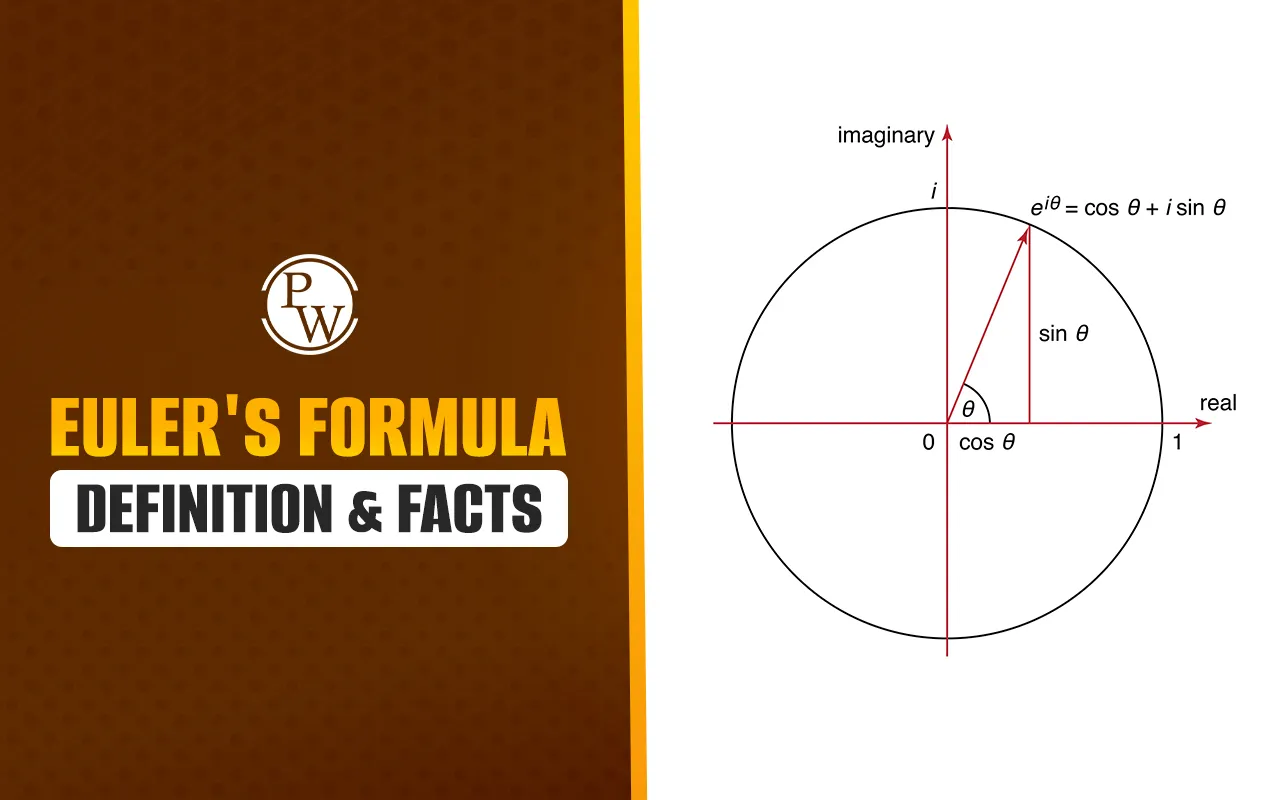
Euler's formula: Mathematics is full of amazing patterns and connections, and one of the most interesting examples is Euler’s formula. Discovered by the famous Swiss mathematician Leonhard Euler, this formula has become a key part of both geometry and advanced mathematics.
Euler’s formula actually refers to two different concepts. One is used in geometry to understand 3D shapes and is written as F + V − E = 2. The other is used in higher mathematics to connect imaginary numbers, angles, and exponential functions, and is written as eix = cosx + isinx. Here, you will learn both of these concepts in detail with solved examples.
Read More: Abacus vs. Vedic Maths: Which One is Better?
Euler's Formula
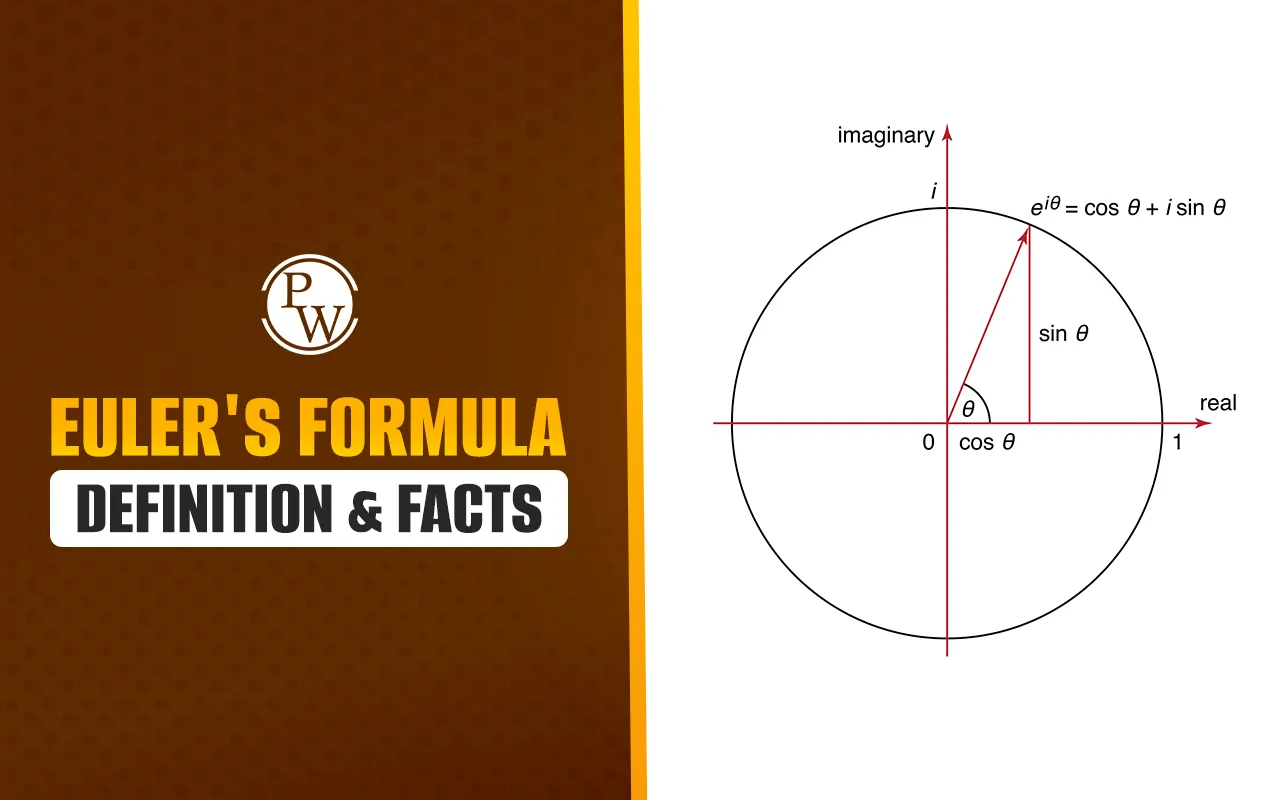
Euler's formula is a famous equation in mathematics discovered by Leonhard Euler. It connects exponential functions with trigonometric functions in a simple and elegant way. The formula is useful in many areas like engineering, physics, and complex number calculations. It shows how complex numbers rotate on the unit circle.
What is Euler’s Formula?
Euler's formula usually refers to two different but equally important ideas in mathematics:
Euler's Equation (related to complex numbers):
eix = cosx + isinx
Euler’s Polyhedron Formula (used in geometry):
F + V − E = 2
Let’s explore each one and understand what they mean.
Euler's Theorem Formula
Euler's theorem in mathematics states that for any two numbers
a
a and
n
n that are coprime,
aϕ(n)≡1(modn)
a
ϕ(n)
≡1(modn)
where
ϕ(n)
ϕ(n) is Euler's totient function. This theorem is important in number theory and cryptography.
Euler's Equation (Complex Numbers)
Euler's Equation is a formula used in higher-level mathematics. It connects the exponential function with trigonometric functions and imaginary numbers. The formula is:
eix = cosx + isinx
What the symbols mean:
-
e is a special number (approximately 2.718), called Euler’s number.
-
i is the imaginary unit, where i2 = −1.
-
x is any real number, usually representing an angle.
-
cos x and sin x are trigonometric functions used to describe angles in circles.
This formula is used in:
-
Electrical engineering (to describe signals)
-
Physics (especially in wave motion)
-
Computer science
-
Advanced mathematics
Euler’s Identity
One of the most famous versions of Euler’s formula is when x = π:
eiπ +1 = 0
This formula is known as Euler’s identity. It connects five of the most important numbers in mathematics:
-
e
-
π (pi)
-
i
-
1
-
0
Many mathematicians consider this the most beautiful equation ever discovered.
Read More: Is My Child Losing Interest in Maths?
Euler’s Polyhedron Formula
This version of Euler’s formula is easier to understand for students. It relates to 3D shapes such as cubes, pyramids, and prisms.
The formula is:
F + V − E = 2
Where:
-
F is the number of faces (flat surfaces)
-
V is the number of vertices (corners)
-
E is the number of edges (straight lines)
This rule applies to most solid 3D shapes called polyhedrons (plural of polyhedron), which have flat surfaces and straight edges.
Read More: Fun Math Activities for Kids to Develop Calculation Speed
When Does Euler’s Polyhedron Formula Work?
Euler’s polyhedron formula (F + V − E = 2) works only for certain types of 3D shapes, called convex polyhedrons.
A convex polyhedron must:
-
Have flat faces
-
Be completely closed (no gaps or holes)
-
Not curve inward at any part
In simple terms, convex polyhedrons are solid, regular shapes like cubes, pyramids, prisms, and other polyhedrons with flat surfaces and straight edges.
Euler’s formula does not work for:
-
Spheres, because they are curved and have no flat faces, edges, or corners
-
Shapes with holes, like a donut (torus) or hollow structures
-
Non-convex shapes, which may have parts that bend inward or intersect themselves
-
Irregular or twisted solids, where faces or edges may not connect in a simple, clean way
To use Euler’s formula correctly, always make sure the shape is a proper convex polyhedron with flat faces and no holes or curves.
Euler’s Polyhedron Formula Examples
Let’s understand Euler’s polyhedron formula using real 3D shapes. The formula is:
F + V − E = 2
Where:
-
F = number of faces
-
V = number of vertices (corners)
-
E = number of edges
This formula helps us check whether a 3D shape follows Euler’s rule. Let’s try it with some familiar solids.
Example 1: Cube
A cube (like a dice) has:
-
Faces (F) = 6
-
Vertices (V) = 8
-
Edges (E) = 12
Apply the formula: F + V − E
6 + 8 − 12 = 2
The cube satisfies Euler’s formula.
Example 2: Square Pyramid
A square pyramid (like the base of the Great Pyramid) has:
-
Faces (F) = 5 (1 square base + 4 triangular sides)
-
Vertices (V) = 5
-
Edges (E) = 8
Apply the formula: F + V − E = 5 + 5 − 8 = 2
Euler’s formula holds for the square pyramid.
Example 3: Triangular Prism
A triangular prism (like a Toblerone chocolate box) has:
-
Faces (F) = 5 (2 triangles + 3 rectangles)
-
Vertices (V) = 6
-
Edges (E) = 9
Apply the formula: F + V − E
= 5 + 6 − 9 = 2
The triangular prism also follows Euler’s rule.
Example 4: Octahedron
An octahedron (a solid with eight triangular faces) has:
-
Faces (F) = 8
-
Vertices (V) = 6
-
Edges (E) = 12
Apply the formula:
F + V − E = 8 + 6 − 12 = 2
Euler’s formula works perfectly for the octahedron as well.
5. A solid has 12 faces and 30 edges. How many vertices does it have?
Use the formula:
F + V − E = 2 ⇒ 12 + V −30 = 2 ⇒ V = 20
The shape has 20 vertices.
6. A shape has 6 faces and 12 edges. How many vertices?
F + V − E = 2 ⇒ 6 + V −12 = 2 ⇒V = 8
It has 8 vertices. This is a cube.
Read More:Successor and Predecessor
Applications of Euler’s Formula
Euler’s formula has many applications in both mathematics and real life. Here are a few important ones:
-
It helps in understanding and analyzing 3D shapes in geometry using the formula F + V − E =2, especially for solids like cubes, pyramids, and prisms.
-
It is used in architecture and construction to design strong and balanced structures such as bridges, towers, and domes.
-
In Physics and Electrical Engineering, Euler’s equation eix = cosx + isinx is used to study wave patterns, circular motion, and alternating electric currents.
-
In computer graphics, it is used to control the rotation and movement of 3D objects in animations, video games, and virtual simulations.
-
It is applied in robotics and artificial intelligence to help with motion planning and shape recognition.
-
In mathematics, Euler’s identity eiπ + 1 = 0 is famous for connecting five important mathematical constants in one equation, showing the deep relationship between different areas of math.
Also Read: Quick Calculation Techniques for School Students
Facts About Euler’s Formula
Here are some easy-to-remember facts that summarise what you’ve learned about Euler’s formula:
-
Euler’s polyhedron formula, written as F + V − E = 2 helps us check and understand the structure of 3D solid shapes.
-
This formula works only for closed polyhedrons with flat faces and straight edges. It does not apply to curved or hollow shapes.
-
Euler’s equation, eix = cosx + isinx is used in science and engineering to study wave motion and circular movement.
-
A special version of this equation, known as Euler’s identity eiπ + 1 connects five important mathematical constants: e, i, π, 1, and 0.
-
Leonhard Euler, the mathematician behind these formulas, made many valuable contributions to mathematics that are still taught and applied today.
Strengthen Your Child’s Maths Skills with CuriousJr Online Tuition
Is your child struggling with low marks in maths, even after spending extra time studying it? This often happens when the basic concepts are not clear. Without a strong foundation, maths can feel confusing, frustrating, and difficult to enjoy.
At CuriousJr, we focus on building strong conceptual understanding from the ground up. Our maths tuition classes for students make learning simple, engaging, and effective.
We use a two-teacher model to give every child individual attention during live sessions. One teacher explains the lesson step by step, while the second teacher supports students by answering questions and providing guidance throughout the class.
Every topic is taught using interactive visuals, real-life examples, and easy-to-follow explanations. Regular practice, homework help, and doubt-solving sessions ensure your child gains both skill and confidence.
We also provide parent progress updates, so you can stay involved and informed about your child’s improvement. If you are looking for a way to help your child improve in maths and feel confident in learning, we invite you to book a demo class for just Rs.29 today.