Abacus vs. Vedic Maths: Which One is Better?
 Praveen Singh30 May, 2026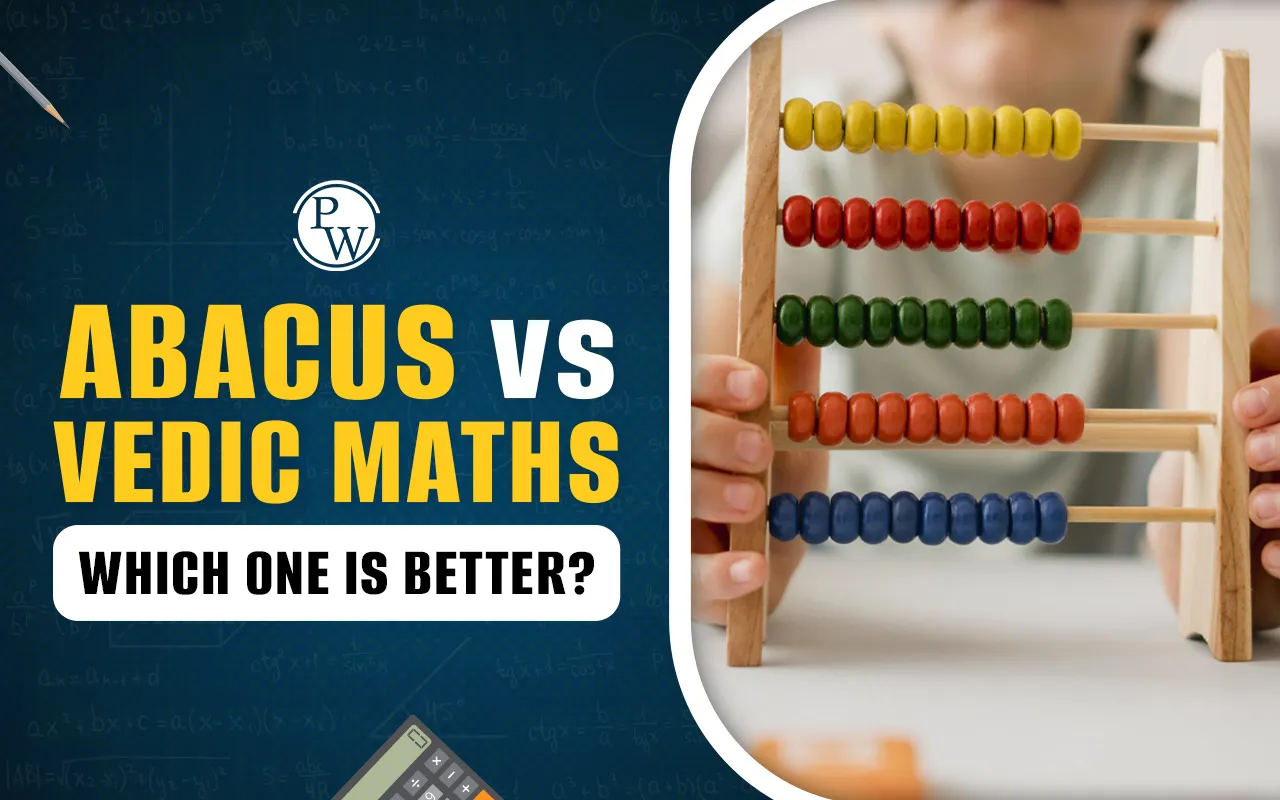
Abacus vs. Vedic Maths: Mathematics is a key part of everyday life, but many students struggle with calculations, making it feel challenging and intimidating.
To make learning easier, two widely used techniques, Abacus and Vedic Maths, help students improve their arithmetic abilities.
Both methods enhance speed and accuracy but follow different approaches. Abacus is a tool-based system that strengthens a child’s understanding of numbers, while Vedic Maths focuses on mental techniques that improve problem-solving efficiency.
An oft-asked question among parents and students alike is, "What is better - Abacus or Vedic Maths?" That question has an answer depending on the age of the learner concerned, their objectives, and their inclination in learning. The blog provides an elaborate comparison between Abacus and Vedic Maths, examining their learning methodologies, advantages, disadvantages, and which is better abacus or vedic maths and for whom.
This blog provides a detailed comparison of Abacus and Vedic Maths, exploring their learning methods, benefits, limitations, and which one is best suited for different learners.
Read More - Top 10 Tricks to Master Mental Maths
What is Abacus?
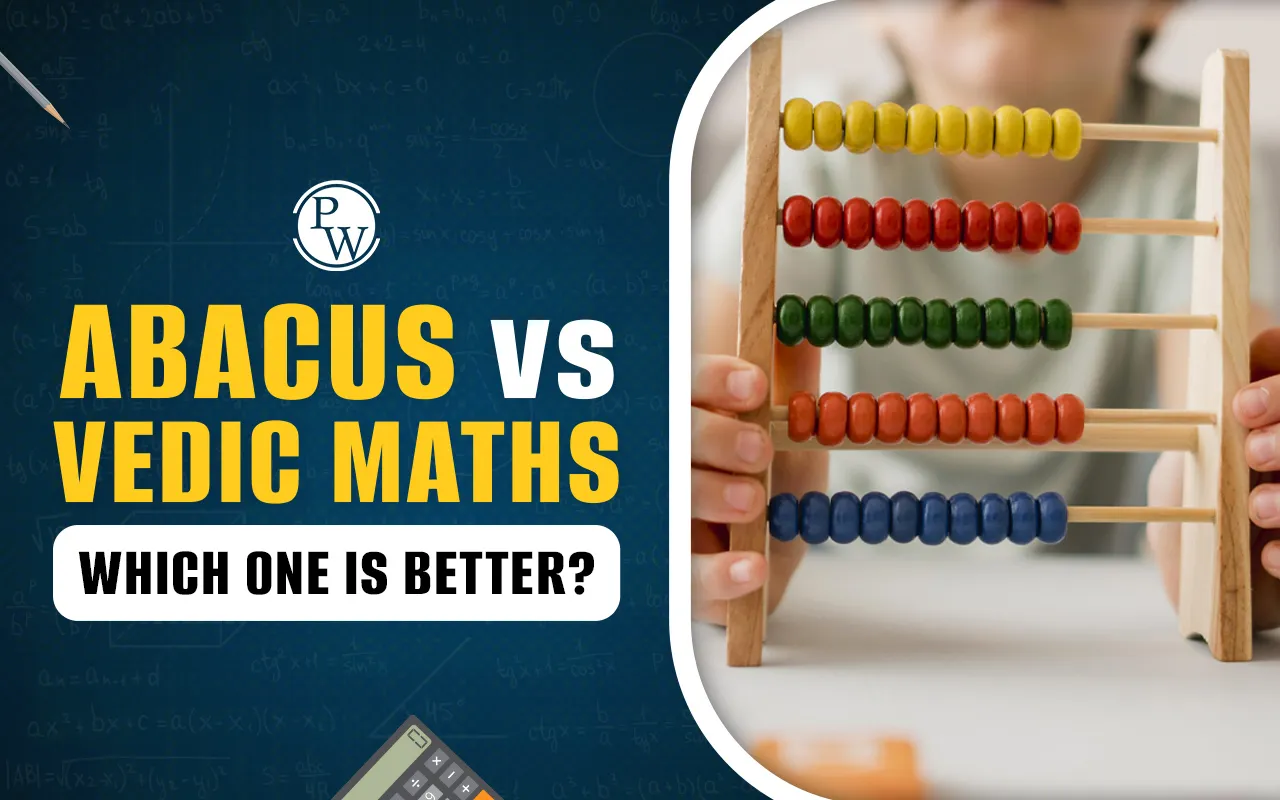
The abacus, an ancient calculating tool, has taught arithmetic for centuries. It comprises a rectangular frame with a series of beads that slide back and forth along rods. Each bead represents a numerical value, thus giving students an impression of numbers and teaching them to use their calculation skills more efficiently.
This device particularly works wonders for the young tots just learning numbers. By continually moving the beads, the child's number sense and mental calculation capabilities are greatly strengthened. For parents pondering over Vedic Maths vs Abacus, the tool is the commonly deemed best for kids between ages 4 and 7.
Read More - Fun Math Activities for Kids to Develop Calculation Speed
How Does the Abacus Work?
The Abacus follows a structured approach to help students perform addition, subtraction, multiplication, and division.
The beads on the rods represent different place values, and children move them according to specific rules to complete calculations.
At first, students use a physical abacus, but with practice, they transition to mental abacus techniques, where they can visualize the movement of beads in their minds. This helps them perform complex calculations quickly and accurately without needing an actual Abacus.
Read More - Quick Calculation Techniques for School Students
Advantages of Learning Abacus
Learning Abacus offers multiple benefits beyond just improving mathematical skills. It enhances cognitive abilities, strengthens memory, and builds a solid foundation for future learning. To understand vedic maths vs abacus lets explore more.
Here are some of the key advantages of using the Abacus for math education:
-
Enhances Concentration & Memory: The Abacus activates both the left and right hemispheres of the brain, leading to improved focus, better concentration, and enhanced memory retention. Children who practice Abacus regularly develop greater attention to detail, which helps them in other academic subjects as well
-
Develops Visualization Skills: With continuous practice, students no longer need to rely on a physical Abacus. They begin to visualize the beads and their movements in their minds, enabling them to perform calculations mentally. This ability strengthens their imagination, problem-solving skills, and numerical fluency.
-
Boosts Speed & Accuracy: Abacus learners develop the ability to calculate faster than traditional methods by eliminating the need for written calculations. This increase in speed comes with improved accuracy, making students more confident in solving mathematical problems.
-
Improves Fine Motor Skills: The physical movement of beads strengthens hand-eye coordination and finger dexterity, especially in young children. The repetitive action of sliding beads enhances neural connections and improves their ability to perform precise tasks.
-
Builds a Strong Mathematical Foundation: Learning Abacus at an early age lays the groundwork for understanding mathematical concepts easily. The skills developed such as number sense, logical reasoning, and pattern recognition help children transition smoothly into higher-level mathematics in school. Abacus is excellent for early learners before moving to Vedic Maths or Abacus comparisons further in the education.
Read More - How to Make My Child a Faster Learner in School Using Mental Maths
Disadvantages of Abacus
Despite its many benefits, the Abacus method has some limitations. While it is an excellent tool for early math education, it may not suit students requiring advanced mathematical knowledge. Below are some key disadvantages of using the Abacus:
-
Limited to Basic Arithmetic: The Abacus is primarily designed for fundamental operations such as addition, subtraction, multiplication, and division. It does not cover advanced mathematical topics like algebra, geometry, or calculus, essential for higher-level education.
-
Takes Time to Master: Becoming proficient in Abacus requires consistent practice over 2-3 years. This can be challenging for students who want quick results or need to focus on other academic subjects. Unlike mental math techniques that can be learned in months, the Abacus method requires long-term commitment to show significant improvement.
-
Not Useful for Higher Education: Since the Abacus is a physical tool, it cannot be used in school exams or competitive tests. While students can transition to mental abacus techniques, many find it difficult to apply their skills in algebra, trigonometry, or calculus, where numbers alone are not enough to solve problems.
This raises the question: “abacus or vedic maths which is better for long-term growth?”
What is Vedic Maths?
Vedic Math is essentially a mental mathematics system based on 16 sutras (i.e. mathematical formulas) that makes the very complex arithmetic calculations simple. It is an ancient science from India rediscovered in the 20th century by Shri Bharati Krishna Tirthaji.
Vedic Math does not, unlike the Abacus, use any instruments whatsoever. Rather, it is focused on mental approaches by which learners can solve problems swiftly and almost effortlessly.
When comparing the difference between Vedic Maths and Abacus, Vedic methods are generally more flexible for older students preparing for competitive exams.
How Does Vedic Maths Work?
Vedic Maths is based on a collection of mathematical formulas, known as sutras, that provide highly efficient calculation shortcuts. These techniques allow students to solve problems mentally, reducing their reliance on lengthy traditional methods.
By applying these sutras, students can complete complex arithmetic operations in seconds. Below are some of the most well-known Vedic Maths techniques and how they work:
Nikhilam Sutra (All from 9 and Last from 10): This technique is primarily used for fast multiplication, especially when dealing with numbers close to base values like 10, 100, or 1000.
Instead of following conventional multiplication rules, this sutra helps students work with complements (differences from the base number), making calculations significantly faster. It is particularly useful for competitive exams and mental math challenges.
Urdhva-Tiryagbhyam Sutra (Vertically and Crosswise Method): This method simplifies multiplication by following a structured crosswise and vertical approach, allowing students to perform calculations quickly without writing multiple steps. Instead of using traditional long multiplication, this technique helps break down numbers into smaller, manageable parts, making problem-solving faster and easier.
For example, let’s multiply 23 × 12 using this method:
-
Multiply the rightmost digits (units place): 3 × 2 = 6.
-
Multiply crosswise and add (tens place): (2 × 2) + (3 × 1) = 4 + 3 = 7.
-
Multiply the leftmost digits (hundreds place): 2 × 1 = 2.
By following this sequence, we get the final answer: 276.
Ekadhikena Purvena Sutra (One More than the Previous One): This formula is used for finding the squares of numbers ending in 5. Instead of using long multiplication steps, students apply this shortcut to find the square of any number ending in 5 instantly.
For example, to find (25)², students multiply the first digit (2) by its successor (3) and place 25 at the end, giving 625 as the answer. This technique makes calculating squares effortless and is commonly used in exams requiring quick mental calculations.
Read More - Brackets in Maths: Types, Rules & Examples
Advantages of Learning Vedic Maths
Vedic Maths is a highly effective approach that simplifies calculations and enhances a student's ability to work with numbers effortlessly. It increases speed and accuracy and encourages a deeper understanding of mathematical concepts.
Here are a few other advantages of learning Vedic Maths:
-
Faster Calculations: Vedic Maths techniques enable students to solve problems 10-15 times faster than conventional methods. By applying shortcut formulas, they can quickly arrive at answers without relying on long, step-by-step calculations.
-
Useful for Competitive Exams: In exams like Olympiads, IIT-JEE, banking exams, and other aptitude tests, time is a major factor. Vedic Maths helps students perform quick calculations, improving their time management and solving complex problems more efficiently.
-
No Tools Required: Unlike other calculation techniques that require physical aids, Vedic Maths is based on mental calculations, allowing students to apply it anytime, anywhere without the need for an abacus, calculator, or pen and paper.
Covers Advanced Topics: While most mental math techniques focus on basic arithmetic, Vedic Maths extends beyond that, covering algebra, trigonometry, square roots, cube roots, and even calculus. This makes it a valuable tool for students at all levels of learning.
Builds Logical Thinking: By following structured patterns and mathematical principles, Vedic Maths strengthens problem-solving skills, pattern recognition, and logical reasoning.
Students not only become faster at calculations but also develop a sharper approach to handling complex mathematical problems.
Disadvantages of Vedic Maths
Despite its many benefits, Vedic Maths has some challenges students may face while learning it.
-
Requires Memorization of Sutras: Students must dedicate time to learning 16 main formulas and 13 sub-formulas.
-
Not Suitable for Very Young Children: The abstract nature of Vedic Maths makes it more appropriate for students aged 8 and above.
-
Initial Learning Curve: Some students may find it difficult to transition from traditional methods to Vedic techniques, requiring practice to master.
Key Differences Between Abacus and Vedic Maths
Parents often compare vedic maths or abacus which is better and wonder about the difference between Vedic Maths and Abacus. Here’s a clear breakdown:
|
Differences Between Abacus and Vedic Maths |
||
Feature |
Abacus |
Vedic Maths |
|
Methodology |
Uses a physical tool with beads and rods to perform calculations. |
Uses mental techniques (sutras) to simplify mathematical operations. |
|
Age Group |
Ideal for 4-12 years, as it helps young children develop number sense and visualization skills. |
Best for 8+ years, as it enhances speed and accuracy for students handling advanced math. |
|
Learning Duration |
Takes 2-3 years to fully master and transition to mental calculations. |
Can be learned in 6-12 months with regular practice |
|
Speed & Accuracy |
Improves calculation speed gradually but takes time to develop accuracy. |
Significantly increases speed and accuracy in a shorter time. |
|
Application in School |
Primarily used for basic arithmetic (addition, subtraction, multiplication, division). |
Useful for both basic and advanced mathematics, including algebra, trigonometry, and calculus. |
|
Use of Tools |
Requires a physical abacus initially, though students later transition to mental visualization. |
No tools required, as all calculations are performed mentally. |
|
Suitability for Competitive Exams |
Not commonly used in competitive exams due to reliance on a physical tool |
Widely used in Olympiads, IIT-JEE, banking exams, and aptitude tests to improve problem-solving speed. |
|
Cognitive Benefits |
Enhances concentration, visualization, and memory through structured practice. |
Develops logical thinking, problem-solving skills, and mathematical intuition. |
|
Limitations |
Limited to basic arithmetic and may take longer to apply in real-world problem-solving. |
Requires memorization of sutras, which may take time for beginners. |
This table shows the difference between Abacus and Vedic Maths in a simple way, helping parents and students decide which method to adopt and vedic maths or abacus which is better.
Abacus vs. Vedic Maths Which One Should You Choose?
Choosing between Abacus and Vedic Maths depends on a child's age, learning style, and long-term goals. Both methods offer unique benefits, and selecting the right one can significantly enhance mathematical skills.
For children aged 4-7: Abacus is the ideal choice as it helps young learners develop basic arithmetic skills, number sense, and concentration. The hands-on approach with beads makes it easier for children to grasp fundamental math concepts in an engaging and interactive way.
For students aged 8 and above: Vedic Maths is more suitable, as it enhances calculation speed, accuracy, and logical reasoning. Its mental math techniques allow students to solve complex problems quickly, making it especially beneficial for competitive exams and higher-level mathematics.
For a well-rounded mathematical foundation: The whole Abacus versus Vedic Maths should not be a clash, but a complementarity. By understanding the difference between Vedic Maths and Abacus, it enables them to take better judgmental calls for their children. Together, Abacus and Vedic Maths develop a strong learning curve that stands on strong fundamentals and advanced mental math capabilities. Join Mental Maths Classes Online Now!!




Abacus vs. Vedic Maths FAQs
1. Can a child learn both Abacus and Vedic Maths?
2. Which method is more fun for kids?
3. Which method is better for students with dyslexia or ADHD?

Get Free Counselling Today
and Clear up all your Doubts
 Live & recorded classes available at easeDashboard for progress trackingLakhs of practice questions