Fun Math Activities for Kids to Develop Calculation Speed
 Jasdeep Singh20 Jan, 2026
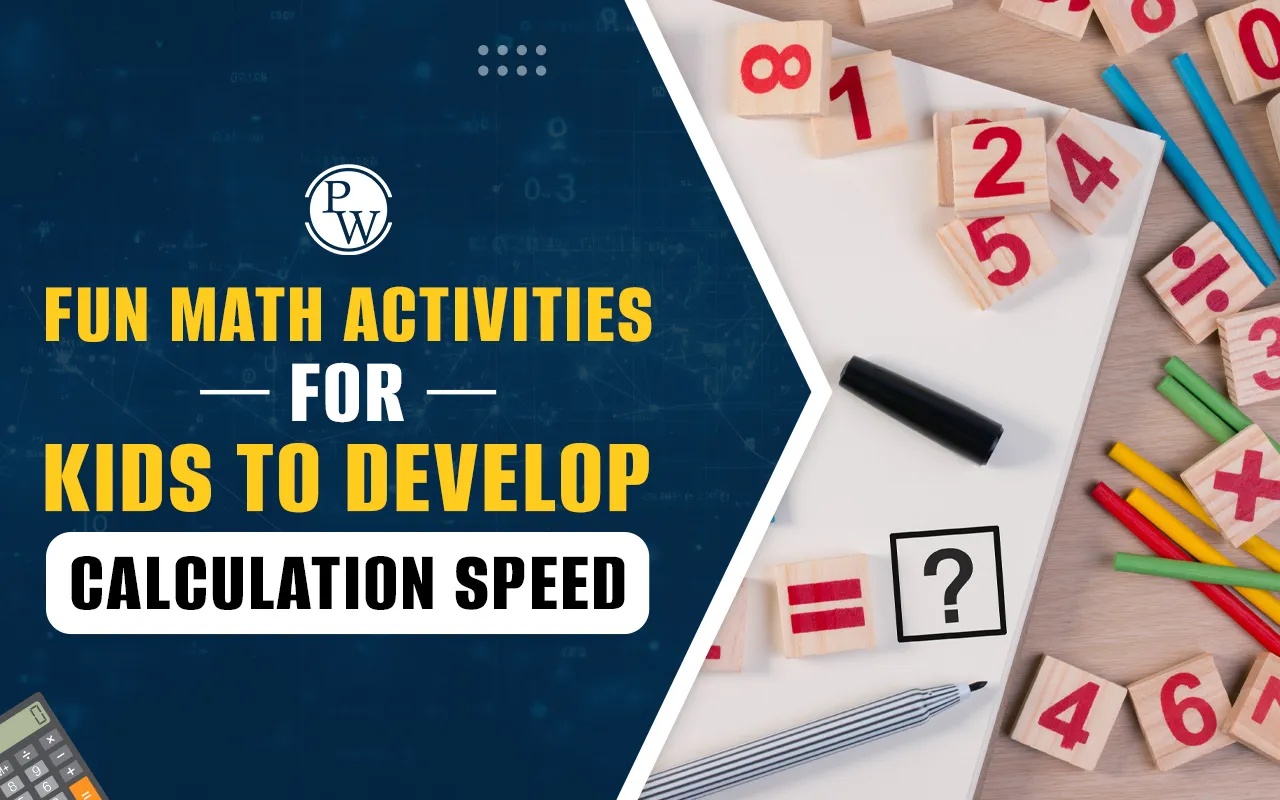
Not everyone finds math easy, and for many students, solving problems quickly can feel overwhelming. However, math does not have to be difficult. With the right approach, it can become an enjoyable and engaging subject.
Just like building blocks, mastering math starts with a strong foundation, allowing students to progress to more complex concepts with confidence.
Quick Calculation Techniques for School Students
This blog explores twelve exciting math activities that help kids develop calculation speed, improve problem-solving skills, and build confidence in numbers. Whether used in the classroom or at home, these activities make learning enjoyable and interactive.
Read the blog till the end to explore exciting ways to make math both fun and effective!
Top 10 Tricks to Master Mental Maths
Why is Speed Important in Math?
Before we explore the activities, let's discuss why calculation speed is essential for kids.
Boosts Confidence: Students who can quickly solve math problems feel more confident in their abilities.
Enhances Problem-Solving Skills: Quick calculations allow children to focus on solving complex problems rather than getting stuck on basic arithmetic.
Prepares for Exams: Many standardized tests require fast problem-solving skills. Practicing speed-based math activities helps students perform better.
Develops Logical Thinking: Math games encourage children to think logically and apply strategies to solve problems faster.
Makes Math Fun: Interactive and engaging activities turn learning into a positive experience, reducing math anxiety.
Abacus vs. Vedic Maths: Which One is Better?
12 Exciting Math Games for Kids to Develop Faster Calculation Skills
Building speed and accuracy in math is easier when learning is interactive. These math games will make practicing calculations fun and rewarding for kids.
1. Math Bingo – A Classic Game with a Twist
Math Bingo is a fantastic way to make practicing basic arithmetic operations exciting. Instead of the usual bingo numbers, each card contains different answers to math problems.
The teacher or parent calls out math equations like "6 + 7" or "9 × 4", and students must quickly solve the problem and check if the answer appears on their bingo card.
The first player to complete a row shouts "Bingo!" and wins.
This game reinforces addition, subtraction, multiplication, and division skills while improving mental calculation speed.
Increasing the difficulty level by incorporating fractions, decimals, or algebraic expressions for older students to make it more challenging.
2. Around the World – A Rapid-Fire Mental Math Challenge
This game is perfect for classroom settings where students compete to answer math problems as quickly as possible.
One student stands behind a seated classmate’s chair, and the teacher calls out a problem such as "8 × 9" or "15 + 27".
The first student to answer correctly moves to the next seat, while the other sits down. The goal is to travel "around the world" by answering all problems correctly before anyone else.
This fast-paced activity improves quick recall of multiplication tables, addition, and subtraction while encouraging a friendly competitive spirit.
How to Manage Time Effectively While Studying
3. Salute! – A Number Guessing Card Game
Salute! is an engaging math game that combines logic and calculation speed. Two players each pick a numbered card (1-10) without looking and place it on their forehead.
A third person, acting as the referee, announces the sum or product of the two numbers. Players must use their mental math skills to figure out the number on their own card.
For example, if the referee says "The sum is 12," and one player sees that their opponent has a 5, they must quickly deduce that their own number is 7. This game enhances addition, subtraction, and multiplication fluency while encouraging logical reasoning.
4. Multiplication Hopscotch – Jump and Learn
This activity combines physical movement with mental math practice. Using chalk, draw a hopscotch grid with numbers in each square.
Students take turns tossing a marker onto a square and must solve a multiplication problem related to that number before hopping through the grid.
For example, if a student lands on 8, they might be asked "What is 8 × 6?" before proceeding. This game helps reinforce multiplication tables in an engaging and active way, making it particularly useful for kinesthetic learners.
5. Math Card War – A Fun Way to Practice Arithmetic
This game is a fun twist on the classic "War" card game. Each player flips two cards and must either add, subtract, or multiply the numbers. The player with the highest result wins both cards. The game continues until all cards are played.
For example, if one player draws 7 and 3, and another draws 5 and 4, they may both multiply their numbers. Since 21 is greater than 20, the first player wins the round. This game enhances quick calculation skills and number fluency in a fun and competitive way.
6. Beat the Clock – Speed-Based Math Challenge
Beat the Clock is an excellent solo or group activity that encourages students to solve as many problems as possible within a set time limit.
A teacher or parent gives students a worksheet with math problems and sets a timer for 2 minutes. The goal is to complete as many problems as possible before time runs out.
Students might have 50 addition and subtraction problems and must try to finish them quickly. This game improves time management and mental math speed, making it great for test preparation.
Top 10 Tricks to Master Mental Maths
7. Math Tic-Tac-Toe – Strategy Meets Calculation
This game is a fun twist on traditional Tic-Tac-Toe, where students must solve math problems to claim their squares. Instead of Xs and Os, each square contains a math equation related to addition, subtraction, multiplication, or division.
To place their mark in a square, a player must solve the problem correctly. The first player to get three correct answers in a row—horizontally, vertically, or diagonally—wins the game. For example, if a square contains "36 ÷ 6," the student must answer "6" before marking their spot.
8. The 24 Game – A Mental Math Puzzle
The 24 Game is a great way to practice arithmetic operations while improving logical reasoning. Players are given four numbers and must use addition, subtraction, multiplication, or division to make 24.
Each number must be used exactly once, and students must think quickly to find a valid equation.
For example, if the numbers are 3, 8, 4, and 6, a possible solution is: (8 - 4) × 6 = 24. Another possible way is (6 × 4) ÷ (8 ÷ 3) = 24. This game challenges students to think critically, develop multiple problem-solving strategies, and improve their calculation speed.
9. Back-to-Back – A Number Estimation Game
Back-to-Back is a game of logical thinking and quick calculations. Two students stand back-to-back and write a number (between 1-50) on the board without looking at their own number.
A third student announces the sum or product of the two numbers, and each player must estimate what number they have.
For example, if the announced sum is 72, and one player sees that their opponent has 25, they must quickly figure out their number is 47. This game helps students strengthen their mental math skills, estimation abilities, and problem-solving speed in a fun and engaging way.
10. Math Jeopardy – A Classroom Quiz Game
Inspired by the classic TV game show, Math Jeopardy is an exciting way to review and reinforce different math concepts. The game board consists of categories like "Multiplication," "Fractions," "Geometry," or "Word Problems," with increasing point values for each question.
Students take turns selecting a category and answering the corresponding math question to earn points.
For example, a 200-point multiplication question might be "What is 12 × 9?", while a 500-point fraction question could be "Simplify 18/24 to its lowest terms." The team or player with the highest score at the end of the game wins. This activity enhances quick thinking, problem-solving, and competitive learning in an engaging way.
11. Number Line Leap Frog – A Fun Movement-Based Game
This interactive game helps young learners grasp addition and subtraction concepts while incorporating physical movement. A large number line is drawn on the floor, with numbers spaced evenly apart.
The teacher calls out a math problem, and students must jump to the correct answer.
For example, if the teacher says "Start at 4 and add 6," the student must jump to 10. To make it more challenging, introduce negative numbers, fractions, or word problems for older students. This game is great for kinesthetic learners and makes math more visual and engaging.
12. Math Baseball – Solving to Score Runs
Math Baseball is a team-based game that turns solving math problems into a fun and competitive activity. The game follows regular baseball rules, where teams take turns "batting" by answering a math question.
-
Single: An easy problem (e.g., 5 × 2)
-
Double: A moderate problem (e.g., 14 + 27)
-
Triple: A challenging problem (e.g., 45 ÷ 5 × 3)
-
Home Run: A difficult problem (e.g., (12 × 4) + (8 × 6) - 10)
If a player answers correctly, they move to the respective base. If they answer incorrectly, it's an out. The team with the most runs at the end of the game wins.
Help your child master the art of fast and accurate calculations with Curious Junior’s One-Week Mental Math Booster Classes, starting from March 10..
Designed to make math easier and more exciting, this program teaches 50+ mental math strategies through interactive audio-video lessons.
Your child will develop fast calculation skills, stronger logical reasoning, and sharper problem-solving abilities, all while having fun.
Spots are filling fast! Enroll now and give your child the competitive edge in math!