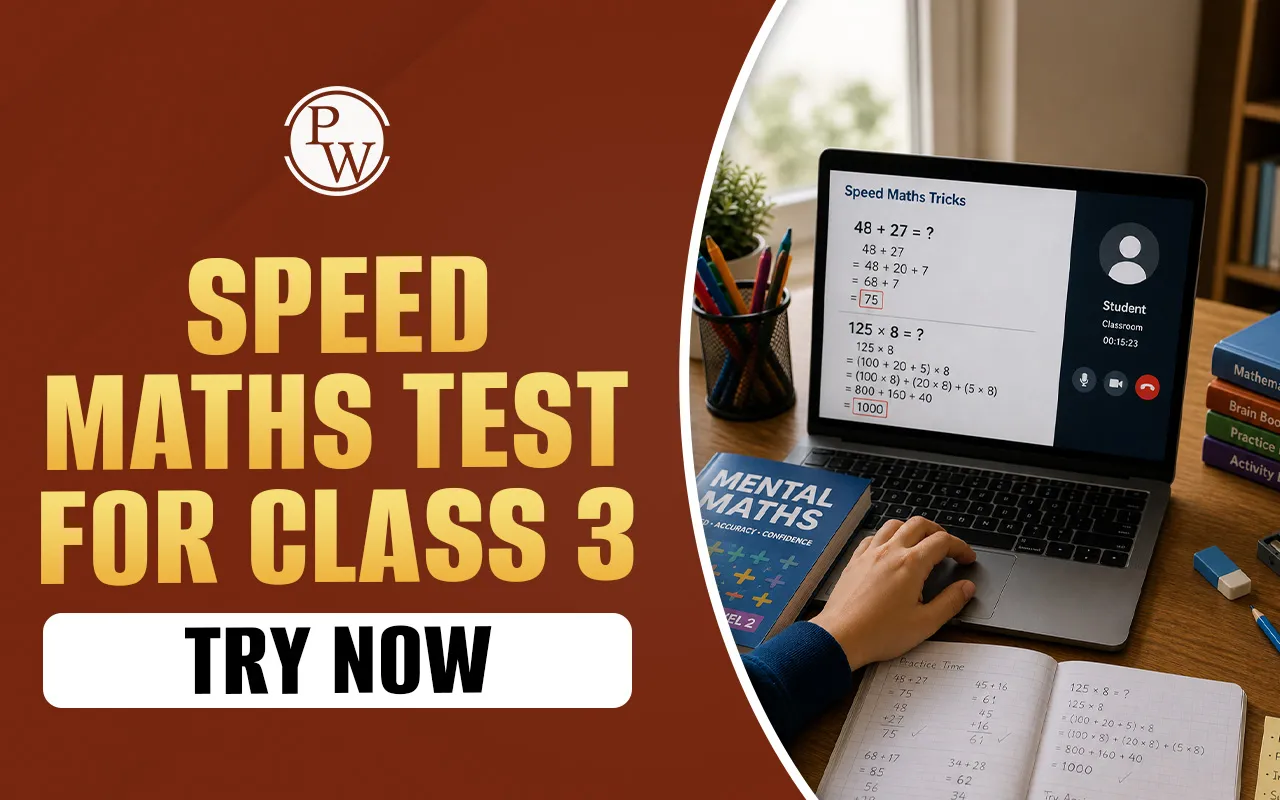
Speed Maths Test for Class 3 (Try Now)
 Nivedita Dar22 May, 2026
Many learners feel under pressure, particularly when working on timed assessments, and find that sums are too difficult to calculate quickly. One of the most frequently encountered difficulties in early learning is the transition from counting to quick mental calculations. A speed maths test class 3 helps the students to overcome this issue.
This article offers a structured way to learn these skills and provides proven techniques, such as mental maths drills and quick quizzes, to ensure your child doesn't fall behind in their learning.
What is Speed Maths?
There are many young mathematicians who struggle to find a quick solution to a maths problem; they know how to do it, just not fast enough to get it right. In Class 3, when children are required to do timed speed maths tests, they may feel pressured and make trivial errors when adding or subtracting.
It is an important step in primary school, moving from slow, laboured counting to quick mental counting. It involves searching for a solution and cultivating a "number sense" in which maths is viewed as a natural language. Pupils are taught to solve equations through structured mental arithmetic, helping them develop their long-term academic confidence and progress in their work.
Speed Maths Test Question for Class 3
Here is a short speed maths test for Class 3; it is carefully selected to challenge students' thinking and enhance their response speed. Wherever possible, encourage your child to solve these without pen and paper to make the most of a mental maths test.
Section A: Addition and Subtraction Sprint
-
What is 45 + 23?
-
Find the difference between 90 and 37.
-
Add 115 and 205.
-
Subtract 48 from 100.
-
What is the sum of 12, 18, and 25?
Section B: Multiplication and Division Quick-Fire
-
Calculate 8 times 4.
-
How many 5s are there in 45?
-
Multiply 12 by 3.
-
Divide 64 by 8.
-
What is double of 49?
Section C: Mental Maths Logic
-
Missing Numbers: 24 + __ = 50
-
Pattern Check: 5, 10, 15, __, 25
-
Time Challenge: How many minutes are in 2 hours?
-
Money Math: If one chocolate costs 7 rupees, how much do 5 cost?
-
Halving: What is half of 84?
Read More - Learn Subtraction Without Borrowing (Class 3)
Section D: Quick Maths Quiz (Advanced)
-
3-Digit Addition: 250 + 150 = ?
-
Subtraction: 500 - 125 =?
-
Grouping: If 4 clusters have 6 stars each, what is the total number of stars?
-
Value Check: How many tens are in 180?
-
Comparison: Which is greater: 12 x 5 or 50 + 15?
Section E: Speed Math Word Problems
-
Rohan has 15 apples and buys 12 more. How many does he have now?
-
A box holds 8 pencils. How many pencils are in 5 boxes?
-
If you have 60 sweets and share them equally between 6 friends, how many does each get?
-
A train leaves at 10:00 AM and arrives at 11:30 AM. How many minutes was the journey?
-
You buy a toy for 45 rupees and give a 100-rupee note. What is your change?
Answer Key for Parents and Teachers
Section A
-
68
-
53
-
320
-
52
-
55
Section B
-
32
-
9
-
36
-
8
-
98
Section C
-
26
-
20
-
120
-
35
-
42
Section D
-
400
-
375
-
24
-
18
-
50 + 15 (65)
Section E
-
Total apples = 27
-
Total pencils = 40
-
Sweets per friend = 10
-
Journey time = 90 minutes
-
Change back = 55 rupees
Read More - How to Make Fractions Easy for Class 3 Students
Benefits of Speed Maths Test Class 3
Just getting the right answer is not the key to a quick maths quiz – the key is how the brain processes information. There are several long-term benefits for Class 3 students to participate in regular testing:
-
Improved Concentration: They have to concentrate on what they are trying to test quickly so that students are able to focus their attention on the distractions.
-
Confidence Boost: When children successfully complete a class 3 speed maths test, they will feel a sense of achievement and be less anxious about maths at school. It makes it easier for the brain to handle complex logical problems later in life.
-
Time Management: Children develop the ability to distribute their time over various subjects, which is very important for competitive exams in higher grades.
-
Foundation for Vedic Maths: Early exposure to speedy calculation instils the concepts of Vedic maths speed in students, making large multiplications and divisions effortless.
How Parents Can Help with Speed Maths Test Class 3
You can use certain strategies and have patience when helping a child with a speed maths test in class 3. Don't make it seem like a chore, but rather a routine of everyday life.
-
The Kitchen Challenge: Make your child add two numbers up while preparing food or shopping.
-
Short Bursts: Avoid sitting for long periods of time (an hour or more). Short daily practice sessions are often more effective than long study sessions.
-
Encourage Approximation: Allow "around" answers. If an answer is supposed to be around 50, it is just as important to be told that it is 52 as it is to be told that it is 50.
How Does Curious Jr Help with Class 3 Mental Maths
Curious Jr is an interactive site that helps students take a mental maths test in a game-based setting. In the place of traditional rote learning, the platform emphasises the following:
-
Visual Learning: Using interactive tools to explain place value and number operations.
-
Adaptive Quizzes: The speed maths test for class 3 is adjusted based on students' performance to consistently challenge them without discouraging them.
-
Instant Feedback: Students instantly know how many they got right and how many they got wrong, giving them a clue as to what they did and how to correct it.
-
Vedic Techniques: Curious Jr. combines the principles of Vedic maths with speed and explains the shortcuts that make long-form math easier for kids to learn.