
Why Learning to Round Off Numbers in Class 3 Makes Mental Estimates Faster?
 Nikita Aggarwal22 Jun, 2026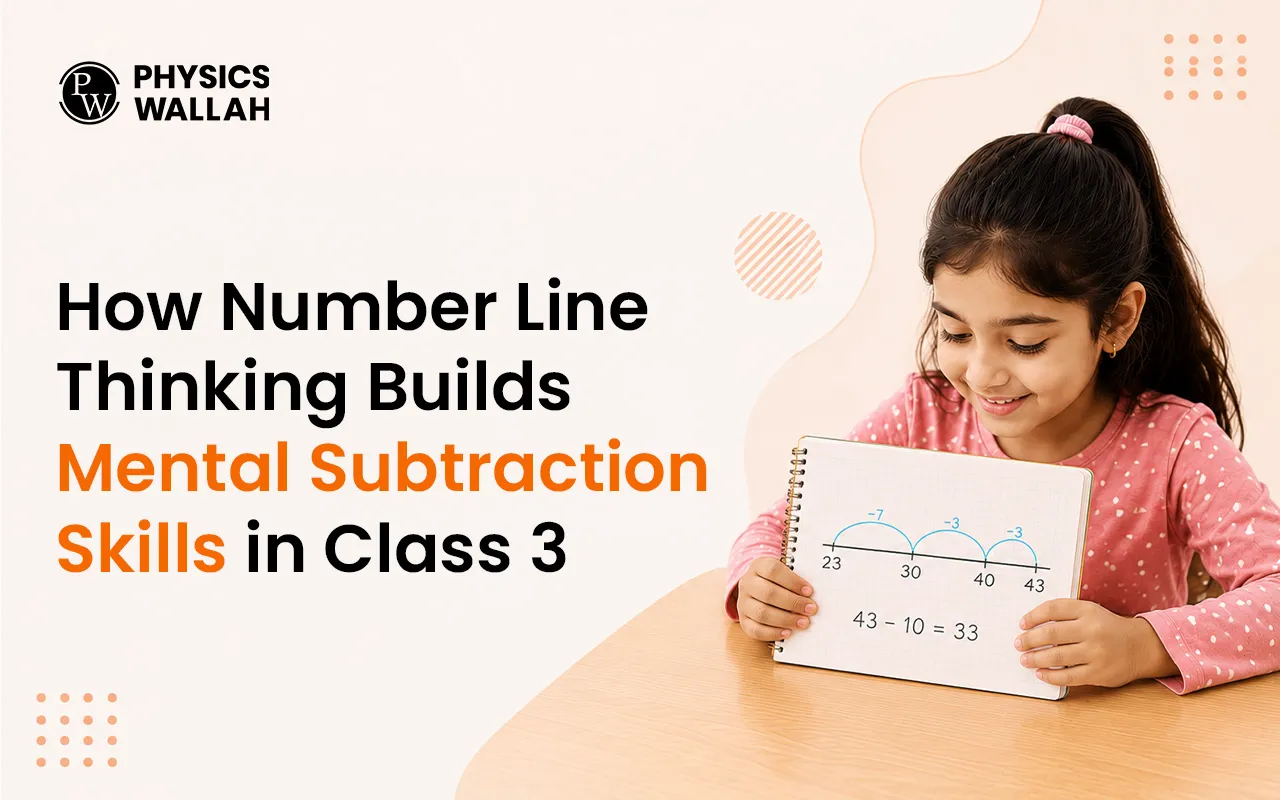
What is Number Line Subtraction Class 3 Mental Maths?
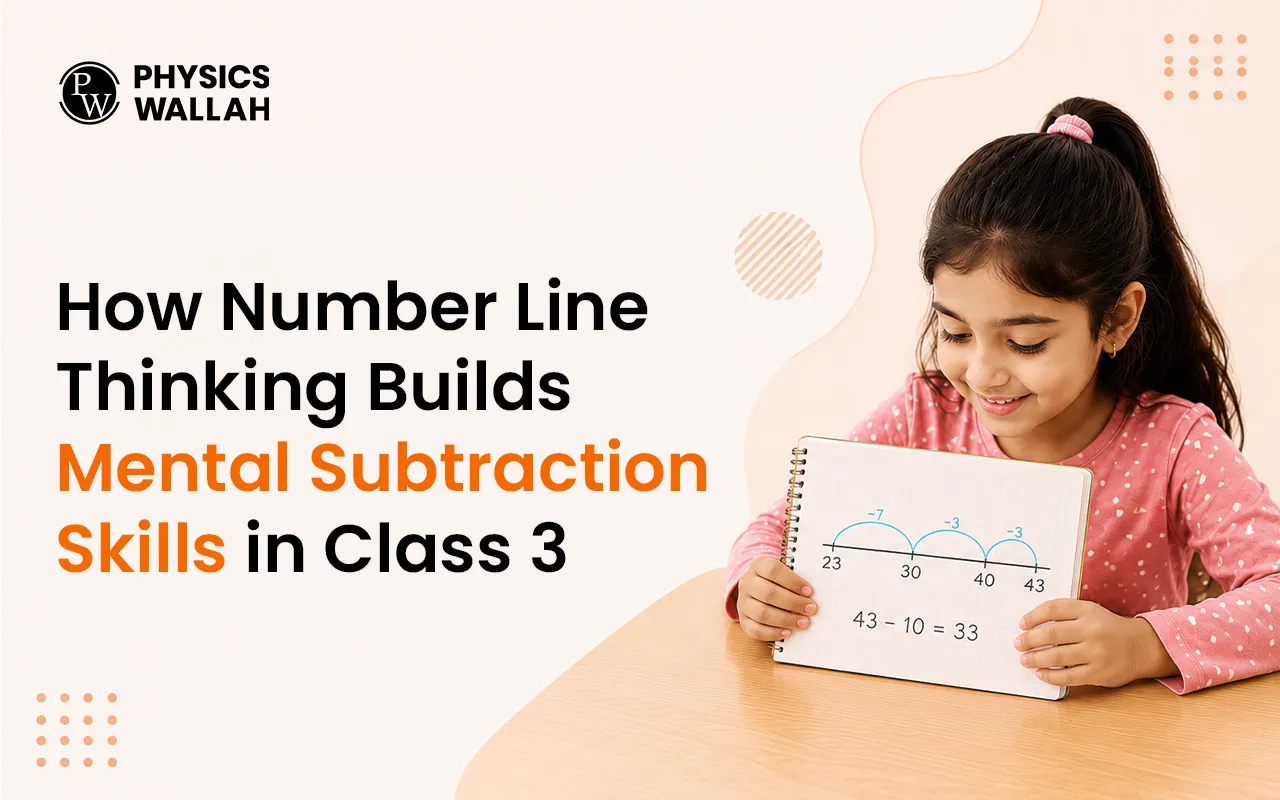
A number line is a straight line with numbers placed in order from left to right. Smaller numbers are on the left side, and larger numbers are on the right side.
Children use this line to understand how numbers are connected and how they move during maths calculations. In number line subtraction Class 3 mental maths, subtraction means moving left on the number line. This simple visual method helps children understand subtraction more clearly and improves their confidence when solving maths problems.
Importance of Number Line Subtraction Class 3 Mental Maths Strategies
Using a visual scale for calculation helps students move away from counting on their fingers or drawing tally marks. It lets children see the actual distance between values, which is the core secret behind fast calculations. This technique helps young learners spot patterns quickly, making arithmetic intuitive.
Developing a strong internal scale prepares students for more advanced math topics later on. When children practice mental subtraction Class 3 skills with a visual axis, they build a flexible layout in their minds. This mental framework makes future arithmetic topics much easier to learn.
-
It boosts spatial reasoning: Children learn to view numbers as positions and distances rather than just abstract symbols.
-
It simplifies borrowing: Instead of following complex column regrouping rules, students simply jump past a multiple of ten.
-
It minimizes common calculation errors: Visualizing the numbers makes it obvious if an answer is far too large or small.
-
It builds speed: With practice, the physical axis fades away, leaving a fast mental tool for subtraction without writing Class 3 MENTAL MATHS — CLASS 4 work.
Number Line Subtraction Class 3 Mental Maths Strategies
Young learners can use different methods to solve problems on a visual scale depending on the specific numbers involved. The two primary methods are counting backward from the larger number or counting forward from the smaller number to find the difference. Both approaches are essential for understanding subtraction strategies effectively.
The Counting Back Method
The counting back strategy is ideal when you need to subtract a relatively small number from a larger one. In this approach, you start at the larger value on the right side of your scale and make jumps toward the left. The size of your steps matches the value you want to subtract.
To solve a problem like 15 minus 4, a student finds 15 on the scale and takes 4 single steps back to the left. They land directly on 11, which is their final answer. This direct tracking reinforces the fact that subtraction always reduces a value.
Counting Back 4 steps from 15:
[11] <-- (1) <-- (1) <-- (1) <-- (1) <-- [15]
This method works beautifully for basic equations. It helps young learners understand the physical action of taking items away. By moving left, students see the value decrease in real-time, matching the true meaning of the minus sign.
Read More - Speed Maths Test for Class 3 (Try Now)
The Counting Up Method
The counting up strategy works best when you are subtracting two numbers that are close to each other in value. Instead of making long jumps backward, you start at the smaller number on the left and move right until you reach the larger target. The total value of your jumps is the answer.
For instance, to find the answer to 14 minus 11, it is much faster to start at 11 and count up to 14. The student calculates the small gap between the two positions.
-
Start at the number 11 on the scale.
-
Take 3 small steps forward to reach 14.
-
Count the total steps taken, which gives an answer of 3.
This method shows that subtraction is simply finding the difference between two points. It links subtraction directly to addition, helping children understand how the two operations work together. This dual view makes mental math tasks much less confusing.
Number Line Subtraction Class 3 Mental Maths Breakdown
5 6 7 8 9 10 11 12
----+---------+---------+---------+---------+---------+---------+---------+----
To help children transition to solving problems mentally, it is best to follow a structured sequence. We begin with simple single-digit equations before moving to double-digit numbers that require splitting values into tens and ones. This gradual progression ensures students never feel overwhelmed.
Step 1: Understanding Single-Digit Equations
Before tackling larger numbers, students must feel completely comfortable using a Class 3 maths number line for single-digit changes. This practice builds the foundational confidence needed for advanced math.
Let us look at the equation: 9 minus 3.
Starting at 9, jump back 3 units to the left:
[6] <====== (jump 3) <====== [9]
-
Locate the starting number 9 on the right side of the scale.
-
Count back 3 spaces to the left, touching 8, 7, and landing on 6.
-
Write down 6 as the final result.
This basic step confirms that moving left always lowers a value. Discovering these simple jumps ensures students are ready for larger numbers. It creates the automatic recall needed for fast mental calculation.
Step 2: Subtracting 2-Digit Numbers Without Regrouping
Once single digits are easy, students can move on to two-digit equations that do not need borrowing. This step introduces tracking tens and ones separately on a scale.
Let us try: 38 minus 14.
We break down the number 14 into one 10 and four 1s (10 + 4).
Subtracting 14 from 38:
[24] <-- (jump 4) <-- [28] <========= (jump 10) <========= [38]
-
Find the starting point 38 on the far right of the scale.
-
Make one large jump of 10 backward to the left to land exactly on 28.
-
Take 4 single steps backward from 28, passing 27, 26, 25, and landing on 24.
-
The final destination is your answer: 24.
Breaking numbers apart makes large equations feel manageable. It prevents the mental fatigue that often causes simple calculation mistakes. This structural approach keeps mental math accurate and straightforward.
Read More - Learn Subtraction Without Borrowing (Class 3)
Step 3: Handling 2-Digit Numbers with Regrouping
The true power of this system shines when handling equations that usually require borrowing. Instead of memorizing abstract column rules, students use friendly landmark numbers like multiples of ten to simplify the problem.
Let us solve: 43 minus 17.
We break 17 down into 10 and 7. To make it even easier, we can split the 7 into 3 and 4 so we can land safely on a clean multiple of ten.
Subtracting 17 from 43 (using 30 as a landmark):
[26] <-- (jump 4) <-- [30] <-- (jump 3) <-- [33] <========= (jump 10) <========= [43]
-
Find 43 on the right side of your line.
-
Make one big jump of 10 to the left to land on 33.
-
Take a small step back of 3 to land on the clean landmark number 30.
-
Subtract the remaining 4 steps from 30 to land safely on 26.
-
Your final answer is 26.
Using landmark multiples of ten turns tricky equations into a series of simple jumps. This method removes the stress of traditional borrowing and makes mental subtraction intuitive. It provides a clean, visual map that protects against calculation errors.
Practice Tables for Mental Subtraction Class 3
Using organized reference tables helps students spot patterns and test their growing calculation skills. The following datasets are structured to build confidence through steady practice.
Single-Digit Subtraction Practice
|
Equation |
Starting Point |
Subtraction Jump |
Final Landing Point |
|
12 - 4 |
12 |
Jump back 4 |
8 |
|
15 - 6 |
15 |
Jump back 6 |
9 |
|
18 - 7 |
18 |
Jump back 7 |
11 |
|
14 - 5 |
14 |
Jump back 5 |
9 |
Double-Digit Subtraction (No Borrowing)
|
Equation |
Starting Point |
Jump 1 (Tens) |
Jump 2 (Ones) |
Final Answer |
|
45 - 12 |
45 |
Jump -10 to 35 |
Jump -2 to 33 |
33 |
|
57 - 23 |
57 |
Jump -20 to 37 |
Jump -3 to 34 |
34 |
|
68 - 15 |
68 |
Jump -10 to 58 |
Jump -5 to 53 |
53 |
|
89 - 34 |
89 |
Jump -30 to 59 |
Jump -5 to 55 |
55 |
Advanced Subtraction (With Regrouping Landmarks)
|
Equation |
Starting Point |
Tens Jump |
Landmark Jump |
Final Jump |
Result |
|
32 - 15 |
32 |
-10 to 22 |
-2 to 20 |
-3 to 17 |
17 |
|
54 - 26 |
54 |
-20 to 34 |
-4 to 30 |
-2 to 28 |
28 |
|
63 - 18 |
63 |
-10 to 53 |
-3 to 50 |
-5 to 45 |
45 |
|
71 - 34 |
71 |
-30 to 41 |
-1 to 40 |
-3 to 37 |
37 |
How CuriousJr Helps with Number Line Subtraction Class 3 Mental Maths
CuriousJr makes learning number line subtraction for Class 3 mental maths fun, simple, and interactive for children.
Instead of only solving questions on paper, students can practice subtraction through engaging games and activities on a mobile platform. Children can move, jump, and explore virtual number lines while solving subtraction problems step by step.
This visual learning method helps students understand subtraction more clearly and improves their confidence in solving maths questions.
The platform provides instant feedback, so children can quickly learn from mistakes and improve their skills. Through fun challenges and guided activities, students get regular practice without feeling bored.
By turning maths into an enjoyable learning experience, CuriousJr helps children strengthen number line subtraction for Class 3 mental maths skills and improve their overall Class 3 mental arithmetic abilities.
Regular practice on the platform helps children become faster, more accurate, and more confident when solving subtraction problems in school and everyday life.




Why Learning to Round Off Numbers in Class 3 Makes Mental Estimates Faster? FAQs
How does a number line for kids help with mental subtraction?
When should children use the counting up strategy?
Can number line subtraction Class 3 mental maths replace column subtraction?
How can parents help children practice subtraction without writing?


Get Free Counselling Today
and Clear up all your Doubts
 Live & recorded classes available at easeDashboard for progress trackingLakhs of practice questions

