Class 7 Geometry: Mental Tricks for Finding Angles in Triangles and Quadrilaterals
 Nikita Aggarwal29 Jun, 2026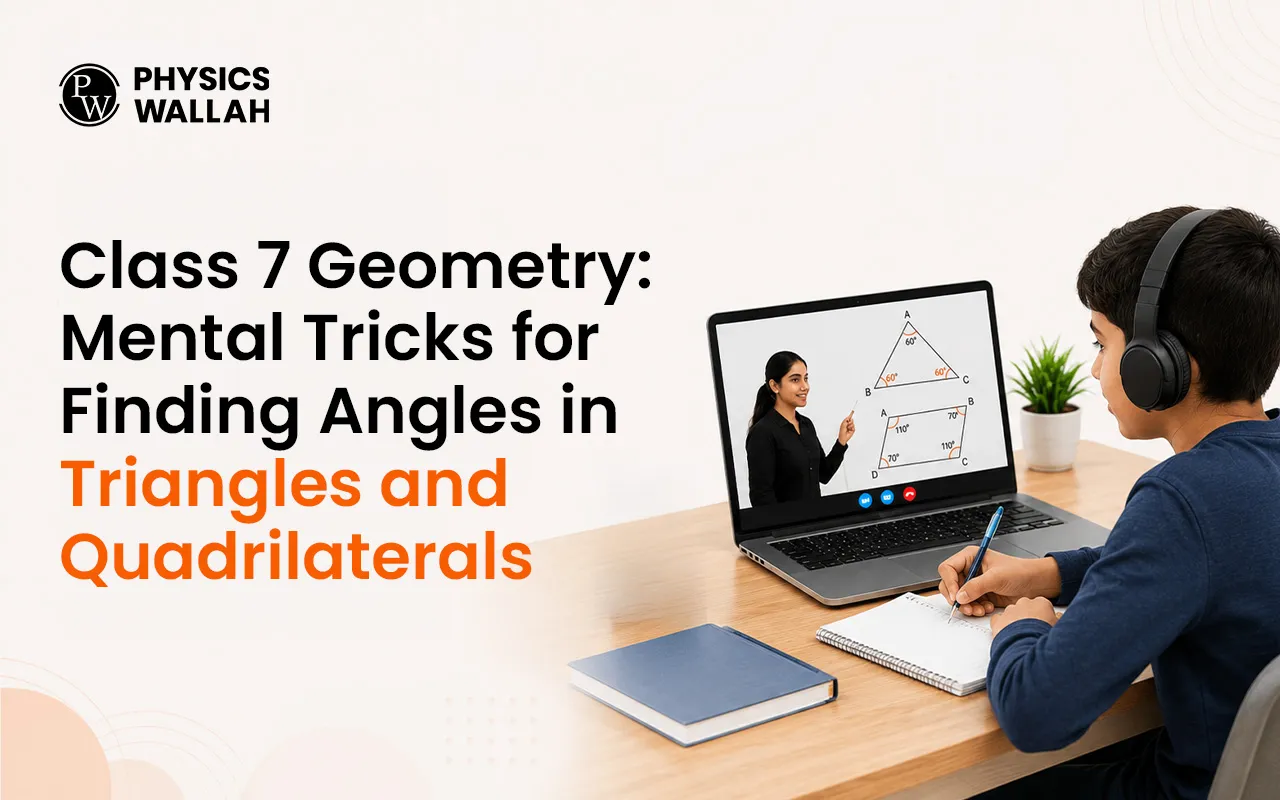
Why Use Class 7 Geometry Angles Triangles Quadrilaterals Mental Maths Tricks?
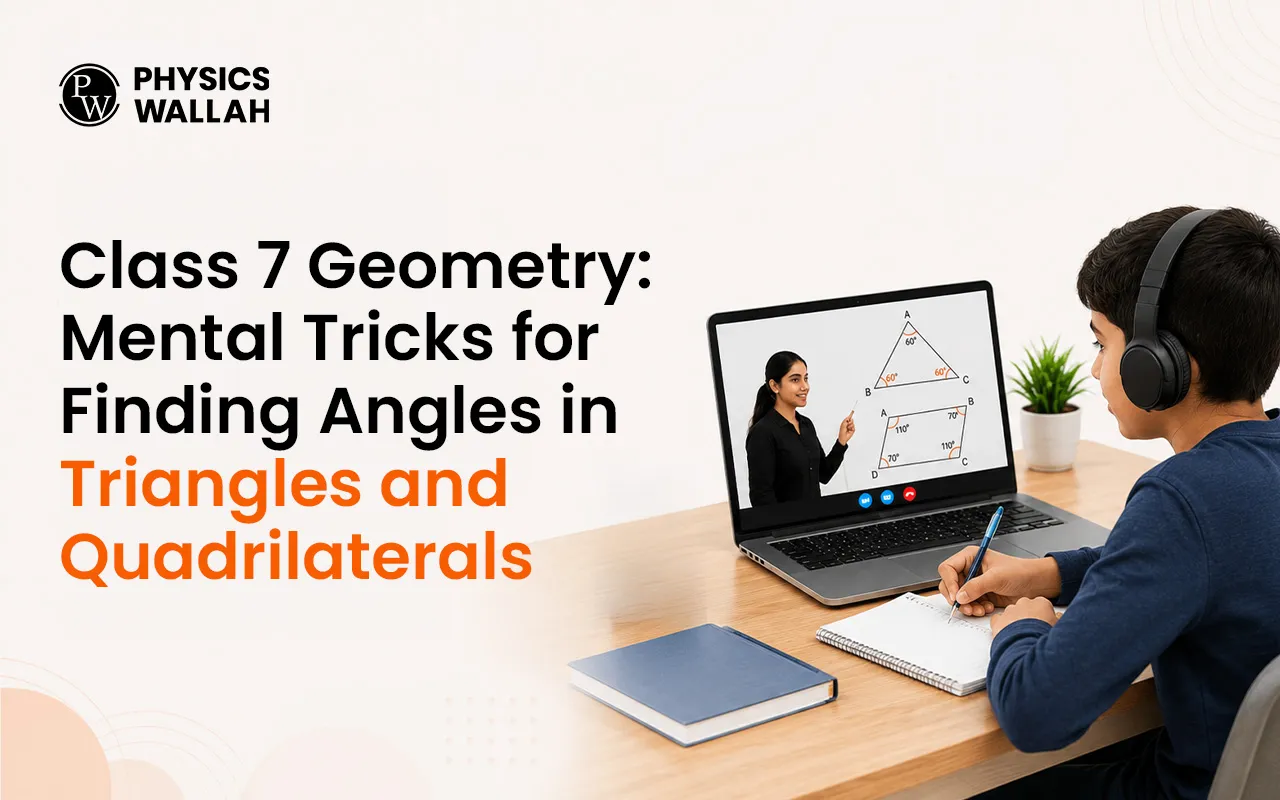
Geometry is not just about memorising theorems; it is about recognizing visual patterns. Developing Class 7 geometry angles triangles quadrilaterals mental maths skills helps you look at a shape and break it down into manageable parts without writing down every single step.
When you practice mental maths geometry Class 7 principles, you build a stronger spatial intuition. Instead of getting stuck on a multi-step problem, your mind automatically runs basic subtraction and addition checks. This visual agility is incredibly useful for competitive exams and everyday mathematical reasoning.
Benefits of Mental Calculation in Geometry
-
Saves Time: You can bypass writing down standard algebraic equations for simple properties.
-
Reduces Errors: Simple mental subtraction from 180 or 360 leaves less room for clerical mistakes.
-
Builds Confidence: Solving shapes visually makes mathematics feel like a puzzle rather than a chore.
Read More - Binary Logic Mental Maths Tricks for Class 7
Class 7 Geometry Angles Triangles Quadrilaterals Mental Maths Tricks for Triangles
Triangles form the foundation of all polygon geometry. To find missing values instantly, you need to use the absolute properties of a triangle as your baseline reference points.
The most critical rule is the Angle Sum Property. The interior angles of any triangle always add up to exactly 180 degrees. Here is how you can use Class 7 angles mental tricks to calculate values rapidly.
The "Sub-from-180" Shortcut
When you are given two angles in a triangle, instead of adding them first and then subtracting from 180, try subtracting them sequentially from 180.
For instance, if a triangle has angles of 60 degrees and 50 degrees, use this quick mental sequence:
-
Start with the total pool of 180.
-
Subtract 60 mentally to get 120.
-
Subtract 50 from 120 to instantly get 70 degrees.
Learning Isosceles and Equilateral Shortcuts
Equilateral triangles are the easiest because every single angle is always 60 degrees. For isosceles triangles, remember that angles opposite to equal sides are equal. The table below outlines how to decode isosceles triangles using rapid arithmetic.
The following data shows how to calculate the remaining equal angles if you know the distinct vertex angle.
|
Given Vertex Angle |
Mental Math Step |
Resulting Base Angles |
|
40 degrees |
180 minus 40 = 140; Half of 140 |
70 degrees each |
|
80 degrees |
180 minus 80 = 100; Half of 100 |
50 degrees each |
|
100 degrees |
180 minus 100 = 80; Half of 80 |
40 degrees each |
Class 7 Geometry Angles Triangles Quadrilaterals Mental Maths Methods
Quadrilaterals add an extra side to our calculations, meaning the interior angles now sum up to 360 degrees. Balancing problems that combine triangles and quadrilaterals Class 7 topics requires you to switch between the 180-degree rule and the 360-degree rule effortlessly.
To make this simple, think of a quadrilateral as two triangles glued together. If you draw a diagonal line through any four-sided shape, you split it into two separate triangles, each worth 180 degrees.
The 360-Degree Balancing Trick
When looking at a quadrilateral with three known angles, your target is 360. Instead of adding three large numbers, look for pairs that make friendly numbers like 100, 150, or 200.
Suppose the given angles are 110 degrees, 70 degrees, and 80 degrees:
-
Notice that 110 and 70 instantly combine to make 180.
-
Now you know the remaining two angles must also add up to 180.
-
Subtract 80 from 180 mentally to get your final answer of 100 degrees.
Class 7 Geometry Angles Triangles Quadrilaterals Mental Maths for Parallel Lines
Many school problems combine triangles with parallel lines. This is where Class 7 maths tricks involving alternating and corresponding angles save a massive amount of time.
When a line cuts across two parallel lines, it creates clusters of identical angles. You do not actually need to calculate all eight positions; you only need to recognise if an angle is acute or obtuse.
The "Z" and "F" Visual Anchors
Train your eyes to look for specific alphabet shapes hidden inside geometric diagrams:
-
The Z-Shape (Alternate Interior Angles): If you can trace a 'Z' path along parallel lines, the corners inside the 'Z' are completely equal.
-
The F-Shape (Corresponding Angles): If you spot an 'F' orientation, the angles underneath the horizontal bars match perfectly.
Important Rule: On a straight line, adjacent angles always add up to 180 degrees. If you know one angle is 120 degrees, its straight-line partner is automatically 60 degrees.
Read More - Mental Division Tricks for Class 7
Practice Scenarios for Class 7 Geometry Angles Triangles Quadrilaterals Mental Maths
Let us look at a few common exam scenarios where applying angle calculation Class 7 MENTAL MATHS — CLASS 8 foundations can yield answers without using a pencil.
Scenario 1: The Exterior Angle Shortcut
An exterior angle of a triangle equals the sum of its interior opposite angles. If you see a triangle where one side extends outward, look at the two far interior corners. If they are 45 degrees and 55 degrees, the outside angle is simply 45 plus 55, which equals 100 degrees.
Scenario 2: Parallelogram Opposites
In a parallelogram, opposite angles are equal, and consecutive angles add up to 180 degrees. If one corner is 75 degrees, the opposite corner is instantly 75 degrees. The neighbor corner is 180 minus 75, which equals 105 degrees.
How CuriousJr Improves Class 7 Geometry Angles Triangles Quadrilaterals Mental Maths
Mastering visual geometry requires consistent interactive practice. Relying solely on textbooks can make it hard to visualize how shapes warp and change when angles alter. Taking advantage of structured digital learning platforms can make a massive difference.
Class 7 mental maths classes focus heavily on intuitive visual tools. Watching a live tutor manipulate digital shapes helps you internalise these mental tricks much faster than studying static diagrams on a printed page.
If you want to take your calculation speed to the next level, interactive exercises are the ideal solution. You can access specialized gamified modules and structured mental arithmetic tracks directly through the CuriousJr Mental Maths program at to build flawless speed and geometric accuracy.




Class 7 Geometry: Mental Tricks for Finding Angles in Triangles and Quadrilaterals FAQs
What is the fastest way to find the third angle of a right-angled triangle?
How do I mentally calculate angles in a regular polygon?
Why do the angles of a quadrilateral always equal 360 degrees?
Can an obtuse triangle have a right angle?

Get Free Counselling Today
and Clear up all your Doubts
 Live & recorded classes available at easeDashboard for progress trackingLakhs of practice questions