
Why Understanding Negative Numbers Mentally Is a Critical Class 6 Skill
 Nikita Aggarwal24 Jun, 2026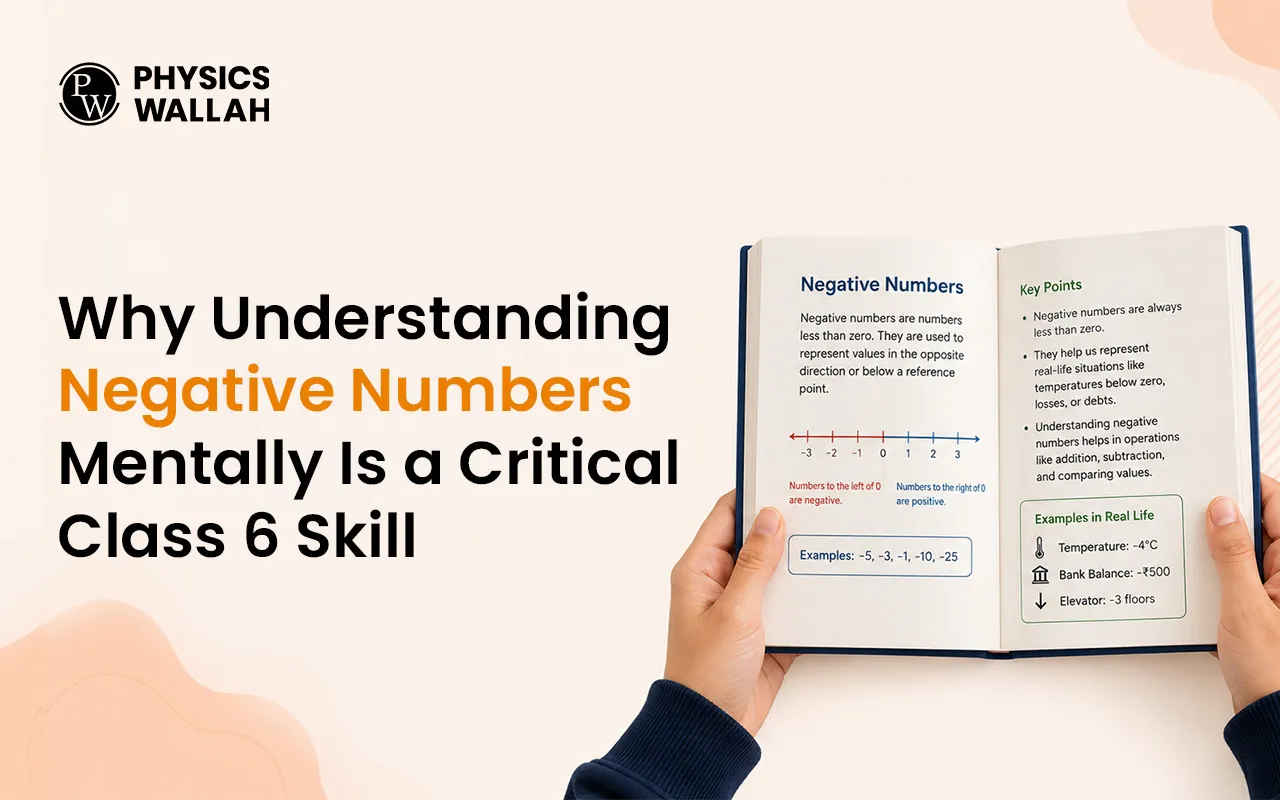
What Are Negative Numbers Mental Maths Class 6?
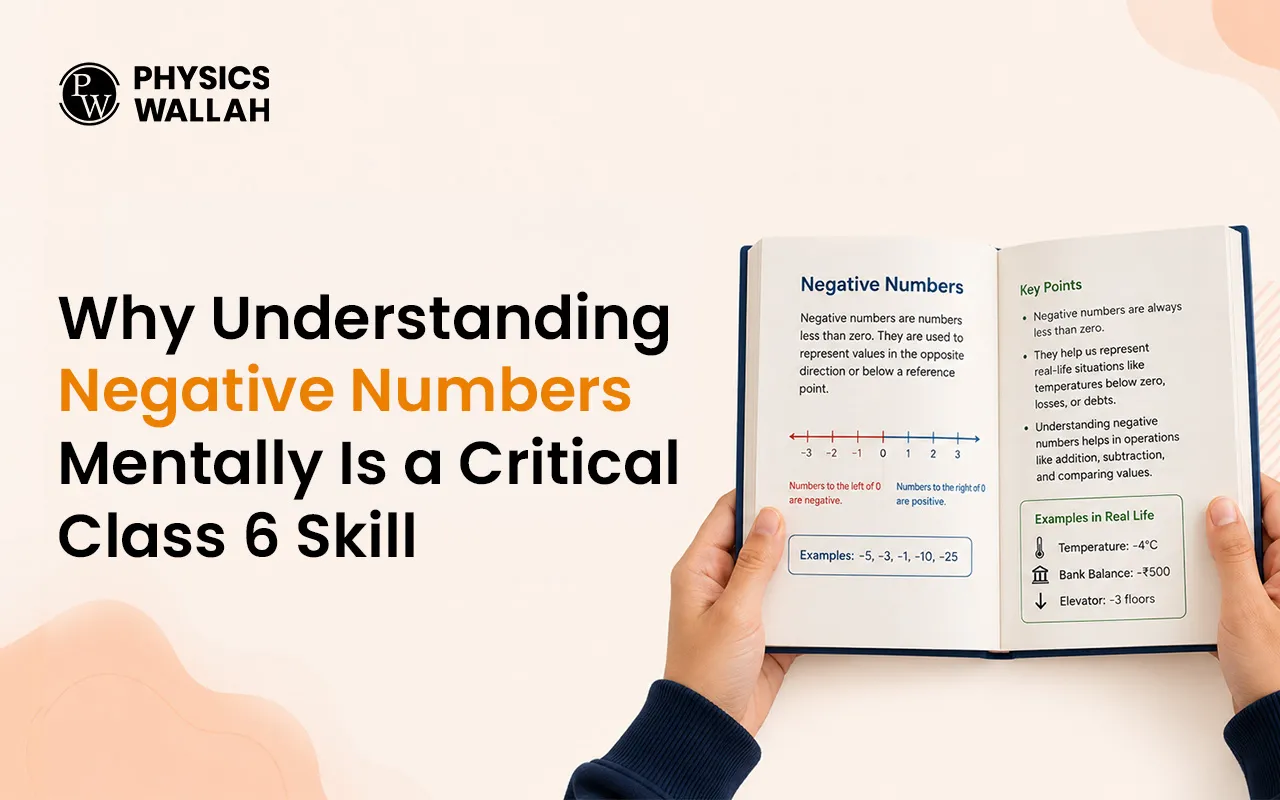
In earlier classes, math always involved counting concrete items like apples or books. However, Class 6 negative numbers introduce values that are less than zero. These values are essential for representing opposite directions or deficits.
When you combine whole numbers, zero, and negative values, you get a complete set of numbers called integers. Understanding Class 6 integers mental maths requires shifting away from basic counting toward directional tracking.
-
Positive Integers: Numbers greater than zero (1, 2, 3, etc.).
-
Negative Integers: Numbers less than zero (-1, -2, -3, etc.).
-
Zero: A neutral integer that is neither positive nor negative.
To understand these numbers clearly, you can look at a standard structured layout of integers:
|
Type of Integer |
Location Relative to Zero |
Real-World Example |
|
Positive |
To the right / Above |
Profit earned, height above sea level |
|
Negative |
To the left / Below |
Debt owed, temperature below freezing |
|
Zero |
Central starting point |
Sea level, freezing point of water |
Importance of Negative Numbers Mental Maths Class 6
Relying entirely on a pen and paper to add or subtract signed numbers slows down your problem-solving speed. Developing speed in negative numbers mental maths ensures that you can handle multi-step algebraic problems easily in higher classes.
When you perform a mental calculation with integers in Class 6, you stop memorising rigid rules and start seeing the movement of values. For example, mentally processing a loss followed by another loss helps you immediately see why the answer becomes more negative.
-
Bypasses Sign Confusion: Students who rely on memory often get confused between rules for addition and multiplication. Mental visualization removes this confusion.
-
Improves Operational Speed: Quick calculations save valuable time during timed school tests.
-
Builds Numerical Intuition: It helps you check if an answer makes logical sense before writing it down.
Important Concepts in Negative Numbers Mental Maths Class 6
To calculate efficiently in your head, you must master the core integers Class 6 concepts. The most effective tool for this is the mental number line.
On a horizontal number line, zero sits directly in the middle. Positive values grow larger as you move to the right, while negative values drop lower as you move to the left.
1. Understanding Absolute Value
The absolute value represents the actual distance of an integer from zero, regardless of its positive or negative sign. For example, both 5 and -5 are exactly 5 units away from zero. Mentally isolating the size of the number from its sign makes comparisons straightforward.
2. Comparing and Ordering Integers
When looking at Class 6 maths integers, a larger digit next to a minus sign actually represents a smaller overall value. For instance, -10 is smaller than -2. This is because -10 sits much further to the left on the number line.
-
Every positive integer is automatically greater than any negative integer.
-
Zero is always larger than any negative number, but smaller than any positive number.
Read More - Coding-Decoding Mental Maths Tricks for Class 6
Rules for Negative Numbers Mental Maths Class 6 Calculations
Performing a mental calculation integers Class 6 becomes easy once you translate positive signs as "gains" or "steps forward" and negative signs as "debts" or "steps backward."
Addition of Integers
-
Adding Two Positive Numbers: Simply add their values together (Result is positive).
-
Adding Two Negative Numbers: Add their absolute values together and place a minus sign in front of the final sum. Think of it as adding up two separate debts (-3 + -4 = -7).
-
Adding a Positive and a Negative Number: Find the difference between the two numbers. Give the final answer the sign of the number that has the larger absolute value. For example, with -8 + 5, the difference is 3, and since 8 is larger than 5, the answer is -3.
Subtraction of Integers
Subtracting an integer is exactly the same as adding its opposite value. When you see a subtraction sign next to a negative number, the two signs combine into a positive action.
-
Example: 5 - (-3) transforms mentally into 5 + 3, which equals 8.
Negative Numbers Mental Maths Class 6 Tricks
Using structured Class 6 negative number tricks turns complex exam problems into quick mental calculations.
-
The Money and Debt Method: Treat positive integers as cash in your pocket and negative integers as money you owe a friend. If you have 10 rupees but owe 12 rupees (-12 + 10), you are still 2 rupees in debt (-2).
-
The Sign Battles Rule: When adding a positive and a negative number, imagine them fighting. The sign with the larger value wins the final battle, and the leftover amount is the difference between them.
-
Double Negative Transformation: Whenever two minus signs sit directly next to each other with no number between them, change them immediately into a single plus sign.
Let us look at a quick mental reference chart for tracking sign combinations:
|
Mental Math Problem |
Hidden Transformation |
Mental Process |
Final Answer |
|
7 + (-3) |
7 - 3 |
Start at 7, take 3 steps back |
4 |
|
-5 + (-2) |
-5 - 2 |
Start at -5, go 2 steps deeper into debt |
-7 |
|
4 - (-6) |
4 + 6 |
Double negatives turn positive |
10 |
|
-9 + 4 |
Difference of 9 and 4 |
Negative team is bigger by 5 points |
-5 |
Read More - Finding Remainders Using Vedic Method for Class 6
How CuriousJr Helps with Negative Numbers Mental Maths Class 6
CuriousJr makes mastering negative numbers in Class 6 mental maths highly interactive, removing the need for boring rote learning. The platform uses gamified coding setups and visual math modules to turn abstract rules into clear, practical concepts.
-
Interactive Visual Systems: CuriousJr uses live code blocks and moving game characters where movements rely on positive and negative coordinates, helping students see how integers work in real time.
-
Instant Assessment Loops: Educational math games provide immediate feedback, showing students exactly where a sign error happened so they can fix their mistake instantly.
-
Speed Calculations: Built-in calculation rewards encourage students to solve problems mentally, reducing their dependence on paper and boosting their confidence during school exams.




Why Understanding Negative Numbers Mentally Is a Critical Class 6 Skill FAQs
How do you explain negative numbers mental maths Class 6 easily?
What is the easiest trick for Class 6 negative numbers subtraction?
Why do two negative signs turn positive during integers Class 6 concepts?
How can I avoid making sign mistakes in a mental calculation integers Class 6?


Get Free Counselling Today
and Clear up all your Doubts
 Live & recorded classes available at easeDashboard for progress trackingLakhs of practice questions

